
The Call That Should Have Ended
The line went dead.
But the chair did not stop moving.
It faced me now.
Completely.
Not slightly turned.
Not shifted by the uneven floor.
Faced me.
The hollow space inside the left armrest gaped open like a wound. The photograph of Lena Vale sat on my kitchen counter beside the brass key and the strip of blue fabric.
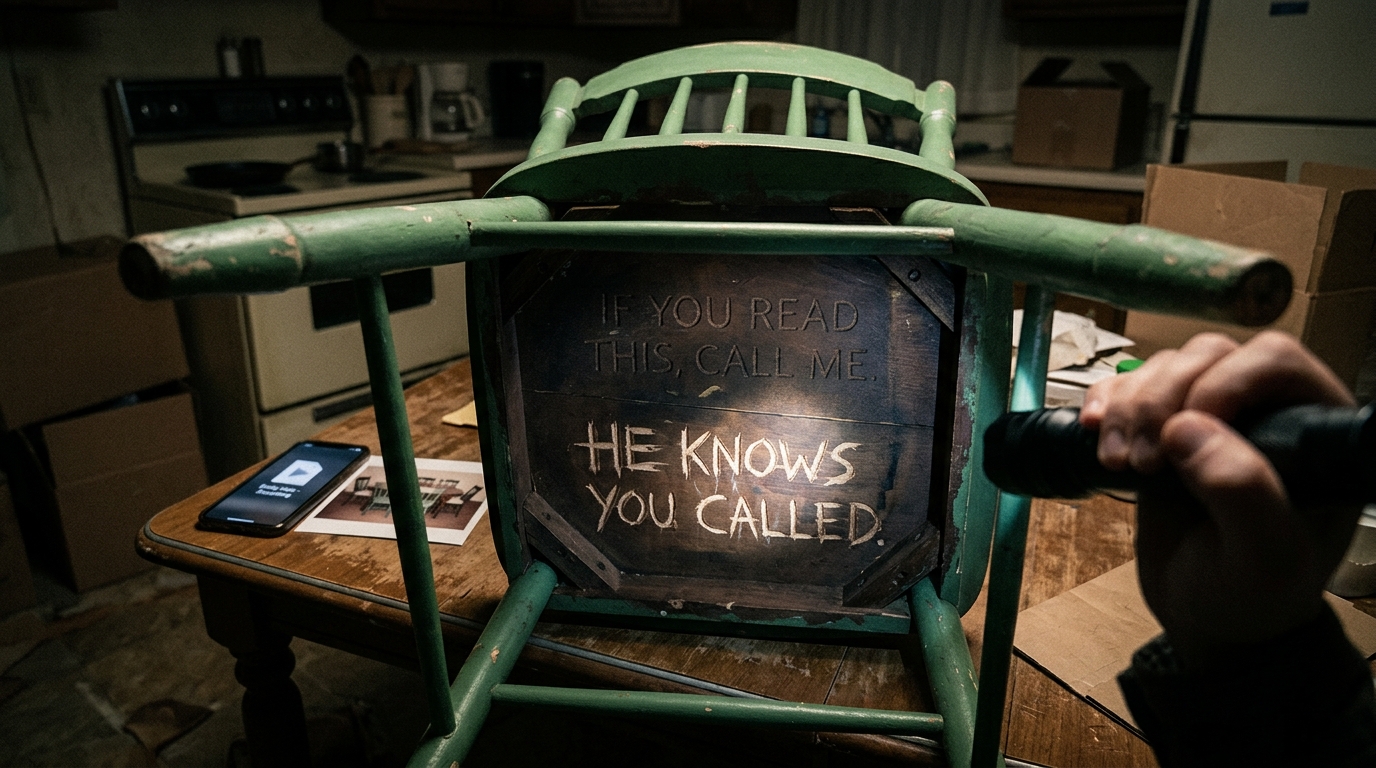
Under the seat, the carved message looked darker than before.
IF YOU READ THIS, CALL ME.
And beneath it, fresh letters had appeared.
HE KNOWS YOU CALLED.
I backed toward the wall, phone still clenched in my hand.
My apartment was silent except for rain tapping against the kitchen window.
Then the phone rang again.
Same unknown number.
I almost dropped it.
For three seconds, I just stared at the screen.
The chair creaked once.
Like it was waiting.
I answered.
This time, there was no static.
No breathing.
No footsteps.
Only an older woman’s voice, shaking so hard the words nearly broke apart.
“Finally,” she whispered. “Finally, someone found it.”
I swallowed.
“Who is this?”
The woman began crying immediately.
Not like Lena had cried.
This grief was older.
Drier.
The kind that had been used up and somehow kept coming back.
“My name is Margaret Hale,” she said. “Seventeen years ago, my daughter disappeared.”
I looked at the chair.
At the carved message.
At the hidden photograph.
“At a house?” I asked.
A pause.
Then the woman’s breathing changed.
“How do you know that?”
“I don’t. I found a chair.”
The crying stopped.
Silence filled the line.
Then she whispered:
“Is it green?”
My blood turned cold.
I looked at the faded cushion.
“Yes.”
The woman made a sound like someone had opened a grave in front of her.
“She used to sit there,” she said. “Every morning. Every night. Always with her knees pulled up like she was afraid her feet would touch the floor.”
“Who?”
“My daughter.”
I gripped the phone tighter.
“What was her name?”
The woman answered softly:
“Emily.”
The chair creaked again.
Not loudly.
Just enough.
Like the name had touched it.
The Girl Who Sat In The Chair
Margaret told me Emily was nine when she vanished.
Nine.
Not twenty-eight.
Not Lena Vale.
Not the woman from the photograph.
A child.
“She was shy,” Margaret said. “The kind of shy people mistake for obedient.”
Her voice trembled.
“She had asthma. She hated loud men. She loved drawing birds. She used to sit in that chair by the kitchen window because she said it made her feel safe.”
I could barely breathe.
The chair in my apartment suddenly looked smaller.
Not physically.
But in meaning.
I imagined a child curled into it.
A little girl with sketch paper.
Rain outside.
A mother washing dishes.
A normal room before it became evidence.
“What happened to her?” I asked.
Margaret did not answer right away.
When she finally spoke, her voice had changed.
“My husband sold the chair two weeks after Emily disappeared.”
I closed my eyes.
“Why?”
“Because I kept sitting in front of it.”
Her breath caught.
“I thought if I stared long enough, I would remember something useful. A sound. A word. Anything. He said I was making myself sick.”
“Your husband?”
“Yes.”
“What was his name?”
“Victor Hale.”
The name hit me like a hand around the throat.
Victor.
Lena Vale had mentioned her husband.
Victor.
The man who would come for the chair.
The man who gave chairs to police.
The man who made people disappear and let furniture remember what bodies could not say.
I looked at the scratched-out man in Lena’s photograph.
“Margaret,” I said carefully, “did your husband know Lena Vale?”
Silence.
Then:
“What did you say?”
“Lena Vale.”
The woman inhaled sharply.
“I never told anyone that name.”
My skin tightened.
“You know her?”
Her voice dropped to a whisper.
“She came to our house before Emily vanished.”
The room seemed to tilt.
“Why?”
“She said my husband had lied about everything.”
Rain struck the window harder.
The chair creaked.
Margaret continued.
“Lena was trying to help me. She said Victor had another name. Another wife. Another house.”
Her voice cracked.
“She said there were other women.”
I looked at the blue fabric in my hand.
“What happened after that?”
Margaret began crying again.
“Lena disappeared too.”
The Message Beneath The Seat
I sent Margaret a photo of the chair.
Not immediately.
First, I took twenty pictures from every angle.
The seat.
The arms.
The hidden compartment.
The carved message.
The new line beneath it.
Then I texted the clearest image to the number on the call.
For almost a full minute, she did not speak.
I heard her breathing through the line.
Then she whispered:
“No.”
My stomach tightened.
“What?”
“No, no, no…”
“Margaret?”
“That isn’t possible.”
“What isn’t?”
Her voice became thin.
Terrified.
“The carving.”
I stared at the underside of the seat.
“You said your daughter carved it.”
“I thought she did.”
“What do you mean you thought?”
Margaret swallowed audibly.
“When Emily disappeared, I searched everything. Her room. Her schoolbooks. Her clothes. The shed. The basement. That chair.”
My fingers went cold around the phone.
“You checked under it.”
“Yes.”
“And?”
“There was nothing there.”
The apartment went silent around me.
The carved words stared back from the wood.
IF YOU READ THIS, CALL ME.
Beneath them:
HE KNOWS YOU CALLED.
I whispered, “Maybe you missed it.”
“No.”
“Seventeen years is a long time.”
“No.” Her voice sharpened through tears. “A mother looking for her missing child does not miss words carved into the bottom of the chair she sat beside for weeks.”
I said nothing.
Margaret continued.
“I checked it again before Victor sold it. I turned it over myself. I scratched my hand on the same cracked arm.”
Her breathing quickened.
“There was no message.”
My skin crawled.
“Then who carved it?”
The line went quiet.
Then Margaret said:
“Send me a close-up.”
I did.
This time, she cried out.
Not grief.
Shock.
“Oh God.”
“What?”
“The wood is fresh.”
I stared.
“It’s old.”
“The chair is old,” she said. “The carving isn’t.”
“How can you tell from a photo?”
“My father was a carpenter.”
Her voice shook harder.
“Those cuts aren’t seventeen years old. They’re not even close. The exposed grain is too clean. The splintering hasn’t darkened. The pressure marks are new.”
My throat went dry.
“How new?”
A long pause.
Then she whispered:
“A few months.”
The chair creaked again.
This time, the sound came from inside the hollow armrest.
Not wood settling.
Not old joints.
Something inside.
Scratching.
Seventeen Years Too Late
A few months.
The message had not been carved by a little girl before she disappeared.
It had been carved recently.
By someone who wanted me to believe the past was reaching out.
Or by someone still alive.
I looked at the chair.
At Lena’s photograph.
At Emily’s mother’s voice coming through my phone seventeen years too late.
“Margaret,” I said, “where did Victor sell the chair?”
“A liquidation warehouse outside Grayford.”
“That’s where I bought it.”
“No.” Her voice changed. “That place closed ten years ago.”
Cold moved slowly through my body.
“I bought it today.”
“From whom?”
“An old man at a clearance market.”
“What did he look like?”
I tried to remember.
White hair.
Thin hands.
Eyes that avoided the chair.
Voice like gravel.
“He was old.”
“Did he have a scar?”
My pulse jumped.
“On his neck?”
Margaret began to breathe faster.
“Yes.”
I swallowed.
“I think so.”
“Caleb, listen to me very carefully.”
The way she said my name made my chest tighten.
“How do you know my name?”
She did not answer.
“Margaret.”
Her voice dropped.
“Victor had a scar on his neck.”
I turned toward my apartment door.
The hallway beyond was silent.
Too silent.
“He’s old now,” she whispered. “But if he sold you that chair, he did not want to get rid of it.”
“Then why sell it?”
“Because he wanted to know who would call.”
My phone nearly slipped from my hand.
The chair shifted slightly across the floor.
One inch.
Toward me.
I backed away.
Margaret heard the movement.
“What was that?”
“The chair.”
A long silence.
Then she whispered:
“Do not sit in it.”
“I’m not planning to.”
“No. You don’t understand.” Her voice broke. “Victor used to make people sit in it before they forgot things.”
My blood turned cold.
“Forgot what?”
“Where they had been. Who they saw. Why they were afraid.”
The chair creaked again.
This time, I smelled something new.
Not dust.
Not varnish.
Smoke.
And beneath it—
Children’s shampoo.
Sweet.
Strawberry.
A memory that did not belong to me flashed through my mind.
A little girl crying in a kitchen.
A man saying, Sit still.
A woman screaming from another room.
Then darkness.
I dropped the phone.
Margaret’s voice came from the speaker on the floor.
“Caleb? Caleb!”
The Hidden Recording
The brass key inside the armrest began vibrating.
Not ringing.
Vibrating.
Like a phone.
I stared at it.
It rattled against the wood, tapping rapidly inside the hollow compartment.
Tap tap tap tap tap.
The same rhythm as frightened fingers.
I picked it up with two fingers.
The moment my skin touched the key, the chair stopped moving.
The apartment lights flickered once.
My phone screen lit up from the floor.
Unknown file received.
No sender.
No app.
Just a black square with a play button.
Margaret was still calling my name.
I picked up the phone.
“I’m here.”
“What happened?”
“I got a file.”
“Don’t open it.”
“Why?”
“Because if Victor sent it, he wants you to hear something.”
“And if Emily sent it?”
Margaret went quiet.
That silence answered for her.
She wanted me to open it.
Even if it destroyed her.
I pressed play.
Static.
Then a little girl’s voice.
Small.
Trembling.
“Mom?”
Margaret gasped through the phone.
“No…”
The recording continued.
“Mom, I wrote the number like she told me.”
A man’s voice in the background:
“Who told you?”
The child began crying.
“The lady in the blue dress.”
Lena.
My stomach tightened.
A slap cracked through the recording.
Margaret screamed.
Not from the past.
From the phone.
In the recording, Emily sobbed.
“I’m sorry. I’m sorry. I won’t tell.”
The man’s voice came closer.
Victor.
Calm.
Polite.
Deadly.
“Sit down, Emily.”
The chair creaked in the recording.
Then the same chair in my kitchen creaked with it.
Perfectly synchronized.
My body went numb.
Victor spoke again.
“Good girl.”
The recording distorted.
A humming sound rose beneath it.
Then Emily whispered:
“Mom, if someone finds the chair, it means I’m not in the house anymore.”
Margaret was sobbing now.
The audio crackled.
The little girl’s voice became faint.
Far away.
“If they call you, don’t come alone.”
Then another voice entered.
Older.
Female.
Lena.
“He’s moving the children tonight.”
The recording ended.
Children.
Not child.
Children.
My apartment lights went out.
The Number Was A Trap
Darkness filled the room.
The only light came from my phone screen on the floor.
Margaret sobbed through the speaker.
“Emily…”
I crouched and grabbed the phone.
“Margaret, where is Victor now?”
“I don’t know.”
“When did you last see him?”
“Seventeen years ago.”
“You said he sold the chair two weeks after Emily disappeared.”
“He left the same night.”
The darkness in my apartment felt thick now.
Almost physical.
“What do you mean he left?”
“He emptied the house. Took documents. Took photographs. Took Emily’s drawings.” Her voice trembled. “And he took the other chairs.”
My grip tightened.
“Other chairs?”
Margaret whispered:
“There were six at our dining table.”
I looked at my chair.
My one chair.
Green cushion.
Hollow arm.
Hidden key.
Carved message.
“How many were sold?”
“All of them.”
The room tilted.
Six chairs.
Six possible messages.
Six buried witnesses.
Or six traps.
My phone buzzed again.
A new text.
Unknown number.
One photograph.
It showed a dining room.
Old.
Dusty.
Six chairs around a table.
The green chair was missing.
Five remained.
On the wall behind them hung a child’s drawing.
A house.
A woman crying.
A man with no face.
And beneath the image, written in black crayon:
HE ONLY MOVES THE ONES WHO CALL.
Margaret whispered, “What happened?”
I could not answer.
Another message arrived.
This one contained an address.
No explanation.
No name.
Just coordinates.
Then a final line:
BRING BACK THE CHAIR OR EMILY FORGETS HER MOTHER.
Margaret made a sound I will never forget.
Not a scream.
Not a sob.
A mother breaking all over again.
I stared at the chair.
Then at the brass key.
Then at the phone.
The chair slowly turned away from me.
Toward the apartment door.
Like it knew where we had to go.
Outside in the hallway, footsteps stopped in front of my apartment.
Three slow knocks.
The same rhythm as before.
Margaret whispered through the phone:
“Caleb, don’t open it.”
The knocking came again.
Then a man’s voice spoke from the other side of the door.
The old man from the clearance market.
“Mr. Ward,” he said gently, “I believe you have something that remembers too much.”
The chair behind me creaked.
And beneath the seat, one more line began carving itself into the wood.
Fresh.
Wet.
Violent.
EMILY IS STILL SITTING.