
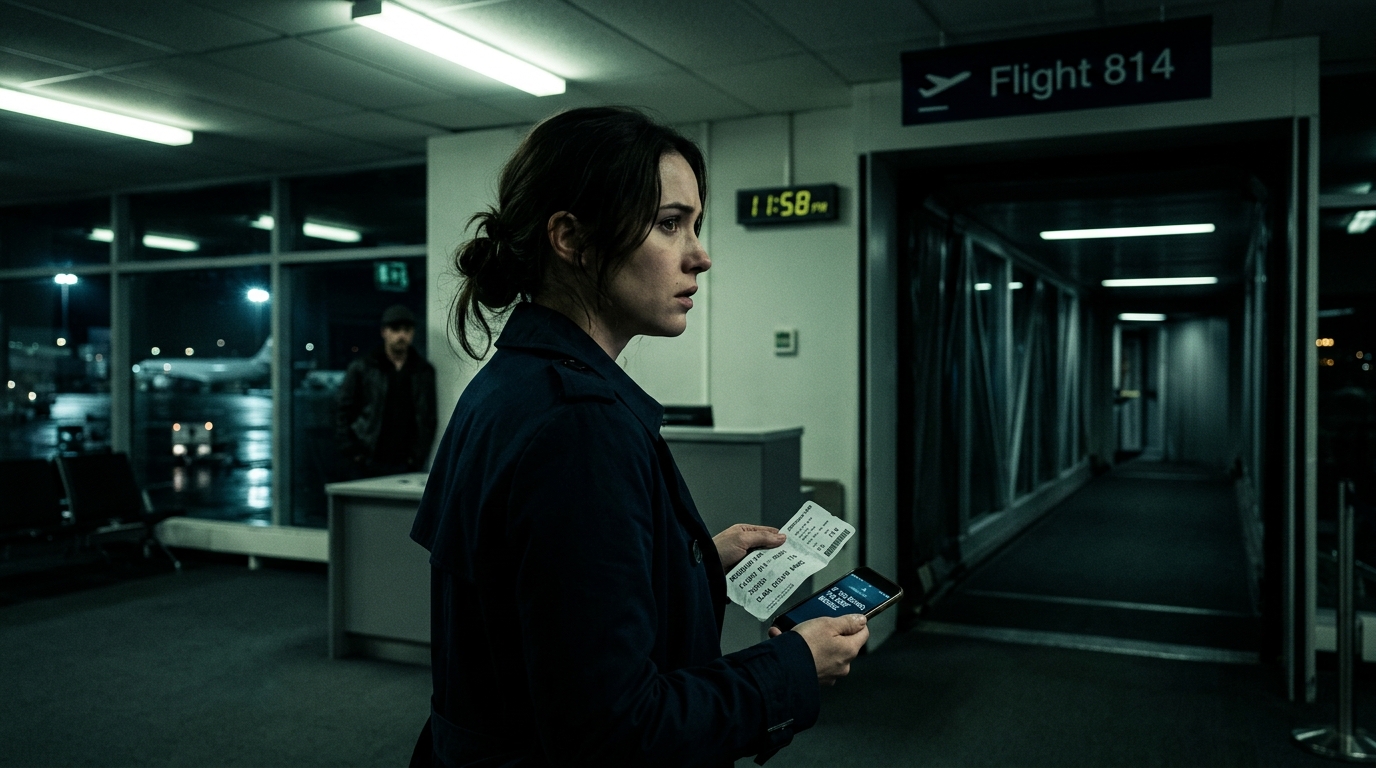
The Signature Expert
I took the contract to a handwriting expert before I told anyone else.
Not the police.
Not my bank.
Not Thomas.
Definitely not Thomas.
After finding my future self in the basement of Meridian Trust Bank, after seeing a marriage certificate linking me to a faceless man named Daniel Cross, after hearing my older self whisper, Don’t believe me either, I stopped trusting explanations that arrived too cleanly.
So I paid cash.
No appointment.
No digital trail.
The expert’s office sat above a tax preparation shop in a building that smelled like dust, toner, and old anxiety. Her name was Dr. Helena Morris, and she had spent thirty years testifying in fraud cases, forged wills, blackmail notes, ransom letters, and signatures that ruined families.
She wore square glasses and spoke like someone who had made a career out of disappointing liars.
“Most people think their signature is unique,” she said while sliding the loan agreement beneath a magnifying lamp. “It isn’t. Not entirely. Habits can be copied. Slants can be trained. Pressure can be imitated if someone has enough samples.”
I sat across from her with both hands locked around my purse strap.
“And fingerprints?”
Her eyes flicked up.
“Harder.”
“Impossible?”
She did not answer.
That was the first bad sign.
She examined the document for forty-seven minutes.
I counted.
Every second sat inside my chest.
She checked the signature under white light.
Then blue light.
Then magnification.
She compared it to eight samples I had signed in front of her.
Then to three old checks I had brought from home.
Then to the signature on my driver’s license.
She became quieter with each comparison.
By the end, she had stopped making notes.
She only stared.
I already knew before she spoke.
People trying to hide uncertainty ask more questions.
People facing certainty go silent.
Dr. Morris removed her glasses.
“Ms. Vance…”
My stomach dropped.
“Just say it.”
She looked at the contract again.
“The signature is yours.”
The room tilted slightly.
“No.”
“It is not a copy. It is not an obvious tracing. It shows natural pressure variation, hesitation points, ink pooling consistent with live signing, and matching micro-movement patterns.”
“You’re saying I signed a contract dated three years from now.”
“I’m saying the signature appears authentic.”
“That’s not the same.”
“No,” she said softly. “It isn’t.”
I leaned forward.
“What about the fingerprint?”
The contract had one.
A right thumbprint beneath the signature.
I had not noticed it the first time because the print was pale, pressed in transparent security ink near the bottom margin.
Dr. Morris had dusted it, scanned it, and compared it to the thumbprint I had just provided.
She looked suddenly older.
“It matches.”
The air left the room.
“My fingerprint?”
“Yes.”
“Exactly?”
“Ninety-nine point nine percent.”
My hands went cold.
“That’s impossible.”
She held the document up again.
“Not if you signed it.”
“The date is in the future.”
“I can read.”
“I didn’t sign this.”
Her voice lowered.
“Then someone has access to your hand.”
That sentence did something worse than frighten me.
It made the memory return.
Future me sitting in the white room.
Bandaged wrists.
Bruised cheek.
Silent mouth forming one word.
Help.
I looked down at my hands.
My right thumb suddenly felt like evidence.
Not part of me.
Something that could be used after I stopped being able to say no.
The Ink That Hadn’t Been Made Yet
Dr. Morris ran one final test.
Ink composition.
I did not ask for it.
She insisted.
“If you’re claiming future dating, we test materials.”
“I’m not claiming anything.”
“Good,” she said. “Then we test anyway.”
She scraped a microscopic sample from an unused corner of the document where the signature bled slightly into the paper.
The machine beside her desk hummed for several minutes.
Too long.
Every time she looked at the monitor, her face tightened.
“What?” I asked.
She did not answer.
“What is it?”
She printed the report.
Then printed it again.
Then compared both pages as if one might apologize for the other.
Finally, she said, “This ink formulation does not exist commercially.”
I stared at her.
“What does that mean?”
“It contains a polymer marker used in anti-fraud inks currently in development.”
“Currently?”
“As in not yet approved for market.”
My stomach turned.
“Could someone have stolen prototype ink?”
“Maybe.”
“From where?”
She turned the report toward me.
“Meridian Trust patented the formulation.”
My throat closed.
The bank.
Of course.
Every road in this nightmare led back to the same building.
The same basement.
The same future filing cabinets.
The same man with no face.
Dr. Morris tapped the document.
“This is either the most sophisticated fraud I have ever seen, or you are involved in something I do not want to understand.”
“I’m not involved.”
She looked at me for a long moment.
Then placed the contract back into the folder.
“Then become uninvolved.”
I almost laughed.
“How?”
She slid the folder across the desk.
“Disappear.”
Before I could respond, her office phone rang.
She glanced at the number and frowned.
No caller ID.
The phone rang once.
Twice.
Three times.
She did not answer.
The voicemail clicked on by itself.
A man’s voice filled the office.
Smooth.
Calm.
Familiar.
Daniel Cross.
“Dr. Morris,” he said, “thank you for verifying the document.”
My blood turned cold.
Dr. Morris went completely still.
The voice continued.
“Please give Ms. Vance the envelope under your desk.”
Slowly, Dr. Morris looked down.
There was an envelope taped beneath the edge of her desk.
Black.
Sealed.
Already there before I arrived.
She reached for it with trembling fingers.
“No,” I whispered.
But she had already pulled it free.
My name was written across the front.
CLARA VANCE.
Inside was a boarding pass.
One-way.
Meridian Air.
August 14.
Flight 814.
Destination: Zurich.
Passenger name: Clara Evelyn Vance.
Seat: 17A.
Departure time: 8:19 p.m.
The date was three days away.
Dr. Morris looked at me.
I looked at the boarding pass.
Then the voicemail spoke again.
“Don’t worry, Clara. You already miss the flight in one version.”
A pause.
Then Daniel Cross laughed softly.
“It doesn’t save you.”
The Flight I Never Booked
I went home because panic makes people return to places they can lock.
That is the lie we tell ourselves.
A lock only matters if the danger respects doors.
My apartment looked exactly as I left it.
One bedroom.
Small kitchen.
Stack of bank folders on the table.
Half-dead plant near the window.
Blue mug in the sink.
Normal life arranged badly enough to feel real.
I locked the door.
Then the chain.
Then pushed a chair beneath the handle even though I knew how childish it looked.
The boarding pass sat on my kitchen table.
August 14.
Flight 814.
Zurich.
I had never booked it.
I did not own a passport anymore. Mine expired two years earlier. I had not left the country since college. I hated flying.
Still, the boarding pass was real.
The airline app confirmed it when I searched the reservation number.
Confirmed.
Paid.
First class.
Booked under my name using a credit card I did not own.
I called Meridian Air.
The representative sounded bored until she pulled up the reservation.
“Yes, Ms. Vance. Flight 814 to Zurich. Departure August 14.”
“I didn’t book this.”
“One moment.”
Typing.
Silence.
More typing.
Then her voice changed.
“Ma’am, the booking was completed through a private corporate travel desk.”
“Which company?”
“I’m not authorized to disclose that.”
“Cancel it.”
A pause.
“I’m sorry. This ticket is non-refundable and cannot be canceled through passenger support.”
“I’m the passenger.”
“Yes.”
“So cancel it.”
“I can’t.”
“Why not?”
Her voice lowered slightly.
“Because the reservation is locked.”
Locked.
That word had followed me for days.
Locked file.
Locked basement.
Locked future.
Locked debt.
“What does that mean?”
“It means only the authorizing account can alter the reservation.”
“Who authorized it?”
She hesitated too long.
“Ma’am, I suggest you contact your travel coordinator.”
“I don’t have one.”
The line went quiet.
Then a different voice came on.
Male.
Too smooth.
Too calm.
Too close to the voice in the basement elevator.
“Clara.”
My hand went cold around the phone.
“Daniel Cross.”
He did not deny it.
“You should pack light.”
I hung up.
The phone rang again immediately.
I turned it off.
It turned itself back on.
New message.
Unknown number.
One sentence.
IF YOU BOARD, THE DEBT BEGINS.
Another message appeared.
IF YOU DON’T, SHE DIES.
My stomach dropped.
Then a video loaded.
Not future me this time.
A hospital room.
A woman sleeping in bed.
Gray hair.
Thin hands.
Oxygen tube.
My mother.
My dead mother.
I stopped breathing.
My mother had died eight years ago.
Lung failure.
Small funeral.
Closed casket because I could not bear the final viewing.
But the woman in the video was moving.
Breathing.
Alive.
A hand entered the frame.
Male.
Silver ring.
Daniel’s voice whispered:
“Some debts are inherited backward.”
The video ended.
I fell to the kitchen floor and vomited into the sink.
The Stranger At My Door
The knock came at 11:43 p.m.
Not loud.
Not threatening.
Three soft taps.
The kind meant to be heard by only one person.
I stood in the dark kitchen with a knife in my hand and watched the apartment door.
The hallway light beneath the crack flickered once.
Then steadied.
Another knock.
Three taps.
I did not speak.
A man’s voice came from the other side.
“I know you’re holding a knife.”
My grip tightened.
He sighed.
“I’m not here to hurt you.”
“That is exactly what people say before hurting you.”
A pause.
Then:
“Fair.”
His voice was older than Daniel’s.
Rougher.
Human.
I moved slowly toward the peephole.
A man stood in the hallway wearing a dark coat.
Late fifties.
Maybe sixty.
Gray hair.
Tired face.
One scar running from his jaw to his collar.
He held both hands where I could see them.
Empty.
No weapon.
No envelope.
No visible threat.
But people like me no longer believed in visible threats.
“Who are you?” I asked through the door.
“Someone who defaulted.”
My blood went cold.
“On what?”
“The same loan.”
I opened the door only as far as the chain allowed.
The man looked worse up close.
Not poor.
Not homeless.
Worn down.
Like someone had spent years running from a number no one else could see.
He looked at my face for a long moment.
Then said:
“You look younger than the file.”
My mouth went dry.
“What file?”
“The one they showed me before I signed.”
“I haven’t signed.”
His eyes moved toward the kitchen table.
The boarding pass.
The contract folder.
The debt notice.
“You will if you get on that plane.”
My chest tightened.
“What happens on Flight 814?”
He looked down the hallway.
Empty.
Still, fear crossed his face.
Not fear of me.
Fear of being overheard by walls.
“If you want to avoid that debt,” he said quietly, “do not board the flight on August 14.”
The sentence landed exactly as the warning from my future should have.
Clean.
Direct.
Terrifying.
“Who are you?”
He looked back at me.
“My name was Daniel Cross.”
I stopped breathing.
“No.”
“I know.”
“You’re not him.”
“No.” His eyes darkened. “Not anymore.”
The hallway lights flickered.
For one second, his face blurred.
Not physically.
Not like a ghost.
Like a camera losing focus.
When the light steadied, he looked older again.
Human again.
But I had seen it.
Something beneath his face did not match the skin above it.
He leaned closer, lowering his voice.
“They use the name Daniel Cross for whoever holds the debt ledger.”
My pulse hammered.
“The faceless man?”
His expression changed.
“You’ve seen him.”
“In the file.”
“Then they’re moving faster.”
“What is he?”
The man swallowed.
“The collector.”
“Of money?”
He shook his head.
“Of outcomes.”
I almost laughed.
My life had become full of sentences people should never say aloud.
“What does that mean?”
“It means they don’t loan money. They loan futures.”
The Debt Ledger
I removed the chain.
I do not know why.
Maybe because the man in the hallway looked like someone who had already lost everything I was still trying to keep.
Maybe because the knife in my hand felt stupid against a future debt.
Or maybe because I wanted one person to finish a sentence without disappearing, glitching, or telling me not to trust them.
He stepped inside slowly.
I kept the knife visible.
He did not object.
He looked around my apartment as if comparing it to a memory.
“Small,” he said.
“Excuse me?”
“Your apartment. In my version, they moved you before the notice.”
My stomach tightened.
“My version?”
He looked at me sadly.
“You’re still thinking in one line.”
“I like one line. One line was working for me.”
“No, it wasn’t.”
I hated him for being right.
He sat at the kitchen table without touching the boarding pass.
His hands trembled when he saw it.
“Flight 814,” he whispered.
“You’ve seen this before.”
“Yes.”
“Were you on it?”
He nodded once.
“Three years ago.”
“That’s impossible.”
“For you.”
I sat across from him.
“Explain.”
He looked at the debt notice.
“The flight is where they create the borrower.”
“They?”
“Meridian.”
“The bank?”
“The bank is only the front. It records the debt after the choice is made.”
“What choice?”
He looked at me.
“Who gets saved.”
The room went still.
“My mother,” I whispered.
He did not look surprised.
“They showed her to you.”
“She’s dead.”
“Was.”
My body went cold.
“No.”
“They do that. Pull someone from a closed outcome. A dead mother. A lost child. A husband who never came home. Then they ask what you would pay to keep them breathing.”
My hands started shaking.
“And the price is four point seven million dollars?”
“No.” His voice lowered. “The money is just how the world understands the wound. The real payment is identity.”
I remembered the future marriage certificate.
Daniel Cross.
Faceless husband.
Death certificate.
Loan.
Estate transfer.
“What happens if I board?”
He picked up the boarding pass carefully.
“On August 14, Flight 814 hits turbulence over the Atlantic.”
My stomach tightened.
“Crashes?”
“No.”
“Then?”
“Disappears for eleven minutes.”
A chill moved through my skin.
“When it lands, no one remembers the missing time. Except the borrowers.”
“Borrowers plural?”
He nodded.
“Every passenger in rows 14 through 17 is given a choice.”
“What choice?”
He looked at me.
“Bring back someone dead. Prevent a death. Erase a mistake. Undo one moment.”
I closed my eyes.
My mother breathing in a hospital bed.
The oxygen tube.
The hand with the silver ring.
“And if we say yes?”
“You sign.”
“And if we say no?”
His face tightened.
“Someone else says yes for you.”
The Woman Who Signed Before Me
I pointed toward the video on my laptop.
“My future self told me not to believe her.”
The man’s face darkened.
“Good.”
“Why?”
“Because by the time they record consent, most versions are already compromised.”
“Compromised?”
“They edit memory. Pain. Desire. Grief. They make you want the debt before they show you the contract.”
My throat felt tight.
“Can I stop it by not boarding?”
He hesitated.
That hesitation frightened me.
“You can delay it.”
“Delay?”
“They’ll try another entry point.”
“So your warning is useless.”
“No.” He leaned forward. “Flight 814 is where Daniel Cross first sees you.”
My skin went cold.
“The faceless man?”
“Yes.”
“But I saw a marriage certificate. August 18, 2029.”
“Because after the flight, he becomes part of your future.”
“No.”
“He marries the borrower in the record system before collection. It gives him legal access to estate rights.”
“That’s insane.”
“Yes.”
“Why me?”
The man looked toward my purse on the counter.
Where the signed future contract waited.
“Because you work inside Meridian’s risk systems. Three years from now, you discover the debt ledger and try to leak it.”
I stopped breathing.
“What ledger?”
He tapped the table.
“The true list. Every borrower. Every revived person. Every erased life. Every future sold backward.”
My pulse thudded painfully.
“And the loan?”
“Punishment. Trap. Insurance.”
The apartment lights flickered once.
He stood immediately.
“We’re out of time.”
“What?”
“He knows I’m here.”
“Who?”
The answer came from my dead phone on the counter.
Daniel Cross’s voice.
“Me.”
The screen lit up though the phone had no battery left.
A live video appeared.
My apartment hallway.
Outside my door.
Empty.
Then the camera angle shifted to inside my apartment.
From the ceiling corner.
Looking down at us.
I looked up.
No camera.
No device.
Nothing.
Still, the feed showed both of us sitting at the table.
The older man went pale.
“He found the witness line.”
A new message appeared on my phone.
THANK YOU FOR CONFIRMING CONTACT.
The older man grabbed my arm.
“Run.”
The apartment door locked by itself.
The windows clicked shut.
The chair scraped backward though no one touched it.
The laptop opened.
Future me appeared on the screen.
Bruised.
Bandaged.
Older.
She looked directly at me and whispered:
“He’s lying.”
The older man shouted, “Don’t listen!”
Future me leaned closer to the camera.
“If you don’t board Flight 814, Mom dies again.”
My vision blurred.
“No.”
The older man’s grip tightened.
“Clara, listen to me. That is not your mother.”
Future me smiled faintly.
Not kindly.
Not cruelly.
Sadly.
Then she said:
“Ask him what he paid to become Daniel Cross.”
The older man released my arm as if burned.
I turned toward him.
His face had gone white.
“What did you pay?”
He backed away.
“Clara…”
“What did you pay?”
Before he could answer, my front door opened.
Not unlocked.
Opened.
A man stood in the hallway.
Tall.
Smooth gray blur where his face should have been.
Silver ring on his hand.
Black suit.
No eyes.
No mouth.
And still I knew he was smiling.
Daniel Cross stepped into my apartment and placed a second boarding pass on the floor.
Passenger name:
CLARA EVELYN VANCE.
Date:
TODAY.
Departure:
IN 47 MINUTES.
Destination:
UNDISCLOSED.
Then he spoke without a mouth.
“Your future debt has been accelerated.”