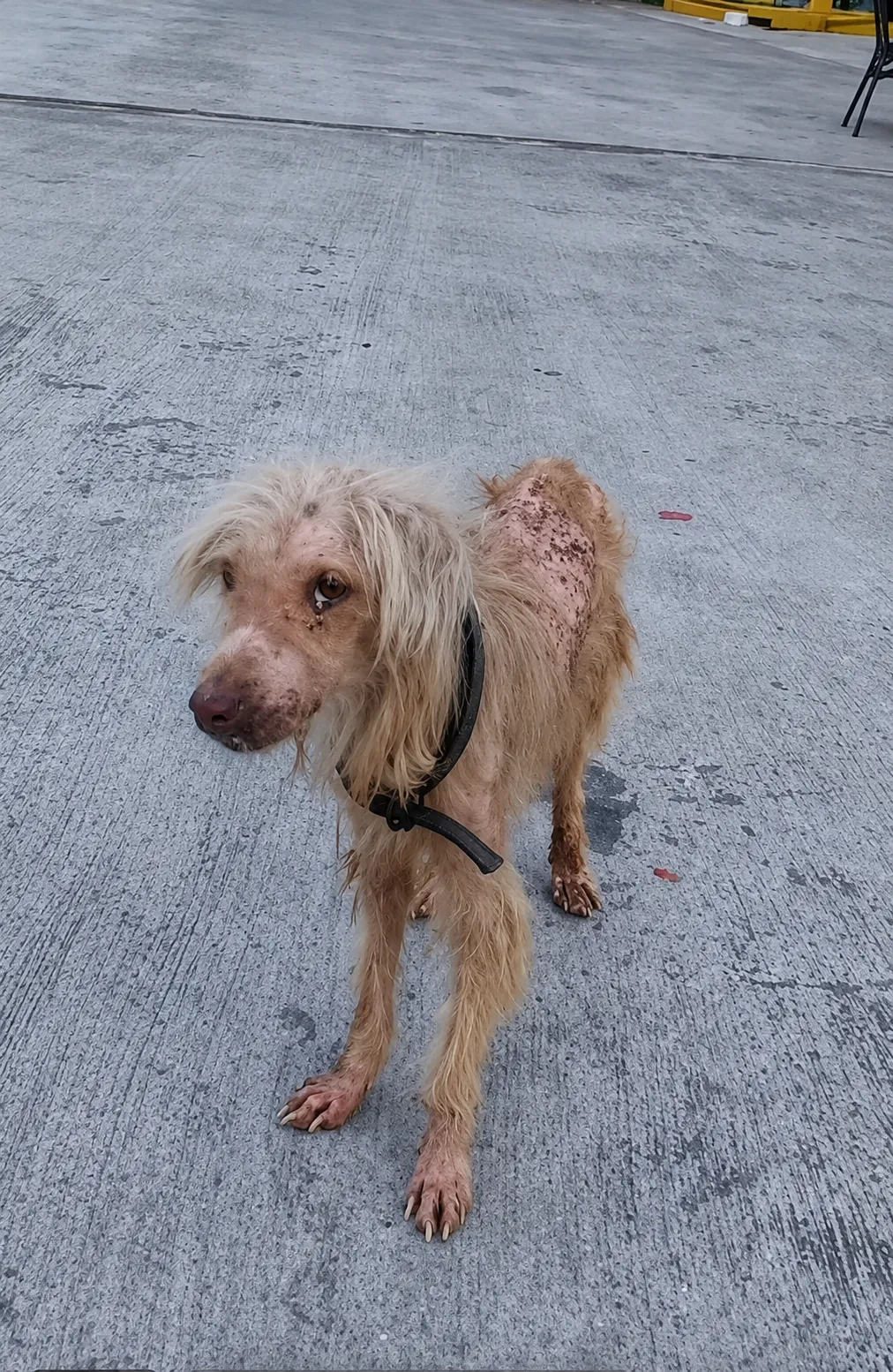
A starving dog wandering around a gas station is not an unusual sight in places where abandoned animals struggle to survive, but there was something painfully different about the frail little dog rescuers found that day. His body was thin, his fur was dirty and patchy, and his eyes carried the exhausted look of an animal that had spent far too long trying to stay alive without help. He was not running, not barking aggressively, and not begging loudly for attention. He was simply there, standing on the concrete, hungry, sick, and almost invisible to the world around him.
When rescuers received a report about a dog in desperate need, they did not know exactly what they would find. But the moment they arrived at the gas station and saw him, they understood that this was not just a stray dog looking for food. This was a dog whose body had been pushed to the edge. His ribs and bones showed clearly, his coat looked unhealthy, and every movement seemed to reveal how weak he had become. He was later named Giant, a name that felt almost ironic at first, because he looked so fragile, but would soon become a symbol of the strength hidden inside him.
@simbacat.bianco parte 1200 rescue of an abandoned dog in difficulty❤️ #heroes #rescue #dog #abandoned #doghelpdifficulty #dogsoftiktok #dogsaved #dogadopt #animalsreact @𝐿𝑎́ 𝑟𝑒𝑖𝑛𝑎 𝑑𝑒𝑙 𝑚𝑎🌊 @ronaldo gogowa @Silvia 77/ 83 @Coraljne @𝐋 @kovovkatarna @alamandra @AileenMonroe @GeraldineG’ @Anaksymenesaa @Ana Maria @Aurélia 🇮🇹🇪🇸 @Brexy_Taylor02 @Bia Araújo @Anitaleal🌸 @Brigitte @andreeaofycyal @alexandra.alex940 @camila🎀 @Biggy @dudabrunassi @Jucus @emy
A Sick and Starving Dog Waiting at a Gas Station
The rescuers first approached Giant with caution, because a starving and frightened dog can react unpredictably, especially when pain, hunger, and fear are all happening at once. Giant was clearly hungry, so they allowed him to eat while they slowly gained his trust. This small moment mattered more than it might appear. For a dog who had likely been ignored, chased away, or mistreated before, food was not only nourishment but also the first signal that the humans approaching him might not be there to hurt him.
As he ate, the rescuers carefully placed a leash on him. Giant did not bite. He did not fight violently. In fact, he seemed to understand how to walk on a leash, which suggested that he may once have belonged to someone. That possibility made his condition even more heartbreaking. Somewhere in his past, Giant may have known human touch, a home, or at least some form of care, yet now he was standing alone at a gas station, critically underweight and visibly sick.
Getting a newly rescued dog into a vehicle is always a delicate process, especially when the dog is weak, scared, and unsure of what is happening. Giant did not fully understand that the car represented safety. To him, it was another unknown space, another frightening change, another moment where he had to decide whether to trust or defend himself. The rescuers moved slowly, lifted him with care, and placed him inside the vehicle so they could take him straight to a clinic.
The First Medical Check Revealed How Badly Giant Needed Help
At the clinic, Giant’s condition became even clearer. He was critically underweight, and his body showed the signs of long-term neglect. His fur was rough and dirty, his skin looked irritated, and his tired posture showed how much his body had endured. But perhaps the most difficult part was not only his physical condition. It was the fear that lived inside him.
Giant did not like being touched. When the veterinary team tried to examine him, he reacted defensively. His mouth opened, his body stiffened, and his face showed a mixture of panic and warning. This was not the behavior of a “bad dog.” It was the behavior of a dog who had learned that touch could mean pain. Many rescued dogs carry invisible wounds that are just as serious as the visible ones. They may flinch when hands come near them, growl when someone tries to hold them, or panic during medical care, not because they are aggressive by nature, but because survival has taught them to protect themselves.
The rescuers and veterinary staff understood this. They did not punish him for being afraid. Instead, they handled him with patience, protective gloves, towels, calm voices, and careful movements. Their goal was not to force affection from him. Their first goal was simply to keep him safe, reduce his stress, and begin the medical care he needed to survive.
Why Fearful Rescue Dogs Need More Than Food and Medicine
A dog like Giant needs far more than one meal and one veterinary visit. Starvation weakens the body slowly, and recovery must be handled carefully. Feeding a severely underweight dog requires patience, because giving too much food too quickly can be dangerous. His meals had to be small, nutritious, and consistent. His body needed time to rebuild strength, and his stomach needed time to adjust to regular feeding again.
At the same time, Giant needed treatment for whatever skin problems, infections, parasites, or injuries may have contributed to his suffering. Dogs living on the street are exposed to dirty water, contaminated food, harsh weather, traffic, and human cruelty. Even when they survive, their bodies often carry the cost. For Giant, every bath, every medical check, every gentle cleaning, and every dose of treatment was a step away from the life he had been forced to endure.
But emotional healing was just as important. Rescue dogs who dislike being touched cannot be rushed into trust. A hand reaching toward them may feel threatening, even when that hand is gentle. A clinic table may feel like a trap. A towel may feel like restraint. A closed room may feel unsafe. That is why rescuers often use slow routines to help fearful dogs recover emotionally: soft voices, predictable feeding times, short contact sessions, and enough space for the dog to understand that no one is trying to harm him.
For Giant, trust did not arrive all at once. It came in tiny moments. The first time he ate without trembling. The first time he allowed someone to stand near him without pulling away. The first time he looked at a rescuer not with panic, but with uncertainty. Those small changes may not look dramatic on the outside, but for a traumatized dog, they are enormous victories.
Giant’s Rescue Became the Beginning of a Second Life
After his first clinic visit, Giant’s rescuers continued his care with patience and consistency. His body slowly began to respond to regular meals, medical treatment, and rest. The dirty, exhausted dog from the gas station began to look a little more alert. His eyes became clearer. His body, once fragile and weak, started to regain strength. The name Giant began to feel less like a contrast and more like a promise.
He still had difficult moments. He still became nervous when people moved too quickly. He still needed careful handling during treatment. But every day, the distance between fear and trust became a little smaller. Rescue is rarely a perfect transformation overnight. It is a process built from repeated kindness. A dog who has been abandoned does not suddenly forget hunger, pain, or loneliness. But when humans keep showing up with food, care, safety, and patience, the dog slowly learns that the past is not the only thing life can offer.
In time, Giant began to understand that the people around him were not there to hurt him. They were there to protect him. The hands he once feared became the same hands that fed him, cleaned him, comforted him, and helped him stand stronger. His story is not only about a starving dog rescued from a gas station. It is about what happens when a forgotten animal is finally seen.
Many people passed through that gas station. Some may have noticed him and looked away. Some may have thought he was too sick, too dirty, or too difficult to help. But one report, one rescue team, and one act of compassion changed the direction of his life. Giant’s journey reminds us that even the most frightened dogs are not hopeless. Behind the defensive growl, the trembling body, and the tired eyes, there is often a soul waiting for safety.
Giant did not need perfect humans. He needed patient ones. He needed people who understood that fear is not a flaw, that sickness is not a reason to abandon a dog, and that even the weakest body can carry a powerful will to live. From a gas station floor to a clinic table, from hunger to healing, and from fear to the first signs of trust, Giant’s rescue became the beginning of the life he should have had all along.
His story is a reminder that rescue does not always begin with a dramatic chase or a perfect ending. Sometimes it begins with a starving dog standing quietly in a public place, hoping someone will notice. And sometimes, when the right people do, that quiet moment becomes the first chapter of a second chance.