
The Girl In Room 306
Landlords learn to fear late rent.
Not because of the money.
Money is only the surface.
Late rent means stories.
Sick relatives.
Lost jobs.
Stolen wallets.
Delayed transfers.
Breakups.
Drinking.
Police.
People who stop answering calls but leave all the lights on.
I had heard every excuse in twenty-three years of renting rooms above my old hardware shop.
That was why I liked Mira Vale.
Room 306.
Quiet.
Polite.
Always paid on the first.
Never asked for repairs unless something truly broke.
Never brought loud guests.
Never left trash outside her door.
Never stayed in the hallway to talk.
She was twenty-six, maybe younger, with dark hair, pale skin, and the tired eyes of someone who slept only because the body eventually forced her to.
She moved in six months ago with one suitcase, two cardboard boxes, and no furniture.
When I asked where she came from, she smiled faintly and said:
“Not far enough.”
I thought it was a joke.
People say strange things when starting over.
So I handed her the keys and told her the building rules.
No smoking.
No pets.
No parties after ten.
Rent due on the first.
She nodded at every rule like she already knew them.
Then she looked past me toward the stairs.
“Does the basement door lock from the outside?”
That should have been my first warning.
Instead, I told her the basement was for storage and tenants were not allowed down there.
Her face relaxed slightly.
“Good,” she whispered.
I pretended not to hear.
That is another thing landlords learn.
Sometimes ignoring a strange sentence keeps the paperwork simple.
For six months, Mira paid in cash.
Always exact.
Always folded inside a white envelope.
Always slipped under my office door before sunrise on the first day of the month.
No note.
No complaint.
No delay.
Until the month everything began to change.
The Envelope Under My Door
The envelope arrived at 5:17 a.m.
I know because I was awake.
The pipes had been banging all night, and the old radiator behind my desk kept making a sound like someone knocking from inside the wall.
I sat in my office with bad coffee, unpaid tax forms, and a headache.
Then the envelope slid under the door.
Slowly.
Not dropped.
Not pushed casually.
Slid.
Like whoever held it on the other side wanted me to notice the movement.
I looked at the door.
No footsteps.
No shadow beneath the frame.
Nothing.
“Mira?” I called.
No answer.
I stood and opened the door.
The hallway was empty.
The stairs were dark.
The security light above the mailboxes flickered once.
Then steadied.
I picked up the envelope.
White.
Same as always.
Room 306 written in neat black ink.
But this time, the paper felt cold.
Not morning cold.
Not hallway cold.
Cold like it had been stored in a freezer.
I opened it at my desk.
Six hundred dollars.
Exact rent.
Five ordinary hundred-dollar bills.
And one bill I had never seen before.
At first, I thought it was foreign currency.
Then counterfeit.
Then some kind of collector sample.
It was the right size.
Right texture.
Right color family.
But the design was wrong.
The portrait was different.
The security strip ran diagonally instead of vertically.
There was a small holographic mark near the corner that shifted when I tilted it under the lamp.
And printed beside the serial number were two tiny words:
SERIES 2027.
I frowned.
The current year was 2026.
The bill was dated next year.
I turned it over.
The back showed a government building I did not recognize.
Beneath it, in microprint, was a phrase I had never seen on money before.
LEGAL TENDER UPON RELEASE.
My stomach tightened.
Fake money usually looks cheap.
This did not.
It looked too real.
That was what made it wrong.
The Bill That Looked Too Real
I checked it with my counterfeit pen.
The mark came back clean.
I held it under ultraviolet light.
A hidden thread glowed.
Not where it should have been.
But it glowed.
I rubbed the ink with my thumb.
Raised texture.
Correct pressure.
Professional.
I compared the serial number to the other bills.
Nothing matched.
Nothing repeated.
No obvious fraud.
Still, the date made no sense.
Series 2027.
Six months early.
I looked up future currency designs online.
Nothing.
No announcement.
No leaked redesign.
No news about a new bill.
I searched the government treasury page.
Nothing.
I searched forums.
Nothing.
I even took a photo and uploaded it into a private collector group I had joined years ago when I inherited a box of old coins from my father.
The first replies came fast.
Fake.
Movie prop.
Photoshop.
Burn it.
Then one user messaged privately.
Do not post that bill publicly again.
I stared at the message.
Who is this? I typed.
The reply came immediately.
Someone who knows that serial number.
My pulse slowed.
What does that mean?
The user went offline.
I looked back at the bill on my desk.
The holographic corner shimmered under the lamp.
For one second, I thought I saw an image inside it.
Not a government building.
Not a pattern.
A face.
Mira’s face.
Mouth open.
Eyes wide.
Like she was screaming from inside the silver strip.
I dropped the bill.
It landed on the desk with a soft snap.
The office radiator knocked again.
Three times.
Then the phone rang.
Building intercom.
Room 306.
My throat tightened.
I answered.
“Mira?”
For a moment, there was only static.
Then her voice came through.
Weak.
Breathless.
“Mr. Hale?”
“Yes?”
“Did I pay rent today?”
I stared at the envelope.
“Yes.”
A pause.
Then she whispered:
“Don’t spend that bill.”
The line cut off.
The Bank Teller
I took the money to the bank at 9:00 a.m.
Not all of it.
Just the strange bill.
I told myself I was being responsible.
A landlord cannot accept counterfeit currency.
That was the practical reason.
The safer reason.
The lie.
The truth was that Mira sounded terrified.
And fear turns ordinary objects into evidence.
The bank sat three blocks away on the corner of Mason and 4th, a polished glass building full of people pretending money behaved logically.
I waited in line behind a woman depositing rolls of coins and a man arguing about overdraft fees.
Normal problems.
Human problems.
When I reached the counter, the teller smiled.
“Good morning. How can I help you?”
I slid the bill under the glass.
“I need to verify this.”
She picked it up casually.
Then stopped.
The smile vanished.
Not slowly.
Instantly.
Her eyes moved over the portrait.
The date.
The holographic corner.
The serial number.
Then back to me.
“Where did you get this?”
I did not like her voice.
“A tenant paid rent with it.”
She looked toward the back office.
Then lowered her voice.
“Please wait here.”
“No, just tell me if it’s fake.”
She did not answer.
That told me enough.
She walked away carrying the bill between two fingers, like it was fragile or contaminated.
Through the glass wall behind the counter, I watched her show it to a manager.
The manager laughed at first.
Then looked closer.
Then stopped laughing.
Another employee came over.
Then another.
One of them scanned the bill.
The machine rejected it.
Then accepted it.
Then rejected it again.
A small red light flashed.
The manager picked up a phone.
My stomach tightened.
I should have left then.
But the teller still had the bill.
And some part of me wanted an adult with a badge or a title to say this was simple.
Counterfeit.
Fraud.
Novelty print.
Anything.
Ten minutes later, the manager came out.
His name tag read: Daniel Cross.
He looked too pale for a man who worked under warm bank lighting.
“Mr. Hale?”
“Yes.”
“Could you come with me, please?”
The Serial Number
The back office was small and windowless.
The manager closed the door behind me.
That was when my body finally understood I had made a mistake.
The strange bill lay on the table inside a clear plastic sleeve.
A scanner sat beside it.
Two printed pages.
A phone.
A locked cabinet.
The manager sat across from me.
The teller remained near the door, arms folded tightly.
Neither of them smiled now.
“Where did you say you got this?” Daniel Cross asked.
“My tenant.”
“Name?”
I hesitated.
“Mira Vale.”
The teller’s face changed.
Only for a second.
But I saw it.
Recognition.
“You know her?” I asked.
She looked down.
Daniel ignored the question.
“Did Ms. Vale say anything when she gave you this bill?”
“She didn’t hand it to me. She slipped it under my office door.”
“When?”
“This morning.”
“What time?”
“About 5:17.”
The manager wrote that down.
Too quickly.
Like the time mattered.
“What is this?” I asked.
He looked at the bill.
Then at me.
“You should not have brought it here.”
That was not the answer I wanted.
“Is it counterfeit?”
“No.”
The word stopped me.
“No?”
He rubbed both hands over his face.
“It isn’t in circulation.”
“I can see that.”
“You don’t understand.” His voice lowered. “It isn’t supposed to exist yet.”
My mouth went dry.
“What does that mean?”
Daniel pulled one of the printed pages toward me.
It showed the serial number from the bill.
The number matched exactly.
Beneath it were several lines of database information.
Treasury batch record.
Print facility.
Release schedule.
Restricted status.
Print date:
Six months from now.
I stared.
“That’s impossible.”
“Yes.”
“The bill is real?”
He did not answer immediately.
Then:
“The serial number is real.”
“But the bill hasn’t been printed yet.”
“No.”
“But I’m holding it.”
“Yes.”
The room suddenly felt too small.
The teller whispered from near the door:
“This is how it starts.”
Daniel shot her a look.
She went silent.
I turned toward her.
“How what starts?”
No one answered.
The bill inside the plastic sleeve flickered under the overhead light.
The holographic corner shifted again.
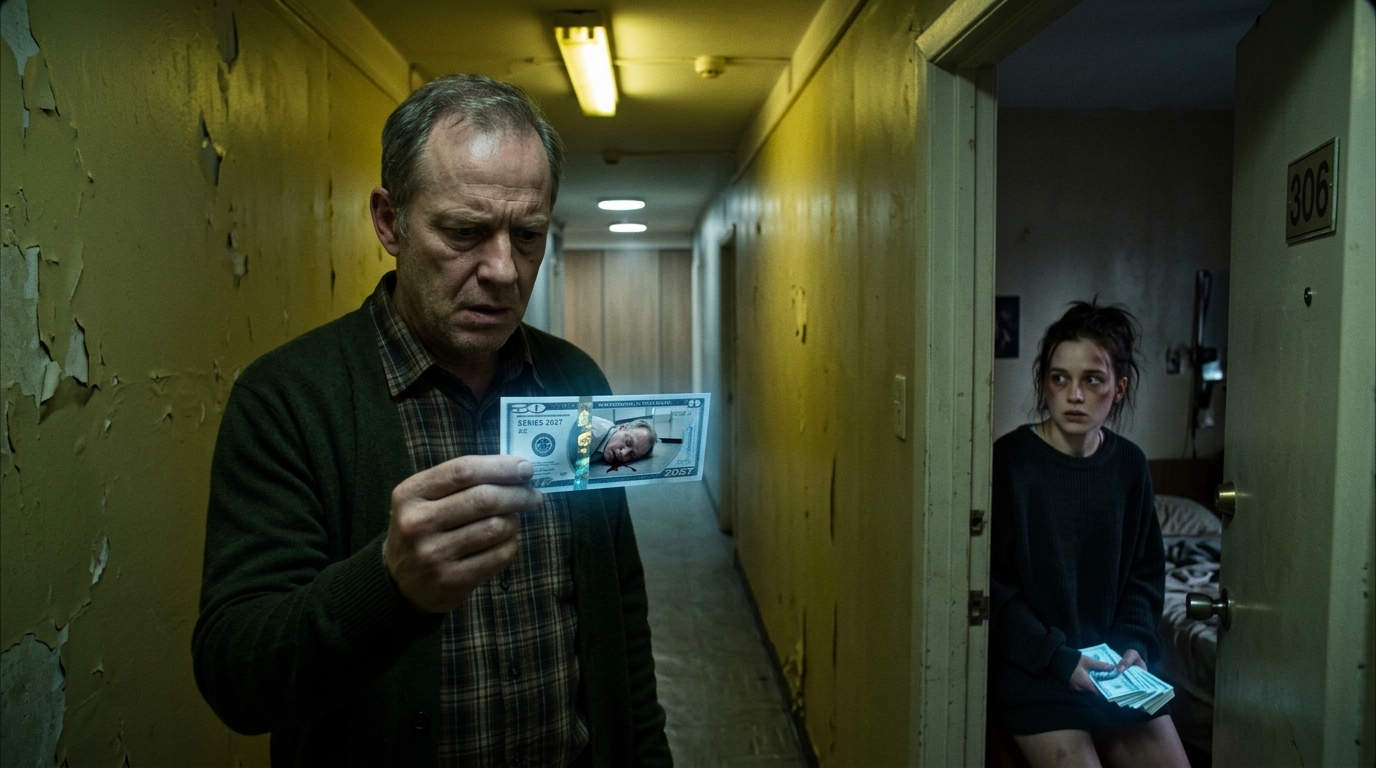
This time, the face inside it was clearer.
Not Mira.
Me.
Older.
Paler.
Lying on the floor of my office.
Eyes open.
Blood at my mouth.
I shoved back from the table.
The chair scraped loudly.
Daniel stood.
“Mr. Hale, calm down.”
I pointed at the bill.
“You saw that.”
“No.”
The lie was too fast.
“You saw it.”
He stepped between me and the door.
“You need to leave the bill here.”
“No.”
“It’s bank property now.”
“It was used to pay rent.”
“It was used to find you.”
My blood turned cold.
“What?”
Daniel froze.
He had not meant to say that.
The teller closed her eyes.
The room went silent.
Then the phone on the table rang.
No caller ID.
Daniel stared at it.
His face drained completely.
It rang again.
The teller whispered, “Don’t answer.”
The phone answered itself.
A woman’s voice filled the room.
Mira.
“Mr. Hale?”
I could barely breathe.
“Mira?”
Her voice shook.
“I told you not to spend it.”
“I didn’t.”
“You brought it to them.”
Daniel stepped back from the phone as if it had bitten him.
Mira began to cry.
“Then they know which version you are now.”
Room 306
I left the bank without the bill.
Or I tried to.
Daniel would not return it.
The teller slipped something into my hand as I passed her near the door.
A receipt.
Not from the bank.
A small folded slip of paper.
I did not look at it until I was outside.
Rain had started.
Cold drops slid down the glass bank doors behind me while people walked past carrying coffee and shopping bags and normal lives.
I unfolded the paper.
It was a printout of the bill’s serial number.
And beneath it, handwritten in blue ink:
Ask her where she gets the money.
Then, below that:
Do not let her leave Room 306 tonight.
My stomach turned.
The teller had signed only one initial.
L.
I shoved the receipt into my coat pocket and walked home too fast.
The whole way back, I kept thinking about the manager’s words.
It was used to find you.
Not Mira.
Me.
I had thought the strange bill belonged to her mystery.
Maybe it did.
But the bank manager looked at me like I was the mistake that had just entered their system.
The building felt different when I returned.
The hallway smelled faintly of wet paper.
The stairs creaked under my feet in a rhythm I did not recognize.
At the third floor landing, I stopped outside Room 306.
Mira’s door was closed.
No light under it.
No sound inside.
I knocked.
Nothing.
“Mira?”
No answer.
I used my landlord key.
I told myself it was an emergency.
Another practical lie.
The door opened.
Room 306 was empty.
Not empty like a tenant had gone out.
Empty like no one had ever lived there.
No suitcase.
No bed sheets.
No clothes.
No toothbrush.
No boxes.
The air smelled of dust and cold metal.
A white envelope lay in the center of the floor.
My name was written across it.
MR. HALE.
Inside was the strange bill.
The same one the bank had refused to return.
Same serial number.
Same 2027 design.
Same holographic corner.
Except now there was writing across the portrait in red ink.
RUN BEFORE THE FIRST PRINT.
My pulse hammered.
Behind me, the door slowly closed by itself.
I spun around and grabbed it before it latched.
The hallway outside had changed.
The wallpaper was newer.
The carpet cleaner.
The light above the stairs brighter.
And on the wall beside Room 306, a framed notice read:
BUILDING RENOVATION COMPLETED — 2027.
My body went cold.
I looked back into the room.
The floor was no longer empty.
A bed stood against the wall.
A suitcase beside it.
Curtains at the window.
And Mira Vale sat on the edge of the mattress.
She looked six months older.
Bruised.
Exhausted.
Holding a stack of future bills in both hands.
She looked at me and whispered:
“You weren’t supposed to find me until after I died.”
Then someone knocked from inside my office downstairs.
Three slow knocks.
And the bill in my hand began printing fresh blood across the serial number.