
The Third Plate
The first time it happened, I blamed my husband.
That was easier than being afraid.
I woke up early on a Tuesday morning and found three sets of bowls and chopsticks on the dining table.
Three.
Not two.
One for me.
One for Daniel.
And one placed neatly across from us.
The third bowl was empty.
The chopsticks lay perfectly straight beside it.
The spoon was turned inward, the way my grandmother used to set the table when she expected someone home before dinner got cold.
I stood in the kitchen doorway for almost a full minute, staring at it.
The apartment was quiet.
Too quiet.
Morning light pressed against the curtains in thin gray lines. The city outside was waking slowly beneath soft rain. The refrigerator hummed. Water dripped from the sink because Daniel always forgot to tighten the faucet.
Everything was normal.
Except the third place setting.
Daniel came out of the bedroom rubbing his eyes.
“What are you doing?”
I pointed at the table.
He stopped.
His face was blank for half a second.
Then he laughed.
A small, uncomfortable laugh.
“Did you do that?”
I turned to him.
“Why would I do that?”
“I don’t know. Sleepwalking?”
“I don’t sleepwalk.”
“You sure?”
I looked back at the table.
The third bowl seemed to wait for an answer neither of us wanted to give.
We checked the front door.
Locked.
Chain still on.
Windows closed.
Balcony door latched from the inside.
Nothing missing.
No muddy footprints.
No open cabinets.
No sign anyone had entered.
Just one extra bowl.
Daniel picked it up and carried it to the sink.
“Probably us being tired.”
That was what he said.
Us.
But his hands shook when he rinsed the bowl.
It Happened Again
The second time happened two mornings later.
This time, the third place setting included a glass of water.
Half full.
Not poured by us.
I knew because Daniel and I never left water on the dining table overnight. It was one of those tiny habits couples create without discussing them.
After dinner, I always cleared the bowls.
Daniel always wiped the table.
I always turned off the kitchen light.
He always checked the door.
Two people.
Two routines.
Two place settings.
But at 6:12 a.m., I walked into the dining room and saw three.
The extra bowl sat in the same position as before.
The glass of water had tiny fingerprints near the rim.
Small fingerprints.
Child-sized.
I did not touch it.
Daniel stared at the glass for a long time.
Then whispered, “Nora…”
That was my name.
He only said it like that when something was truly wrong.
I looked at him.
“You still think I’m sleepwalking?”
He shook his head slowly.
We called building security.
They checked hallway footage.
Nobody entered our apartment.
Nobody exited.
No suspicious movement.
The guard even looked irritated by the end.
“Maybe one of you forgot,” he said.
Forgot.
Such a simple word.
A word people use when reality becomes inconvenient.
Forgot an extra bowl.
Forgot a glass of water.
Forgot child-sized fingerprints on the rim.
Daniel thanked him.
I did not.
That night, I stayed awake until 2 a.m., sitting on the sofa with every light on.
Nothing moved.
No footsteps.
No whispering.
No cabinet doors.
Eventually, exhaustion pulled me under.
In the morning, there were three bowls again.
This time, the third bowl had been used.
A thin smear of rice stuck to the bottom.
The Camera
We bought the camera that afternoon.
Not a professional security system.
Just a small wireless camera from an electronics store, the kind nervous parents use to watch babies sleep.
Daniel installed it above the kitchen cabinet, angled toward the dining table and hallway.
“It records motion,” he said.
His voice sounded too casual.
I knew him well enough to hear the fear beneath it.
That night, we made dinner together.
Noodles.
Boiled vegetables.
Tea.
Nothing special.
Then, deliberately, we set only two bowls on the table.
I took a picture before bed.
Two bowls.
Two glasses.
Two sets of chopsticks.
Daniel watched me do it.
“Proof?” he asked.
I nodded.
“Proof.”
Before sleeping, he checked the front door twice.
I checked it again after him.
The chain was locked.
The deadbolt turned.
The windows closed.
The balcony latched.
Our apartment was on the ninth floor.
No one could climb in.
No one could enter.
That was what I told myself as I lay beside Daniel in the dark.
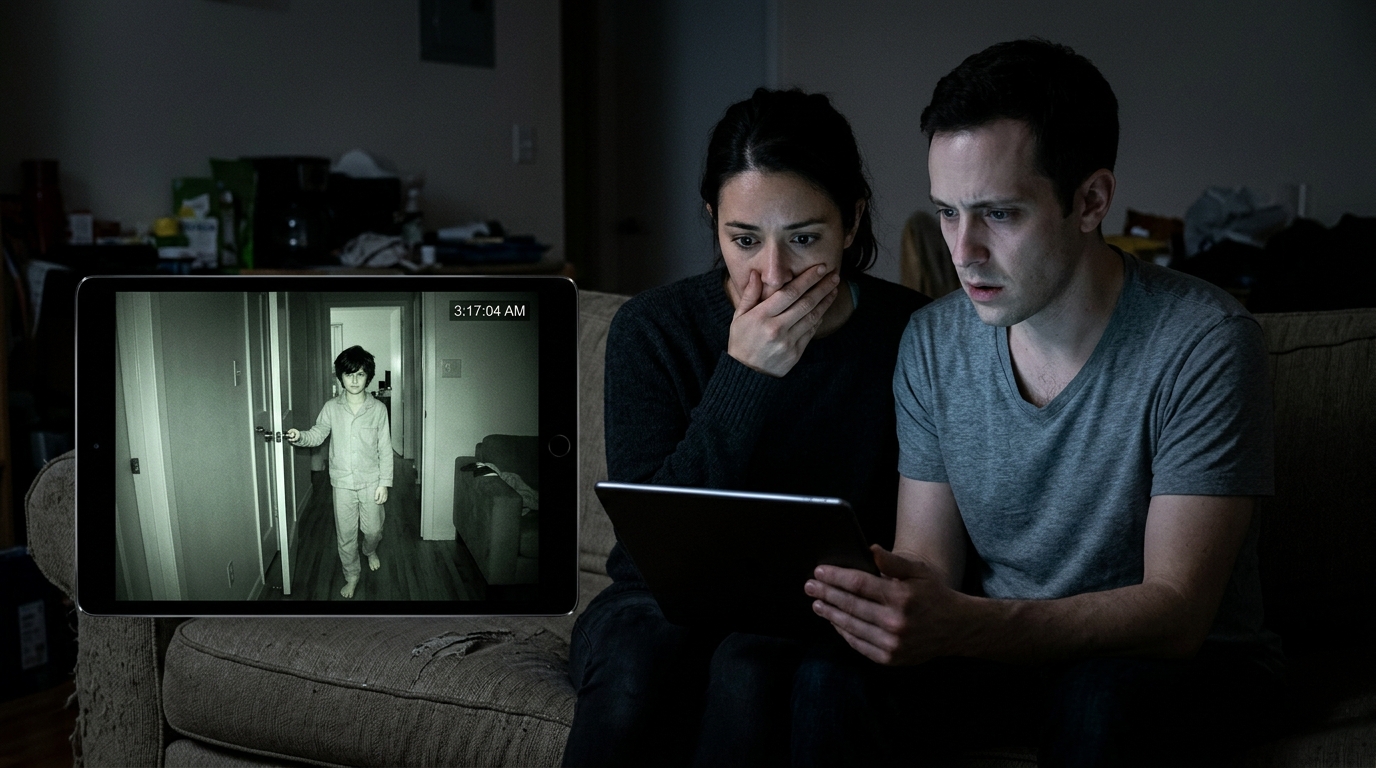
At 3:17 a.m., the camera detected motion.
We did not know that until morning.
At the time, I woke only once.
Not fully.
Just enough to feel the room had changed.
Daniel was asleep beside me.
His breathing slow.
The air cold.
Too cold for our apartment.
I remember thinking the bedroom door was open.
But I also remembered closing it.
Then I heard something from the kitchen.
Soft.
Ceramic touching wood.
A chair moving carefully.
Not dragged.
Lifted.
Placed down.
Like someone trying not to wake us.
I wanted to open my eyes.
I did not.
Fear does that sometimes.
It makes cowards of muscles.
In the morning, the third bowl was back.
And this time, Daniel whispered:
“Check the camera.”
3:17 A.M.
We watched the footage on my phone.
Neither of us sat down.
I stood near the kitchen island, arms crossed tightly over my chest.
Daniel stood behind me, one hand on the counter, the other pressed against his mouth.
The first few hours showed nothing.
Empty kitchen.
Dim hallway.
Dining table with two bowls.
Rain streaking the dark window behind the curtains.
Then the timestamp changed.
03:17:09.
The bedroom door opened.
My hand went numb around the phone.
On the screen, our bedroom door opened slowly from the inside.
Not from the hallway.
From the inside.
The same bedroom where Daniel and I had been sleeping.
A small figure stepped out.
A boy.
Maybe ten years old.
Thin.
Barefoot.
Dark hair falling across his forehead.
He wore pale pajamas that looked old-fashioned somehow, with buttons down the front and sleeves too short at the wrists.
He did not look scared.
He did not look lost.
He walked down the hallway naturally, as if he had done it every night for years.
As if this was his home.
I stopped breathing.
Daniel whispered, “Who is that?”
His voice sounded far away.
The boy entered the kitchen.
He opened the cabinet.
The camera caught him clearly reaching for a bowl.
Not randomly.
He knew exactly where we kept them.
He took chopsticks from the drawer.
A spoon.
A glass.
Then he set the third place at the table.
Same position.
Same careful angle.
Then he sat down.
Daniel made a sound behind me.
Not words.
Just air leaving him.
The boy poured water from the pitcher.
Took leftover rice from the fridge.
Warmed nothing.
Ate cold rice in silence.
Slowly.
Politely.
Like someone had taught him table manners in a house that no longer existed.
I zoomed in.
His face was pale.
His eyes were dark.
Too serious for a child.
When he lifted the glass, I saw a thin scar across his wrist.
A scar shaped like a circle.
My heart began pounding so hard I heard it in my ears.
Because Daniel had a scar like that.
Same wrist.
Same shape.
From an accident he never explained properly.
The Boy At Our Table
The footage continued.
The boy ate for seven minutes.
Seven full minutes.
Daniel and I watched in silence while a child neither of us knew sat in our kitchen at 3:17 a.m. eating rice from our refrigerator.
Then he stopped.
He lowered his chopsticks.
His head tilted slightly.
Like he had heard something.
I turned toward the real hallway instinctively, even though it was morning now.
Empty.
On the screen, the boy pushed the bowl away.
Then he looked toward our bedroom door.
He did not go back immediately.
Instead, he reached into the pocket of his pajamas and placed something on the table.
A key.
Small.
Brass.
Old.
I zoomed in until the image blurred.
The key had a tag attached.
Apartment 9C.
Our apartment.
Only we lived in 9C.
Daniel had bought the unit three months before our wedding.
At least, that was what he told me.
The boy sat still for another few seconds.
Then he turned his head toward the camera.
Slowly.
Deliberately.
My entire body went cold.
His eyes met the lens.
No confusion.
No surprise.
He knew the camera was there.
He had known the whole time.
Then he smiled.
Not like a child.
Like someone much older wearing a child’s face because the truth had not yet learned how to grow up.
Daniel grabbed my wrist.
“Turn it off.”
I did not.
The boy leaned closer to the camera.
His lips moved.
There was no audio on the cheap device.
But I could read the words.
You finally saw me.
The footage glitched.
For one second, the kitchen went black.
When the image returned, the boy was no longer at the table.
The chair was pushed in.
The bowl remained.
The key remained.
And our bedroom door was closed again.
Daniel stepped away from me.
His face had gone white.
Not frightened white.
Guilty white.
I turned toward him slowly.
“Daniel.”
He did not look at me.
I held up the phone.
“Who is that child?”
He shook his head.
Too fast.
“I don’t know.”
The lie was so obvious it made the room feel colder.
Before I could speak, something clinked behind us.
We both turned.
On the real dining table, beside the third bowl, sat the brass key.
Apartment 9C.
Wet.
As if someone had just pulled it from a mouth.
Then, from inside our locked bedroom, a child’s voice whispered:
“Dad said you would make me disappear again.”