The Rule In The Contract
When I moved into Hollowbrook Lane, the first thing they gave me was not a key.
It was a rule.
Not a welcome packet.
Not parking instructions.
Not a list of trash pickup days.
A rule.
Printed on page seven of the homeowner agreement, beneath clauses about lawn height, exterior paint colors, and noise restrictions.
Resident agrees never to open, touch, tamper with, or inspect Mailbox 17 under any circumstances.
I read the line three times.
Then looked up at the woman across the desk.
Her name was Mrs. Vale.
She managed the neighborhood association and smiled the way locked doors smile.
“Mailbox 17?” I asked.
“Yes.”
“Why?”
Her smile did not move.
“It is not assigned to your property.”
I glanced through the office window.
The mailbox cluster stood directly across from my new house.
Sixteen little black boxes on one side.
Sixteen on the other.
And one separate mailbox at the far end.
Number 17.
It stood alone.
Right in front of my walkway.
“So whose is it?”
Mrs. Vale folded her hands.
“No one’s.”
“Then why is it there?”
“It has always been there.”
I laughed because I thought she was joking.
She was not.
My name is Clara Reed, and I had moved to Hollowbrook Lane because I wanted quiet.
After my divorce, I wanted no shared walls.
No neighbors hearing me cry through vents.
No elevator mirrors.
No city noise.
Just a small white house, a garden I would probably kill by accident, and enough silence to remember who I was before becoming someone’s abandoned wife.
So I signed.
People sign strange things when they are exhausted.
Mailbox 17 stood outside when I carried the first box into my new home.
Black metal.
Old.
Slightly crooked.
Its number painted in faded white.
17.
The other mailboxes looked new.
This one looked like it had survived a fire.
I told myself not to be dramatic.
That was the first mistake.
One Year Of Not Looking
For one year, I obeyed.
That surprises people when I tell the story.
They think curiosity always wins quickly.
It doesn’t.
Fear can be very disciplined.
Every morning, I walked past Mailbox 17 to collect my mail from box 12.
Every morning, I did not touch it.
I learned its shape without looking directly.
The dent on the left side.
The rust near the handle.
The tiny scratch beneath the number.
The way birds never landed on it.
The way snow melted around its base faster than anywhere else.
The way the mail carrier skipped it without slowing down.
Once, I asked him about it.
He went pale.
“I don’t deliver to that box.”
“I know. But why is it there?”
He looked toward my house.
Then back at me.
“Lady, if your contract says don’t open it, don’t make me explain why that’s good advice.”
After that, I stopped asking neighbors too.
Not because they had answers.
Because they had reactions.
Mrs. Hollow from across the street crossed herself when I mentioned it.
The young couple in house 14 pretended not to hear.
The old man in house 9 said:
“Every neighborhood needs somewhere to put the mail that should never arrive.”
Then he shut the door.
By the sixth month, I started dreaming about it.
Mailbox 17 opening by itself.
Letters breathing inside.
My name written over and over on envelopes sealed with black wax.
Sometimes, in the dream, I opened one.
Sometimes I read it.
Sometimes I woke screaming before I could.
By the tenth month, I stopped sleeping with the curtains open.
Because at night, I could see Mailbox 17 from my bedroom window.
And sometimes, around 3:17 a.m., the little red flag on its side would lift.
Then lower.
Lift.
Then lower.
Like something inside was trying to wave.
The Letter That Fell Out
The rule broke on an ordinary morning.
That was the cruel part.
No storm.
No power outage.
No mysterious knock.
Just sunlight.
Coffee.
A grocery list in my hand.
I stepped outside at 8:12 a.m. wearing slippers and the sweater I only wore when I had given up on appearing functional.
My mailbox held two bills, a coupon booklet, and a postcard meant for someone named Daniel who had not lived there for years.
I turned to walk back inside.
Then Mailbox 17 clicked.
A small sound.
Metal releasing.
I froze.
The door opened half an inch.
No wind.
No mail carrier.
No hand.
Just the small black door slowly easing open.
Then a letter slid out.
It dropped onto the wet grass at my feet.
Cream envelope.
No stamp.
No postal mark.
No return label.
My name written across the front.
Clara Reed.
I stood there for a full minute, unable to move.
The rule said never open the mailbox.
It did not say anything about a letter that had already fallen out.
That is how the mind betrays you.
It finds loopholes in warnings written by people who survived before you.
I picked up the envelope.
It was warm.
Like someone had been holding it moments ago.
I turned it over.
The back was sealed with gray wax.
Pressed into the wax was the number 17.
My hands shook as I opened it.
Inside was one folded page.
At the top:
Dear Clara,
If you are reading this, then I failed to keep you from opening the first letter.
I stopped breathing.
The handwriting was mine.
Not similar.
Mine.
The same narrow loops.
The same hard pressure when I wrote the letter r.
The same uneven line spacing when I was nervous.
I sat down on the porch steps because my legs no longer felt reliable.
The letter continued.
Do not trust Mrs. Vale.
Do not ask the mail carrier.
Do not burn the letter.
And whatever happens tonight, do not answer the second delivery.
At the bottom was a signature.
Clara Reed.
My signature.
But underneath it was a date.
Tomorrow.
The Mailbox Watched Me
I took the letter inside and locked the door.
Then the chain.
Then the back door.
Then every window.
I taped the envelope to my kitchen table like evidence.
For the next hour, I compared the handwriting to old notebooks.
Shopping lists.
Birthday cards.
Divorce papers.
It matched.
Of course it matched.
Everything in nightmares always matches when you need it not to.
I called the neighborhood association.
Mrs. Vale answered on the first ring.
“Hollowbrook Residents Office.”
“I got a letter from Mailbox 17.”
Silence.
Not confusion.
Not surprise.
Silence with teeth.
Then she said:
“Did you open the box?”
“No.”
“Did you touch the box?”
“No.”
“Did you open the letter?”
I looked at the page on my table.
“Yes.”
Her breathing changed.
“Clara, listen carefully. Do not leave your house after sunset.”
My mouth went dry.
“Why?”
“Because the mailbox has accepted you.”
“What does that mean?”
She did not answer.
Instead, she asked:
“What did the letter say?”
“It said not to trust you.”
Another silence.
Then Mrs. Vale whispered:
“Good.”
The line cut.
I stood in my kitchen holding the dead phone.
Outside, the sky darkened though it was barely noon.
Clouds moved over Hollowbrook Lane too quickly.
The street became gray.
Then colder.
I looked through the window.
Mailbox 17 stood in front of my house.
Door closed.
Red flag down.
Still.
But I had the terrible feeling it was facing me.
Mailboxes cannot face people.
I know that.
But this one did.
At 3:17 p.m., the doorbell rang.
I nearly dropped my phone.
On the porch stood a delivery man in a dark blue uniform.
No company logo.
No name tag.
He held a second envelope.
I did not open the door.
Through the glass, he smiled.
“Second delivery for Clara Reed.”
My blood turned cold.
Do not answer the second delivery.
I backed away.
The delivery man’s smile widened.
He lifted the envelope to the glass.
My name was written on it.
But this time, the handwriting was not mine.
It was a child’s.
Uneven.
Shaking.
Desperate.
Mom, please let me out.
I had no children.
The delivery man knocked again.
Not on the door.
On the glass.
Once.
Twice.
Three times.
Then he leaned close and whispered:
“She’s been in Box 17 longer than you’ve been alive.”
The Second Delivery
I called the police.
The line connected.
A woman answered.
“911, what is your emergency?”
“There’s a man at my door.”
“What is your address?”
I gave it.
The line went silent.
Then the dispatcher said:
“There is no Hollowbrook Lane in our system.”
I looked out the window.
The delivery man was gone.
The envelope lay on my porch.
“I’m standing inside my house.”
“I understand, ma’am.”
“No, you don’t. There is a mailbox outside my house. Number 17. I was told never to open it.”
The dispatcher stopped breathing for half a second.
I heard it.
Then her voice changed.
Lower.
Older.
“Do not open the second letter.”
My skin went cold.
“Who is this?”
The line crackled.
The dispatcher whispered:
“Clara, I’m the one who wrote the first.”
The call ended.
I stared at my phone.
The first letter on the kitchen table began to darken.
Ink spread across the paper.
New words appeared beneath my future signature.
He will come back at sunset.
Do not let him see your face.
I ran to the front window and pulled the curtain shut.
Then every curtain in the house closed by itself.
One by one.
Living room.
Kitchen.
Bedroom.
Bathroom.
Even the small window above the stairs.
My house went dim.
The temperature dropped.
From outside came the sound of a mailbox opening.
Metal creak.
Then closing.
Metal click.
Again.
Open.
Close.
Open.
Close.
Like breathing.
I pressed my hands over my ears.
Then the letter on the porch slid under my front door.
Slowly.
No hand pushing it.
No gap wide enough.
It flattened itself beneath the frame and emerged on my floor.
I did not touch it.
I backed away.
The envelope opened by itself.
The page unfolded.
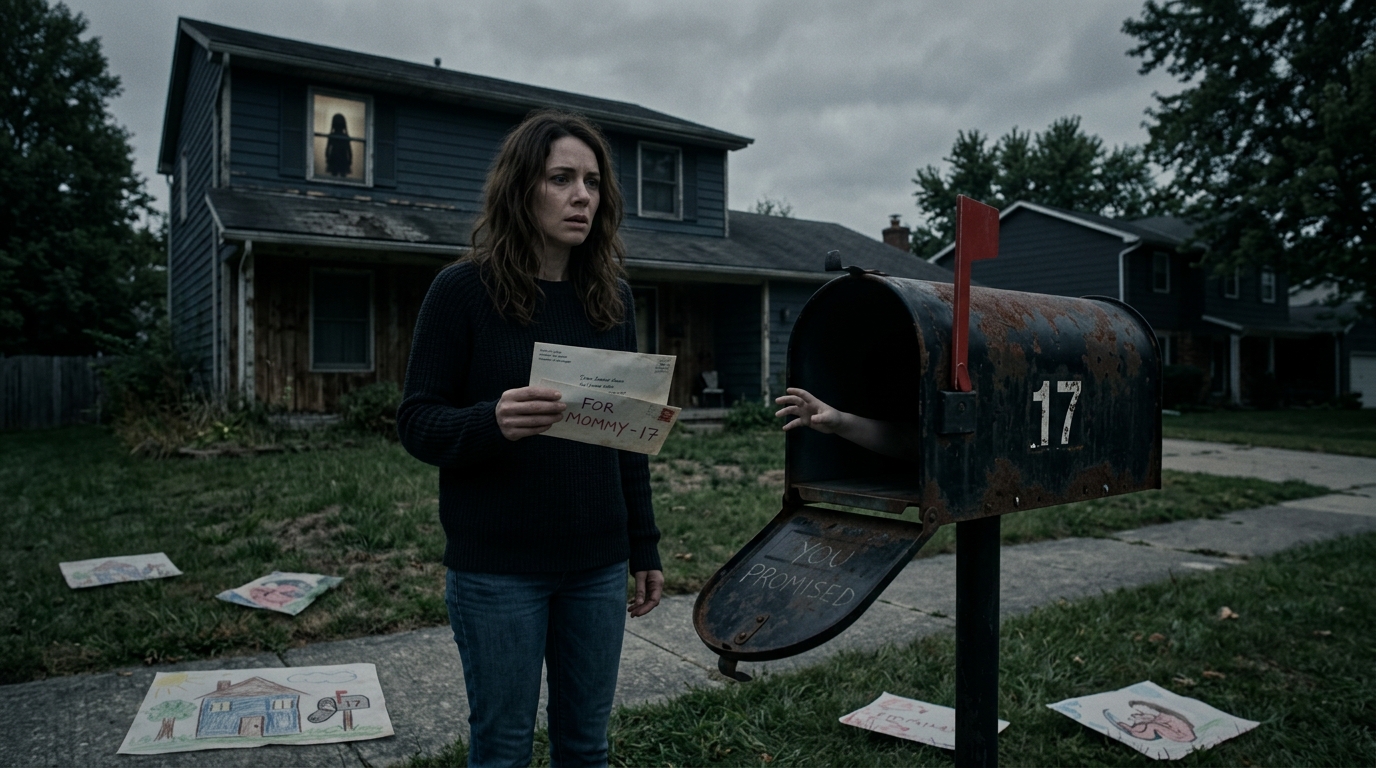
A child’s drawing faced upward.
A house.
My house.
A woman in the window.
Me.
A mailbox with the number 17.
And inside the mailbox, drawn in red crayon, was a little girl curled in the dark.
Under the drawing were five words.
You promised to be my mother.
My knees weakened.
The front door unlocked.
The deadbolt turned.
The chain slid free.
Outside, the red flag on Mailbox 17 lifted by itself.
And from inside the box, a little girl began crying.