
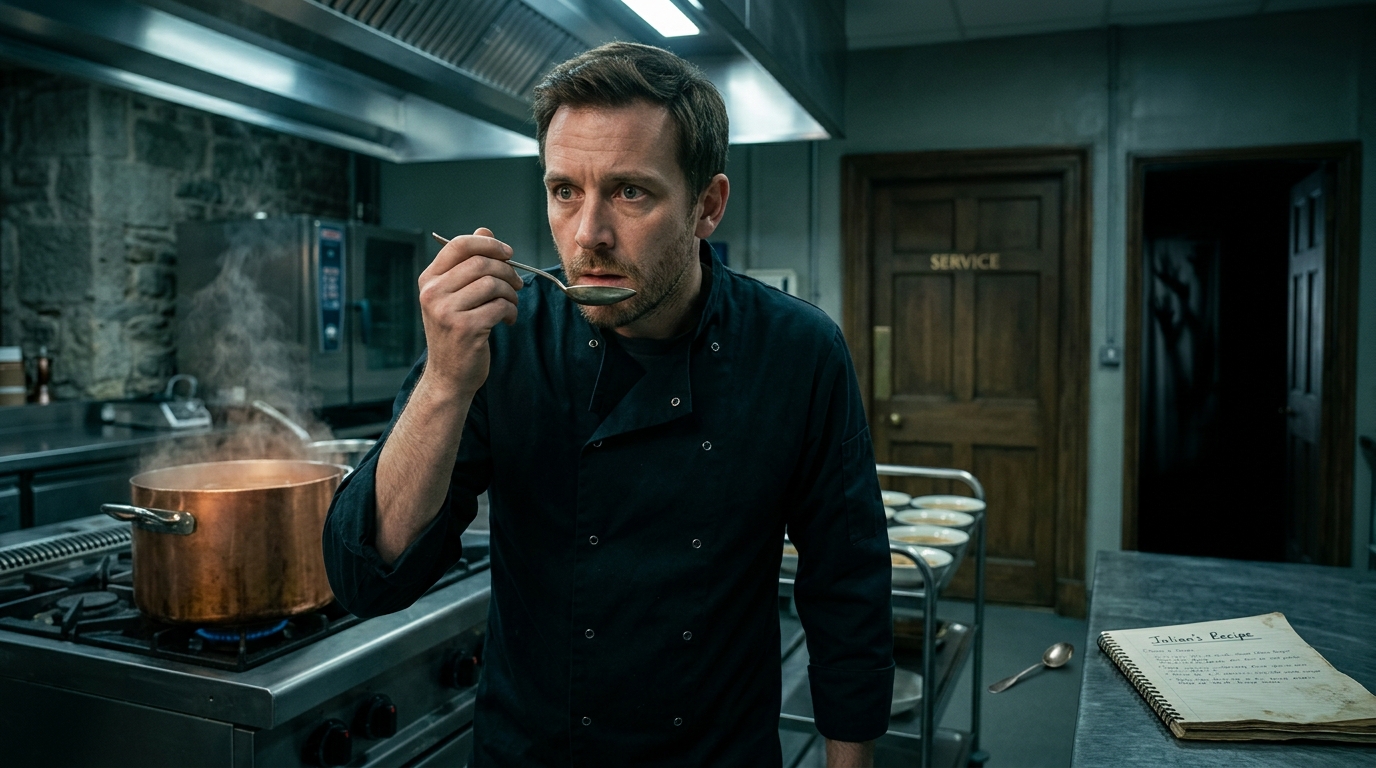
The Rule In The Contract
Chefs taste everything.
That is not arrogance.
That is survival.
A sauce can break in the last thirty seconds.
Salt can hide in butter.
Garlic can turn bitter.
A soup can look perfect and still be dead on the tongue.
So when I read the contract, I thought it was a joke.
Private chef.
Seven nights.
Family estate.
Full confidentiality.
No phone during service.
No questions about guests.
Payment: more money than I had made in six months.
Then the final clause.
The chef must not taste any prepared food under any circumstance.
I read it twice.
Then a third time.
No tasting.
Not before cooking.
Not during plating.
Not before service.
If I violated the rule, the contract ended immediately.
Payment forfeited.
Legal penalties applied.
I almost laughed.
Almost.
My name is Adrian Vale, and I had cooked for governors, actors, men who owned private islands, women who collected husbands the way other people collected art.
Rich people always had strange requests.
No onions.
No red food.
No knives visible at the table.
No staff with brown eyes.
One tech billionaire once asked me to serve every course clockwise because his fortune teller said counterclockwise food invited betrayal.
But this was different.
Never taste the food.
That was not preference.
That was fear.
I should have refused.
But the restaurant I built with my brother had burned down six months earlier.
Insurance delayed payment.
Debts piled up.
My name still carried prestige, but prestige does not pay suppliers when the bank account is empty.
So I signed.
The family name on the contract was Ashbourne.
Old money.
Private banking.
Hospitals.
Real estate.
A family people whispered about without ever saying anything clear.
Their estate sat three hours north of the city, behind black iron gates and a forest thick enough to hide entire lives.
When I arrived, rain was falling.
Of course it was.
In stories like mine, it always rains before the house begins keeping secrets.
Ashbourne House
Ashbourne House was too large to be called a home.
Homes invite people in.
This place watched them arrive.
Gray stone walls.
Tall windows.
Ivy crawling up one side like veins.
A fountain in the courtyard that had no water, only dead leaves gathered in the basin.
The front doors opened before I knocked.
A woman in a black dress stood inside.
Sixty, maybe older.
Straight posture.
White hair pulled tightly back.
No jewelry except a small silver key hanging at her throat.
“Chef Vale,” she said.
“Yes.”
“I am Mrs. Harrow. I manage the household.”
Her voice was soft.
Not warm.
Soft in the way a locked room is quiet.
She led me through the entrance hall without asking about my drive.
Portraits lined the walls.
Generations of Ashbournes staring down in oil paint, all pale skin, sharp bones, and eyes that looked less painted than preserved.
The kitchen was enormous.
Professional range.
Copper pans.
Marble counters.
Walk-in refrigerator.
A room built for abundance.
And yet it felt unused.
Too clean.
Too silent.
No smell of onions.
No old smoke.
No warmth.
A kitchen without memory.
Mrs. Harrow placed a folder on the counter.
“Menus are inside. Ingredients are prepared daily. You will cook exactly as written.”
I opened the folder.
Seven menus.
Each handwritten.
Each course detailed with almost obsessive precision.
Lamb broth with winter herbs.
Black rice with saffron cream.
Roasted pheasant with plum reduction.
Pear tart with clove custard.
Expensive.
Elegant.
Not impossible.
Then I noticed something strange.
No portions listed.
No guest count.
“Who am I cooking for?” I asked.
“The family.”
“How many?”
“That changes.”
“How many tonight?”
She looked at me.
“That changes too.”
I waited for her to explain.
She did not.
Instead, she pointed toward a steel service trolley near the back door.
“When each course is finished, place it there. Ring the bell once. Step away.”
“Who serves it?”
Mrs. Harrow touched the silver key at her throat.
“The room receives it.”
I looked at her.
“The room?”
She did not blink.
“The dining room is locked during service.”
“Locked?”
“Yes.”
“With the family inside?”
Her expression did not change.
“No one goes inside.”
I laughed once.
Because I thought I had misunderstood.
Mrs. Harrow did not laugh.
“Not even Lord Ashbourne enters during dinner.”
Something cold moved slowly through my chest.
“Then who eats the food?”
Mrs. Harrow closed the folder.
“Chef Vale, your contract was very generous because your work requires discipline, not curiosity.”
Then she walked toward the kitchen door.
Before leaving, she turned back.
“One final reminder.”
I already knew what she was going to say.
Still, my stomach tightened before she said it.
“Do not taste anything.”
The Locked Room
The first dinner was perfect.
Technically.
I followed the menu exactly.
Lamb bones roasted dark but not burned.
Stock simmered slowly with bay, thyme, peppercorn, and a strange dried root I did not recognize from the ingredient tray.
The smell was extraordinary.
Too extraordinary.
Rich.
Deep.
Almost familiar.
It sat at the back of my throat like a word I had forgotten.
I lifted a spoon out of habit.
Then stopped.
Do not taste anything.
I stared at the broth.
Every instinct in my body hated that rule.
A chef who cannot taste is a surgeon forced to operate blind.
But the money.
The debt.
The contract.
I poured the soup into six porcelain bowls.
Six.
That was the number of bowls Mrs. Harrow had set out.
Yet when I placed them on the trolley, I saw something else.
Seven spoons.
I counted again.
Six bowls.
Seven spoons.
Before I could ask, the kitchen bell rang.
Not from my side.
From somewhere beyond the back door.
One soft chime.
Mrs. Harrow appeared immediately.
“Step back, please.”
I did.
She unlocked the rear kitchen door with the silver key and pushed the trolley into a narrow corridor.
I followed only far enough to see the hallway.
At the end stood a black door.
No handle on the outside.
Only a small service hatch at waist height.
Mrs. Harrow stopped halfway, turned, and looked at me.
I stepped back.
She continued.
The trolley reached the black door.
The hatch opened by itself.
Not from her hand.
From inside.
Darkness waited beyond it.
Mrs. Harrow slid the bowls through one by one.
Six bowls.
Seven spoons.
When the last spoon disappeared, the hatch shut.
A lock turned.
Then silence.
I stood in the kitchen, unable to breathe properly.
No voices.
No chairs.
No clinking silverware.
Nothing that suggested anyone was eating beyond that door.
Twenty minutes later, the hatch opened again.
The trolley rolled back by itself.
Empty bowls.
All six.
Every drop of soup gone.
Seven spoons returned.
One of them bent almost in half.
The Family Dinner
The second course was worse.
Not because of the cooking.
Because of the sound.
I was reducing plum sauce when something came through the wall.
Faint.
Almost below hearing.
A child laughing.
I froze.
The kitchen had no windows facing the dining wing.
No staff corridor nearby.
The black room was at least thirty feet away.
Still, I heard it.
A child.
Laughing softly.
Then crying.
Then silence.
The sauce began to burn.
I swore, pulled the pan from heat, and saved it barely in time.
My hands were shaking.
Mrs. Harrow entered behind me.
“You heard something.”
Not a question.
I turned.
“There’s a child in that room.”
She looked at the sauce.
“You nearly ruined the reduction.”
“There’s a child.”
“Finish the course.”
I stared at her.
“Who is in that room?”
She stepped closer.
For the first time, I saw something behind her controlled face.
Fear.
Old fear.
The kind polished smooth by years of obedience.
“Chef Vale,” she said quietly, “some families inherit land. Some inherit money. This family inherited an appetite.”
My skin went cold.
“What does that mean?”
Her expression closed immediately.
“Finish the course.”
I should have walked out then.
Taken my knives.
Taken the advance payment.
Left the estate and let rich people feed their locked rooms without me.
But I thought of the burned restaurant.
My brother’s medical bills after the fire.
The suppliers calling every morning.
And the contract.
Always the contract.
So I cooked.
Course after course.
Each one placed on the trolley.
Each one taken to the black door.
Each one returned completely empty.
No one thanked me.
No one complained.
No one appeared.
At midnight, Mrs. Harrow handed me an envelope with the first payment installment.
Cash.
More than promised.
“Lord Ashbourne is pleased.”
“With what?”
“The meal.”
“He ate it?”
Her eyes shifted briefly toward the corridor.
“No.”
“Then who did?”
She placed the envelope on the counter.
“Sleep well, Chef.”
That night, I did not sleep.
I lay awake in the guest room above the kitchen while the house creaked beneath the rain.
At 2:13 a.m., I heard silverware scrape under the floor.
The Spoonful
By the third night, hunger for truth became worse than fear.
The menu began with soup again.
Different recipe.
Bone broth.
Mushrooms.
Cream.
White pepper.
And the same strange dried root from the first night.
I found it inside a sealed glass jar with no label.
Dark brown.
Twisted.
Almost like dried ginger, but sweeter.
Earthier.
Familiar in a way that made my stomach tighten.
I opened the jar and smelled it.
My body reacted before my mind did.
A memory flashed.
A hospital hallway.
My mother crying.
My brother coughing smoke into a mask.
The burned restaurant.
A man in a black coat standing outside the fire line.
Smiling.
Then it vanished.
I stepped back from the counter.
No.
Impossible.
Smell does strange things.
Trauma makes strangers out of ordinary ingredients.
I kept cooking.
The soup came together beautifully.
Too beautifully.
Cream folded into the broth like silk.
Mushroom and root deepened into something rich, sweet, and haunting.
I knew that flavor without tasting it.
That was what scared me.
I ladled six bowls.
Placed them on the trolley.
Then stopped.
The seventh spoon lay beside the bowls.
Clean.
Waiting.
I stared at it.
The kitchen was empty.
Mrs. Harrow had not arrived yet.
The black corridor door remained closed.
Rain tapped against the window above the sink.
I looked at the soup.
Then at the spoon.
Do not taste anything.
The rule pressed against my skull.
I picked up the spoon anyway.
Just one taste.
A chef has to know.
I dipped the spoon into the nearest bowl.
Lifted it to my mouth.
The soup touched my tongue.
And the world vanished.
The Taste I Recognized
The spoon fell from my hand and struck the marble floor.
The sound exploded through the kitchen.
I grabbed the counter to keep myself upright.
The soup tasted like my brother’s recipe.
Not similar.
Not inspired.
Exactly.
Roasted bone.
Black mushroom.
Cream.
White pepper.
And underneath it all, that strange sweet-earth root.
My brother Julian’s final dish.
The dish he cooked the night our restaurant burned.
The dish no one else knew how to make because he never wrote it down.
Julian had created it for a private dinner.
One client.
Anonymous.
Cash payment.
No questions.
He told me it would save the restaurant.
He told me rich people paid for secrets, not food.
Then the fire happened.
The kitchen exploded before service ended.
Julian survived, but barely.
Burned lungs.
Damaged hands.
Memory gaps.
He never cooked again.
For six months, I believed the fire destroyed the only recipe he never got to finish.
Now I stood inside Ashbourne House, tasting it from a bowl I was forbidden to touch.
My mouth went numb.
Not from heat.
From recognition.
I leaned over the sink and spat.
Too late.
The flavor stayed.
More than flavor.
Memory.
A locked basement.
My brother’s voice whispering:
Don’t let them eat after midnight.
Then the kitchen bell rang.
One chime.
Mrs. Harrow entered.
She saw the spoon on the floor.
Then saw my face.
For the first time, her composure broke completely.
“You tasted it.”
I wiped my mouth with the back of my hand.
“What is in this soup?”
She took one step back.
“Chef Vale…”
“What is in it?”
The black corridor door opened by itself.
Slowly.
From beyond it came the sound of someone breathing.
Wet.
Hungry.
Close.
Mrs. Harrow whispered:
“Now it knows you remember.”
The service hatch at the end of the corridor slammed open.
Every light in the kitchen flickered.
And from the locked dining room, a voice spoke in my brother’s voice.
“Adrian?”
My blood turned to ice.
Julian was in the hospital three hours away.
He could barely speak above a whisper.
But the voice behind the black door called my name again.
“Adrian… don’t feed them.”
Then one of the six soup bowls on the trolley began to boil by itself.