
The Dress In The Back Room
Antique shops always smell like other people’s lives.
Dust.
Old perfume.
Polished wood.
Yellowed paper.
Clothes that once touched skin, held warmth, absorbed secrets, then waited quietly for someone new to carry them home.
I never liked them.
My mother loved them.
She said old things had souls.
I said old things had stains.
Still, on the afternoon I found the red dress, I walked into Marlowe Antiques because rain was coming down so hard the street looked silver, and the nearest bus stop had no roof.
I only meant to wait there for ten minutes.
That was what I told myself later.
The shop sat between a closed bakery and a watch repair store with no watches in the window. Its sign hung crooked above the door, the gold letters faded almost completely.
MARLOWE ANTIQUES.
Inside, a bell rang softly.
Not cheerful.
Warning.
The shop was narrow and dim, crowded with velvet chairs, cracked mirrors, porcelain dolls, old lamps, and framed portraits of families who looked angry about being remembered.
Behind the counter stood an elderly woman with white hair pinned tightly at the back of her head.
She looked up when I entered.
Then froze.
Not politely.
Not with surprise.
With fear.
For one second, she looked like she recognized me.
Then her expression closed.
“We close in twenty minutes,” she said.
“I’m just waiting out the rain.”
She looked toward the window.
Then back at me.
“You shouldn’t stay long.”
I almost laughed.
People in old shops loved being dramatic.
I wandered between shelves, pretending to care about silver spoons and cracked music boxes while rain battered the windows.
Then I saw the red fabric.
Only a glimpse.
At the back of the shop, behind a half-open storage door.
Dark red.
Not bright.
Not cheerful.
Deep red.
The color of wine spilled on a white tablecloth.
The color of lipstick on a goodbye note.
The color of blood after it dries.
I stepped closer.
The old woman behind the counter said sharply:
“That room is private.”
I stopped.
“Sorry.”
But I had already seen enough.
A dress hung inside the storage room.
Long.
Elegant.
Red silk.
Sleeves narrow at the wrist.
Waist impossibly small.
The kind of dress no one buys casually.
The kind of dress that waits for a body.
I should have turned away.
Instead, I asked:
“How much for the red dress?”
The shop went silent.
Not quiet.
Silent.
Even the rain seemed to fade.
From somewhere behind the shelves, a younger employee stepped out carrying a box of old books.
He looked at me.
Then at the storage room.
The box slipped from his hands.
Books scattered across the floor.
The old woman whispered:
“It isn’t for sale.”
The Dress No One Wanted
People say something isn’t for sale in two ways.
Sometimes it means expensive.
Sometimes it means cursed.
The way the old woman said it made my skin tighten.
I looked at the dress again.
“It’s beautiful.”
“No.”
Her voice cut through the room.
Not loud.
Final.
“It is not beautiful.”
The young employee bent down quickly to gather the books, but his hands shook.
I looked between them.
“What’s wrong with it?”
“Nothing for you to know.”
That should have ended the conversation.
But I was twenty-eight, recently divorced, newly unemployed, and exhausted from being told what was not meant for me.
So I smiled.
Badly.
“If it’s not for sale, why keep it?”
The old woman’s eyes sharpened.
“Because some things are worse when thrown away.”
The younger employee whispered, “Mrs. Marlowe…”
She silenced him with one look.
I should have left then.
The rain had softened.
The bus stop was visible through the window.
The world outside was wet and gray and normal.
But the red dress seemed to glow inside the storage room.
Not with light.
With attention.
As if it had noticed me noticing it.
I stepped closer again.
Mrs. Marlowe moved from behind the counter faster than I expected for a woman her age.
“Miss.”
“My name is Clara.”
Her face changed.
Only slightly.
Enough.
The young employee stopped gathering books.
I stared at them.
“What?”
Mrs. Marlowe’s hand tightened around the counter edge.
“Nothing.”
“You reacted.”
“No.”
“You did.”
She looked toward the storage room.
Then back at me.
“What is your full name?”
I almost refused.
Then something in her fear made me answer.
“Clara Vale.”
The young employee crossed himself.
Actually crossed himself.
Like people do in old movies before entering graves.
Mrs. Marlowe went pale.
“Leave.”
The word landed cold between us.
“Excuse me?”
“Leave my shop.”
I stood there, stunned.
“Because of my name?”
“Because you came too late.”
My throat tightened.
Too late for what?
The storage room door moved behind her.
Just slightly.
No wind.
No one inside.
The red dress swayed once on its hanger.
Mrs. Marlowe turned sharply.
Her face was no longer only afraid.
It was defeated.
The dress wanted to be seen.
And everyone in that shop knew it.
The Woman Who Owned It Before
I don’t know why I said the next sentence.
Maybe pride.
Maybe the dress.
Maybe because somewhere beneath my ribs, a locked part of me had already started responding to a memory I did not own.
“I want to try it on.”
The young employee dropped the same book again.
Mrs. Marlowe whispered:
“No.”
“I’m not buying it. Just trying.”
“No one tries that dress.”
“Why?”
“Because the last woman who wore it never came back.”
I laughed once.
Then stopped when neither of them smiled.
“What does that mean?”
Mrs. Marlowe closed her eyes briefly.
The kind of closing people do when they are deciding whether truth is safer than silence.
“The dress belonged to Evelyn Ashford.”
The name sounded familiar.
Not famous.
Not exactly.
The kind of name you hear once in a documentary you half-watch while folding laundry.
“She was a singer,” the young employee said quietly.
Mrs. Marlowe glared at him.
But he kept going.
“A long time ago. Beautiful. Rich husband. Big house near the river.”
I looked at the dress.
“What happened to her?”
He swallowed.
“She disappeared on the night she wore it.”
Mrs. Marlowe snapped, “Enough.”
“No,” I said. “Tell me.”
The young man lowered his voice.
“She came here before a charity gala. Bought the dress from Mrs. Marlowe’s mother. Everyone said it looked made for her.”
He looked at me then.
Too carefully.
“Exactly made.”
Mrs. Marlowe said, “She left the gala before midnight. Her husband said she was tired. But security footage showed her walking out alone.”
“And?”
“And three days later, they found the dress.”
My skin went cold.
“Where?”
Mrs. Marlowe answered this time.
“In a locked room inside her house.”
I looked at the red silk.
“If she disappeared, how did the dress come back here?”
Neither answered.
That was answer enough.
I stepped toward the storage room.
Mrs. Marlowe grabbed my arm.
Her fingers were cold.
“Listen to me, Clara Vale. That dress does not fit women. It chooses what it wants to remember.”
I pulled away slowly.
“You sound insane.”
“Yes,” she whispered. “That is what everyone says before they put it on.”
The Fitting Room
The fitting room was at the back of the shop beside the storage area.
It had a velvet curtain, a tarnished mirror, and one yellow bulb that flickered every few seconds.
Mrs. Marlowe did not bring me the dress.
I took it myself.
That detail matters.
Because later, when she cried, she kept saying:
I didn’t give it to her.
I didn’t give it to her.
As if that made a difference.
The red dress was heavier than it looked.
The silk felt cold at first, then warm too quickly, like skin remembering body heat.
I carried it into the fitting room.
Behind me, the old woman whispered something under her breath.
A prayer.
Or an apology.
The curtain closed.
For a moment, I stood alone with the dress hanging from my hands.
The mirror reflected me clearly.
Wet hair.
Tired eyes.
Cheap black sweater.
Jeans damp at the hem.
A woman who had spent months feeling invisible.
Then the dress entered the reflection.
And I swear my reflection smiled before I did.
I blinked.
Normal again.
I undressed slowly.
My fingers trembled for reasons I refused to name.
The dress slid over my head like water.
No struggle.
No stuck zipper.
No tight shoulders.
No awkward waist.
It fit.
Perfectly.
Not well.
Perfectly.
The sleeves ended exactly at my wrists.
The neckline sat precisely against my collarbone.
The waist closed without pressure.
The hem brushed the floor at the exact right length.
The dress did not feel tailored.
It felt remembered.
Outside the curtain, the shop had gone completely silent.
I looked at myself in the mirror.
And for one breathtaking second, I did not see myself.
I saw another woman.
Dark hair styled in old Hollywood waves.
Red lips.
Diamond earrings.
Eyes full of terror behind a practiced smile.
Then she vanished.
My reflection returned.
But my face looked wrong.
Older.
Sharper.
Beautiful in a way that frightened me.
I touched the mirror.
The glass was freezing.
Behind me, someone whispered:
“Don’t let him see you wearing it.”
I spun around.
The fitting room was empty.
The Employees Turned Pale
I opened the curtain.
Mrs. Marlowe was crying.
The young employee stood beside the counter, both hands over his mouth.
Neither moved.
Neither spoke.
Their faces told me what the mirror had not.
This was not just a dress that fit.
This was a resurrection.
Mrs. Marlowe whispered one name.
“Evelyn.”
I looked down at myself.
The red silk clung to my body like it had been made from my measurements.
“I’m Clara.”
Mrs. Marlowe shook her head slowly.
“No.”
The word hurt more than it should have.
The young employee stepped backward until his shoulders hit the shelf behind him.
A porcelain doll fell and shattered on the floor.
He did not look down.
His eyes stayed on me.
“Same height,” he whispered.
Mrs. Marlowe said, “Stop.”
“Same face shape.”
“Stop.”
“Same scar.”
My hand flew to my collarbone.
There was a small scar there.
A thin pale line near the left side of my chest.
Appendix surgery when I was twelve, my mother always said.
Except appendix scars are not on the collarbone.
I had never questioned it.
Not once.
The dress neckline exposed the scar perfectly.
Mrs. Marlowe looked like she might faint.
“Take it off.”
I stepped toward the mirror near the front of the shop.
Every antique mirror reflected me differently.
In one, I was Clara.
In another, Evelyn.
In another, something between us.
Then the shop lights flickered.
All the mirrors went dark at once.
The old wall clock stopped ticking.
From inside the storage room, music began playing.
Soft.
Crackling.
A woman singing.
Mrs. Marlowe covered her mouth.
I recognized the song.
Not from radio.
Not from memory.
From a dream I had every year on my birthday.
A woman in a red dress singing on a staircase.
A man watching from below.
A glass breaking.
A scream cut short.
My knees weakened.
“What is that song?”
Mrs. Marlowe whispered:
“It was the last song Evelyn sang before she vanished.”
The music grew louder.
The red dress tightened around my ribs.
Not painfully.
Possessively.
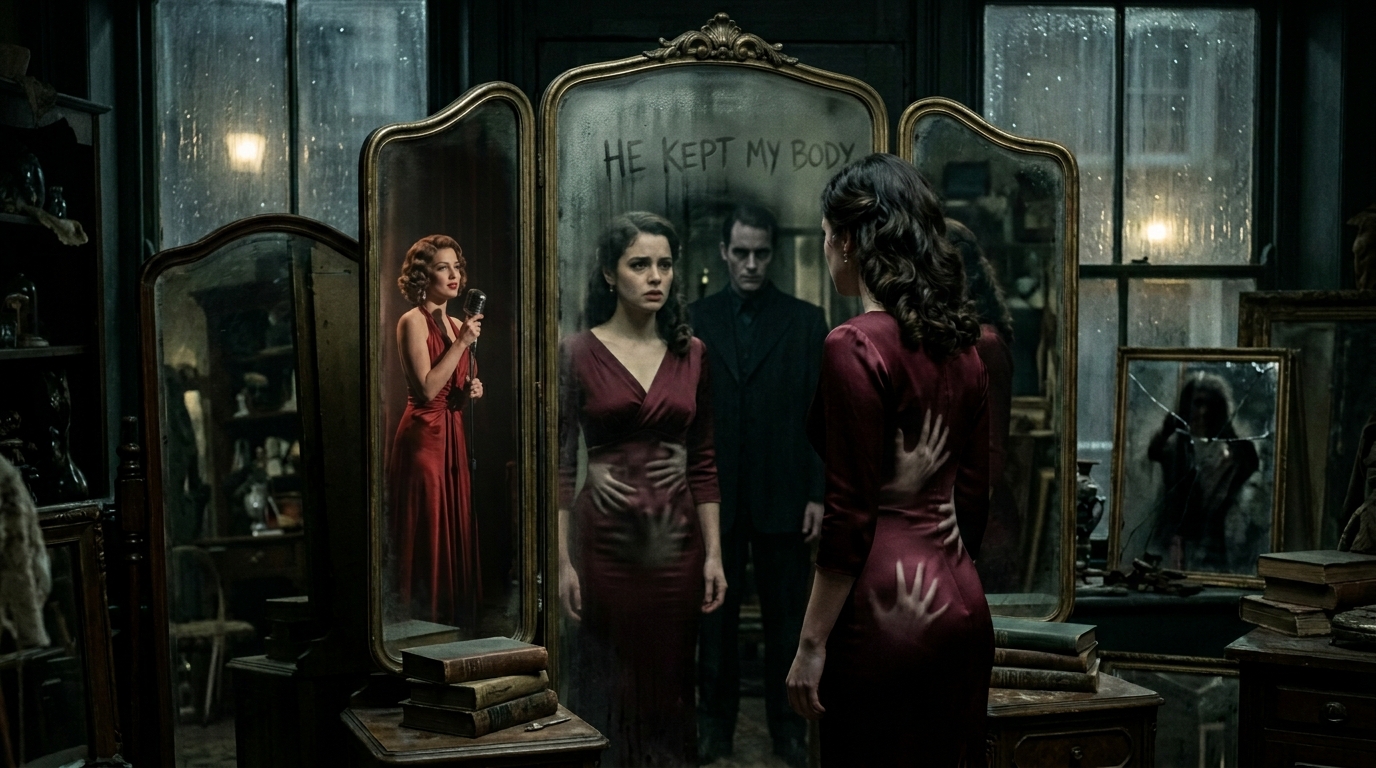
Then the mirror in front of me fogged from the inside.
Letters appeared across the glass.
Drawn by an invisible finger.
HE KEPT MY BODY.
The young employee screamed.
Mrs. Marlowe grabbed my wrist.
“Take it off now.”
But the zipper on the back of the dress was gone.
The Name Sewn Inside
We tried to remove it.
Mrs. Marlowe pulled at the back.
The young employee searched for seams.
I clawed at the sleeves until my skin burned.
Nothing worked.
The dress had no zipper now.
No buttons.
No opening.
The fabric had closed around me like a second skin.
My breathing turned shallow.
“Cut it,” I said.
Mrs. Marlowe shook her head.
“Cut it!”
The young employee grabbed scissors from behind the counter.
The blades snapped the moment they touched the silk.
One half flew across the room and struck a mirror.
The mirror cracked in a long red line.
Not silver.
Red.
Blood seeped from the crack.
I backed away, shaking.
The dress warmed against my skin.
Mrs. Marlowe whispered:
“It’s starting.”
“What is?”
She did not answer.
Instead, she knelt beside the hem and turned the inner lining outward.
Her hands shook as she searched the seam.
“There was a label,” she muttered. “There was always a label.”
She found it near my left hip.
A small white tag sewn into the lining.
The thread looked new.
Too new.
Mrs. Marlowe pulled it flat.
Her face drained of color.
I looked down.
The label did not say Evelyn Ashford.
It did not list a designer.
It did not show a size.
It showed my name.
CLARA VALE.
Beneath it was a date.
Tomorrow.
My mouth went dry.
“What does that mean?”
The music stopped.
All the mirrors turned clear again.
In every reflection, I stood in the red dress.
But behind me stood a man.
Tall.
Gray hair.
Black suit.
One hand resting on my shoulder.
I spun around.
No one there.
In the mirrors, he remained.
Mrs. Marlowe saw him too.
Her voice broke.
“Lord Ashford.”
Evelyn’s husband.
The man who reported her missing.
The man who said she left him.
The man who had died ten years ago.
In the mirror, he leaned close to my reflection and smiled.
Then he whispered, though his mouth did not move:
“She fits better than the last one.”
The front door slammed shut by itself.
The lock turned.
The shop lights went red.
And from beneath the dress, against my skin, a woman’s hand pressed outward from inside the fabric.