The Contract After My Last Show
The last time I performed comedy for free, nobody laughed.
Not one person.
Not the drunk couple in the front row.
Not the bartender polishing glasses behind the counter.
Not even the man who laughed at everything because he thought it made him look charming.
I stood under a blue stage light in a basement club that smelled like beer, sweat, and failure, holding a microphone that had been touched by too many desperate people before me.
My name is Julian Reed.
For twelve years, I told people I was a comedian.
For eleven of those years, I believed it.
By the twelfth, it had become less of a profession and more of a lie I repeated because I didn’t know who I was without it.
That night, halfway through my set, I forgot the punchline to a joke I had written myself.
The audience stared.
Someone coughed.
A glass clinked.
The silence did not feel empty.
It felt full.
Full of pity.
Full of judgment.
Full of every version of myself that had once believed I could make strangers happy by being wounded in public.
After the show, the club owner paid me forty dollars and a free beer.
I took the money.
I left the beer.
Outside, rain fell through the alley in silver lines. My phone had three missed calls from my landlord and one message from my agent.
We need to talk about expectations.
That meant he was dropping me.
I stood under the club’s back awning, cold, broke, and too tired to be ashamed.
That was when the man in the gray coat appeared.
I did not hear him walk up.
One moment the alley was empty.
The next, he stood beside the dumpster holding a black umbrella.
He was tall.
Older.
Clean-shaven.
Smiling in a way that did not reach any part of his face that mattered.
“Mr. Reed,” he said.
I looked around.
If this was a mugging, he had chosen a disappointing target.
“Do I know you?”
“No.”
“Then why do you know me?”
He tilted his head slightly.
“Because no one else does anymore.”
That should have made me leave.
Instead, I laughed.
A short, bitter sound.
The kind of laugh that comes out when nothing is funny but dignity needs somewhere to go.
The man reached into his coat and handed me a business card.
No logo.
No company name.
Only three words embossed in black.
THE LAUGHTER EXCHANGE.
Beneath it was a phone number.
I looked up.
“What is this?”
“A contract opportunity.”
“I don’t do corporate parties anymore.”
“This is not a party.”
“Good. Because I’m not funny.”
For the first time, his smile widened.
“That is not a problem.”
One Thousand Dollars Per Laugh
I met him the next morning because hunger makes strange invitations sound reasonable.
The address on the card led to the twenty-second floor of a building I had passed a hundred times without noticing.
No sign outside.
No receptionist.
No directory listing.
Only an elevator that accepted the business card like a key.
The doors opened into a room with white walls, black chairs, and a desk so empty it looked staged.
The man in the gray coat waited behind it.
He introduced himself as Mr. Vale.
No first name.
Of course.
People who make impossible offers never have first names.
He slid a contract across the desk.
I expected legal language.
Performance rights.
Content ownership.
Maybe some humiliating clause about viral reaction videos.
Instead, the document had one sentence at the top.
The participant will be compensated $1,000 for every verified instance of genuine laughter.
I read it twice.
Then looked at him.
“This is a joke.”
“No.”
“I laugh, you pay me?”
“Yes.”
“How do you verify laughter?”
“Biometric response.”
“That sounds illegal.”
“It is not.”
“That sounds like something illegal people say.”
Mr. Vale folded his hands.
“You may decline.”
I should have.
I know that now.
But my rent was overdue.
My agent was gone.
My career was dying quietly in rooms where strangers checked their phones during my best jokes.
And someone was offering me a thousand dollars for the only thing left in my life that still happened by accident.
I turned the page.
There were restrictions.
Laughter must be spontaneous or internally triggered.
Forced laughter may be rejected.
Laughter produced under sedation does not qualify.
Participant may not transfer contract benefits.
Participant agrees that laughter, once compensated, becomes property of the Exchange.
I stopped.
“Becomes property?”
Mr. Vale nodded.
“What does that mean?”
“It means we pay for what you produce.”
“Like buying a song?”
“Something like that.”
“Can I still laugh after you buy it?”
His smile returned.
“At first.”
I looked at him.
“What does that mean?”
“It means most clients lose interest before that becomes relevant.”
I laughed again.
Not because he was funny.
Because the room was absurd.
Because the contract was absurd.
Because some polished stranger had looked at my ruined life and decided the only valuable part left was the sound I made when I didn’t know what else to do.
My phone buzzed.
Bank notification.
Deposit received: $1,000.
I froze.
The laugh had lasted less than two seconds.
I looked at Mr. Vale.
He looked back calmly.
“Verified,” he said.
The First Month
At first, it felt like winning.
That is how traps work.
They arrive dressed as rescue.
I left The Laughter Exchange with ten thousand dollars before noon.
Mr. Vale made me watch old comedy clips in the private room.
Some worked.
Some didn’t.
Every genuine laugh triggered another payment.
One thousand.
One thousand.
One thousand.
The deposits appeared instantly.
No delay.
No pending status.
No tax forms.
Just money.
Real money.
That night, I paid rent.
The next morning, I paid every overdue bill.
By the end of the week, I had bought groceries without checking prices.
By the end of the month, I was laughing at everything.
Bad movies.
Old sketches.
Children falling gently in harmless home videos.
My own jokes.
Other people’s jokes.
Memes.
Stories.
Memories.
Once, I made eight thousand dollars laughing alone in my kitchen over a video of a dog stealing bread from a table.
I told myself I deserved it.
After years of rooms refusing to laugh with me, the universe was finally paying me to laugh alone.
My friends noticed the money.
They thought I had sold a script.
I let them think that.
My agent called again.
Suddenly, expectations had changed.
So had his tone.
I ignored him.
For the first time in years, I slept without calculating bills in the dark.
Then the first strange thing happened.
I was watching an old clip of my father.
Not a performance.
A home video.
He had died when I was nineteen.
In the video, he danced terribly in our kitchen while my mother begged him to stop.
I laughed.
Hard.
The kind of laugh that hurts your ribs and fills the room with the person you lost.
My phone buzzed.
Deposit received: $1,000.
Then the video changed.
Not on the screen.
In my memory.
My father’s dance was still there.
My mother’s voice was still there.
But the warmth was gone.
I remembered it like a fact instead of a feeling.
My laughter had taken something with it.
Or someone had.
The Price Hidden In The Sound
The second month, I stopped performing.
Why stand onstage begging strangers to laugh when my own laughter paid better?
The third month, I moved into a better apartment.
The fourth, I bought suits.
Not because I needed them.
Because rich people wear proof before anyone asks for it.
By then, I had made over three hundred thousand dollars.
Three hundred laughs.
Some short.
Some ugly.
Some uncontrollable.
Each one purchased.
Each one logged.
I received monthly statements from The Laughter Exchange.
Date.
Time.
Duration.
Intensity.
Payment.
Classification.
The classifications disturbed me.
Amusement.
Relief.
Social compliance.
Nervous response.
Memory-triggered joy.
Grief-adjacent laughter.
Fear displacement.
That was the first one that truly frightened me.
Fear displacement.
It appeared after I laughed during a nightmare.
I woke at 3:17 a.m. choking on laughter.
Not screaming.
Laughing.
My phone buzzed beside the bed.
Deposit received: $1,000.
The statement arrived a minute later.
Classification: Fear displacement.
Source: Unknown.
I called Mr. Vale the next morning.
He answered on the first ring.
“You said you only pay for genuine laughter.”
“Yes.”
“I was asleep.”
“Yes.”
“How do you verify laughter while I’m asleep?”
Silence.
Then:
“The body does not require permission to be honest.”
I hung up.
That should have been the end.
Instead, I kept laughing.
Money makes red flags look decorative.
By month five, I noticed people around me laughing less.
My neighbor’s little girl used to giggle in the hallway every morning while racing to the elevator.
Then one week, she stopped.
A friend who laughed too loudly at every dinner suddenly sat quiet through an entire comedy film.
My mother called and said she couldn’t remember the last time something felt funny.
I told myself it was coincidence.
The world was tired.
People were tired.
Not everything was about me.
Then I found the second statement.
Not in my email.
Printed on my kitchen table.
One page.
No envelope.
At the bottom, beneath my laughter payments, was a line I had never seen before.
Donor source: redistributed.
My hands went cold.
Donor source.
I called Mr. Vale again.
This time, he did not answer.
When The Laughter Started Leaving
The first laugh I lost was small.
A bartender dropped a glass.
Not dangerous.
Not dramatic.
It shattered behind him, and he froze with such perfect comic horror that everyone in the room burst out laughing.
Everyone except me.
I felt the laugh rise.
I felt the shape of it inside my chest.
The little pressure behind the ribs.
The spark in the throat.
The warmth.
Then nothing.
It vanished.
Like someone had cut the wire.
I smiled instead.
A fake smile.
The kind people give at funerals when someone says the dead would have wanted us happy.
My phone did not buzz.
No payment.
No statement.
I went home unsettled.
The next day, I tried making myself laugh.
Comedy specials.
Old sitcoms.
Stand-up legends.
Clips that had once ruined me.
Nothing.
I understood the jokes.
I saw the rhythm.
I recognized the craft.
Setup.
Misdirection.
Punchline.
Technically funny.
Emotionally dead.
It was like looking at food after losing taste.
By the end of the week, I was desperate.
Not for money.
I already had more than I needed.
For the sound.
For the feeling.
For proof that something inside me had not been sold piece by piece.
I played my father’s video again.
The kitchen.
The dance.
My mother laughing behind the camera.
My father spinning too fast and nearly falling.
Nothing.
No warmth.
No ache.
No laugh.
Only memory as information.
That was when I checked my account.
The money was still there.
Every dollar.
But beside each deposit, the description had changed.
Not payment.
Not compensation.
Acquisition.
Laughter acquisition.
Three hundred and forty-two entries.
Three hundred and forty-two pieces of myself bought cleanly through a contract I had signed because I thought pain was worse than emptiness.
I was wrong.
Emptiness has teeth.
The Final Clause
I returned to the building on the twenty-second floor.
The elevator accepted the card again.
The white room waited.
Mr. Vale sat behind the empty desk like he had never moved.
“You lasted longer than most,” he said.
I slammed the contract onto his desk.
“What did you take from me?”
He looked at the papers.
“Only what you sold.”
“My laughter?”
“Yes.”
“That’s not a thing you can own.”
He almost smiled.
“Then why do you miss it?”
I wanted to hit him.
Instead, I sat.
Because rage can still exist without laughter, and sometimes rage is the last proof you are alive.
“I want out.”
“You already signed.”
“I’ll return the money.”
“It was never about money.”
My throat tightened.
“What was it about?”
Mr. Vale opened the contract to the final page.
A page I did not remember seeing.
That should have surprised me.
It didn’t.
Contracts like his always grow new teeth after you bite.
He pointed to a clause near the bottom.
Participant agrees that after total laughter depletion, remaining emotional responses may be eligible for acquisition review.
My mouth went dry.
“Remaining emotional responses?”
“Grief. Fear. Affection. Shame. Hope.”
“No.”
“You agreed.”
“I didn’t read that.”
“Most people laugh before the end.”
His voice was gentle.
That made it worse.
I stood.
“I’m done.”
Mr. Vale looked at me with something almost like pity.
“You cannot be done with a debt that has not finished eating.”
The white room lights dimmed.
A sound came from behind the wall.
Laughter.
Not mine.
Many people.
Men.
Women.
Children.
Hundreds of laughs layered together.
Some joyful.
Some terrified.
Some broken.
Then one laugh rose above the others.
A little girl’s laugh.
Familiar.
My neighbor’s daughter.
The one who had gone silent.
My stomach turned.
“What did you do?”
Mr. Vale stood and walked to the wall behind him.
He pressed one hand against it.
The wall opened.
Not a door.
A panel sliding soundlessly into darkness.
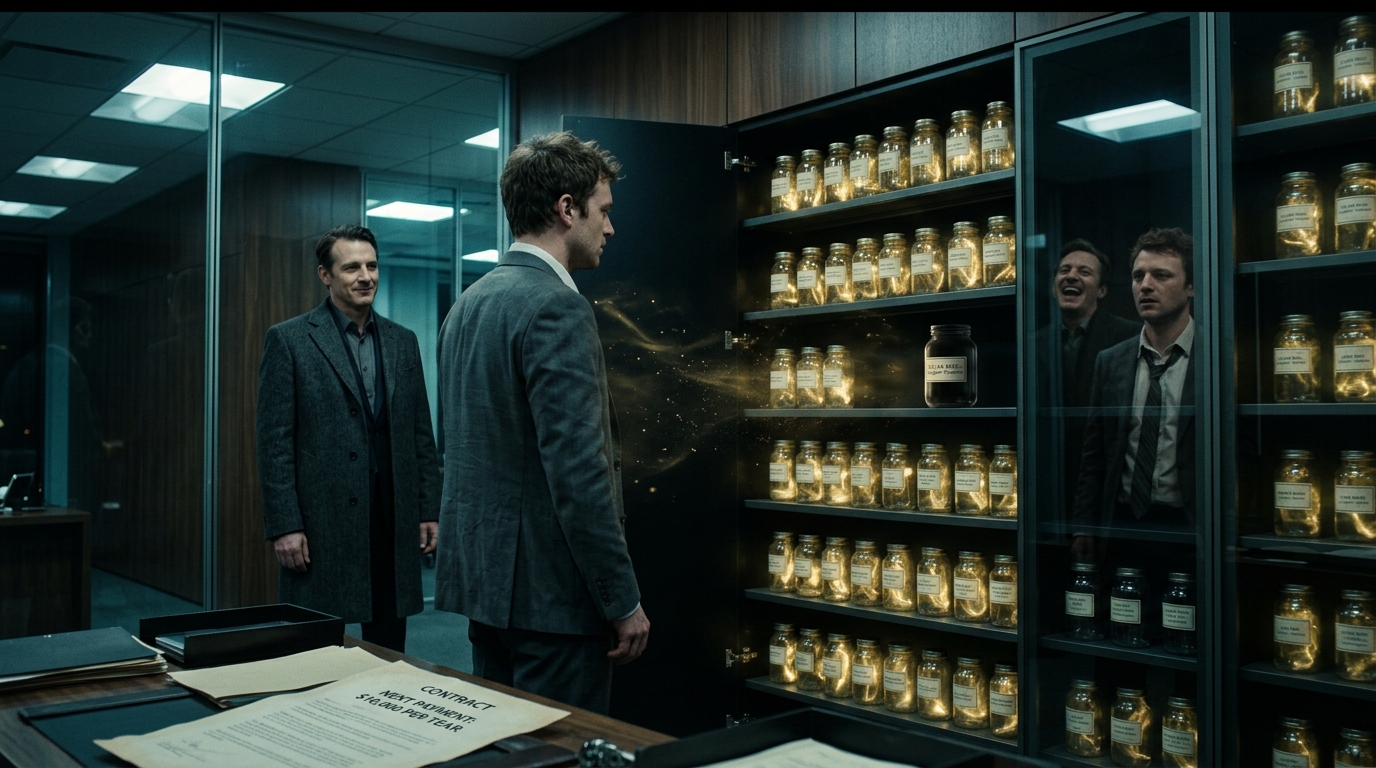
Behind it was a room full of glass jars.
Thousands.
Each jar held a faint golden light that trembled whenever laughter sounded.
Some jars were bright.
Some dim.
Some almost black.
Each had a label.
Names.
Dates.
Durations.
At the center of the room sat one empty jar.
My name was written on it.
Julian Reed.
Status:
Laughter complete.
Next extraction:
Pending.
I backed away.
“No.”
From somewhere inside the shelves, my own laugh played.
The first laugh from the alley.
The bitter one.
The laugh that earned my first thousand dollars.
It sounded younger than me now.
More alive.
Then Mr. Vale lifted the empty jar and smiled.
“Do not worry,” he said. “Most people cry beautifully once they can no longer laugh.”
The lights went out.
When they came back on, I was back in my apartment.
The contract sat on my kitchen table.
A pen beside it.
A new line had appeared at the bottom.
NEXT PAYMENT: $10,000 PER TEAR.
And for the first time in my life, I wanted to cry.
But nothing came out.