
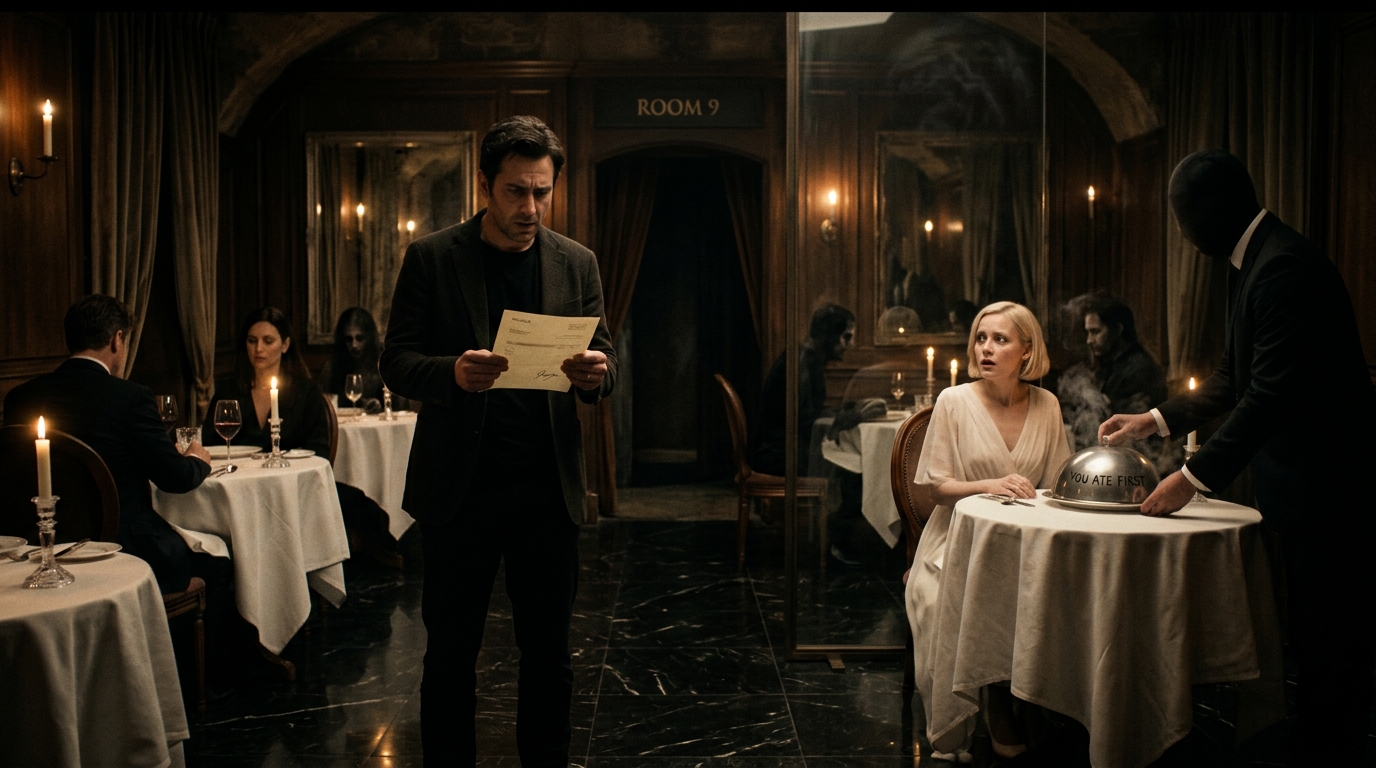
The Invoice On My Desk
Accountants are trained to trust numbers before people.
People forget.
People exaggerate.
People lie because lying feels cheaper than consequence.
Numbers are supposed to be cleaner.
A date.
A total.
A balance.
A signature.
A record that either exists or doesn’t.
That was what I believed before the invoice from Restaurant 9 appeared on my desk.
My name is Elias Ward.
I was a forensic accountant for a private firm that specialized in finding money people did not want found.
Hidden transfers.
Fake vendors.
Shell companies.
Inheritance theft.
Luxury spending disguised as business expense.
I had seen million-dollar frauds built out of restaurant receipts and hotel bills.
But I had never seen a bill like this.
It arrived on a Monday morning.
No envelope.
No courier.
No email trail.
Just a cream-colored folder placed neatly in the center of my desk before I arrived.
My assistant swore she had not put it there.
The building security log showed no one entering my office after midnight.
The camera outside my door glitched between 3:16 and 3:17 a.m.
Exactly one minute of missing footage.
Inside the folder was an invoice.
Thick paper.
Black ink.
Gold seal.
Restaurant 9.
I had heard of it.
Everyone in the city had.
A private dining restaurant for billionaires, politicians, actors, and people rich enough to make privacy feel like a food group.
No website.
No public reservations.
No menu online.
No phone number anyone admitted worked.
People said you did not book a table there.
You were invited.
I had never been invited anywhere in my life that required more than a clean shirt.
So when I saw the total, I almost laughed.
$18,000.
For dinner.
One table.
Two guests.
Twelve courses.
Wine pairing.
Private room surcharge.
Late-hour service fee.
And at the bottom:
Payment scheduled for next Friday at 11:40 p.m.
Next Friday.
A week from now.
I checked the date again.
Then the name.
Elias Ward.
My name.
And beneath it, in blue ink, was my signature.
Not copied.
Not printed.
Signed.
The same sharp E.
The same heavy line under Ward.
The same tiny break before the final d because my hand always lifts too early.
My signature.
On a bill I had not paid.
For a dinner I had not eaten.
At a restaurant I had never visited.
One week in the future.
The Meal I Hadn’t Ordered
At first, I thought it was a prank.
A good one.
Expensive paper.
Excellent forgery.
Someone in the office with too much time and too specific a sense of cruelty.
Then I looked at the itemized menu.
That was when the room got colder.
Course One:
Black garlic consommé.
No onion.
I hate onions.
Not dislike.
Hate.
I have hated them since I was six and my mother forced me to eat soup after my father’s funeral because people bring casseroles to grief like sadness needs side dishes.
Course Two:
Seared scallop.
Burnt lemon.
No cilantro.
I never tell restaurants that unless I have to.
Course Five:
Duck breast.
Skin crisp.
Blood orange reduction.
Rare.
Not medium rare.
Rare.
Course Seven:
Bone marrow toast.
Extra salt.
No parsley.
Course Eleven:
Pear tart.
Clove cream.
Warm.
Course Twelve:
Espresso.
No sugar.
No milk.
Served after midnight.
Every preference was correct.
Not generic.
Not guessed.
Mine.
The kind of details only someone who had watched me eat for years would know.
I turned the page.
There was a second sheet.
Guest notes.
Mr. Ward does not drink white wine after 9 p.m.
Mr. Ward refuses shellfish if served cold.
Mr. Ward asks for the check before dessert but never leaves before coffee.
Mr. Ward becomes quiet when piano music begins.
My mouth went dry.
I had never written those things down.
Not anywhere.
Not in a dating profile.
Not in a food app.
Not in a reservation system.
Some of them I barely knew about myself.
At the bottom of the guest notes was one final instruction.
Do not mention Table 9 until he remembers why he came.
My office lights flickered.
Once.
Then again.
The invoice paper curled slightly at the corners though the room was cold.
I stood up too fast.
My chair rolled backward and hit the wall.
That was when the office phone rang.
Not my cell.
The landline.
No one called that number except clients over sixty and debt collectors who had not updated their systems since 2004.
I picked it up.
“Elias Ward.”
For three seconds, there was only restaurant noise.
Soft piano.
Silverware.
Low conversation.
Then a woman’s voice spoke.
Calm.
Polite.
Almost amused.
“Restaurant 9. Calling to confirm your reservation.”
My throat tightened.
“I don’t have a reservation.”
A pause.
Then:
“Not yet.”
The Reservation
I should have hung up.
Instead, I did what accountants do when fear disguises itself as paperwork.
I asked for details.
“What date is this reservation?”
“Next Friday.”
“What time?”
“11:00 p.m.”
“How many guests?”
“Two.”
“I didn’t book this.”
“Yes,” the woman said softly. “That is usually how the first dinner begins.”
My hand tightened around the phone.
“What does that mean?”
“I’m sorry, Mr. Ward. We are not permitted to explain the bill before the meal.”
“I’m holding the bill.”
Another pause.
Longer this time.
The piano music behind her stopped.
When she spoke again, her voice was lower.
“You received it early.”
“Yes.”
“That should not have happened.”
“Then cancel it.”
“I can’t.”
“I never booked it.”
“You signed the check.”
“Next week.”
“Yes.”
“Do you hear yourself?”
“Yes,” she said. “That is why I am speaking quietly.”
The line crackled.
Then I heard another voice in the background.
Male.
Angry.
Muffled.
“Has he seen the second signature?”
The woman on the phone inhaled sharply.
The restaurant noise vanished.
Silence.
I looked back at the invoice.
Second signature?
There was only mine.
At least, that was what I thought.
I turned the final page over.
Nothing.
I held it to the light.
There, faintly pressed into the paper, was an indentation beneath my signature.
Another name had been written there.
Hard enough to bruise the page.
But the ink was gone.
I rubbed a pencil lightly across the space.
The letters appeared one by one.
Clara Vale.
My body went cold.
Clara Vale had been my fiancée.
Seven years ago.
Before the crash.
Before the hospital.
Before the funeral with no body because the car burned too badly for anyone to show me what was left.
Clara Vale was dead.
And her signature was underneath mine on a future restaurant bill.
The woman on the phone whispered:
“Mr. Ward?”
I could barely speak.
“Who is the second guest?”
The line filled with static.
Then she said:
“She ordered for you.”
The phone went dead.
The Signature Expert
I took the invoice to the one person I trusted to ruin a lie properly.
Mara Collins.
Document examiner.
Former fraud investigator.
Woman who once proved a billionaire’s will had been forged because the ink pressure changed after a comma.
She owed me a favor.
I arrived at her office just after lunch with the invoice sealed in a plastic sleeve and my stomach feeling like it had been filled with cold sand.
Mara looked at the Restaurant 9 seal first.
Her expression changed.
“You’ve been there?”
“No.”
“Then why do you have this?”
“That’s what I need you to tell me.”
She examined my signature for twenty minutes.
Under magnification.
Under angled light.
Against old checks.
Against the signature from my passport.
Against three fresh samples she made me sign in front of her.
She said nothing for a long time.
That was never good.
Finally, she leaned back.
“It’s yours.”
“No.”
“Yes.”
“Could it be copied?”
“Everything can be copied badly. This wasn’t.”
“You’re saying I signed it.”
“I’m saying the movement pattern, pressure, hesitation, and stroke rhythm match your live writing.”
“I didn’t sign it.”
She looked at me over her glasses.
“Then someone used your hand.”
I hated that sentence.
My eyes moved to the faint second signature.
Clara Vale.
“What about this one?”
Mara’s face softened.
She knew Clara’s name.
Everyone close to me did.
Or used to.
She took longer with that signature.
Too long.
At one point, she got up, locked her office door, and closed the blinds.
My mouth went dry.
“What?”
She slid a comparison sheet toward me.
It showed Clara’s old signature from an engagement contract we once signed for a mortgage we never completed.
Beside it was the faint indentation on the Restaurant 9 invoice.
Same C.
Same slanted V.
Same gentle pressure at the end.
Mara whispered:
“It’s hers.”
The room tilted.
“No.”
“Elias—”
“She died seven years ago.”
“I know.”
“She couldn’t sign something dated next week.”
Mara looked at the invoice again.
Then at me.
“Where did you say this restaurant is?”
“I didn’t.”
Her face went pale.
“What?”
“I never told you the address.”
Mara turned the invoice toward me.
At the bottom, below the payment schedule, a new line had appeared.
It had not been there before.
I was sure.
Table location:
Private Room 9.
Lower level.
Entrance through the old theater.
Meal classification:
Last Supper.
Restaurant 9
There was no official address for Restaurant 9.
But accountants know how to find places that do not want to be found.
You follow vendors.
You follow permits.
You follow shell companies with boring names.
You follow payments for linen, alcohol licensing, waste disposal, private security.
By 5:30 p.m., I had enough.
Restaurant 9 operated beneath the old Marlowe Theater.
A building downtown that had been closed for twelve years after a fire killed eleven people during a charity performance.
The theater was supposed to be condemned.
But according to city records, the basement level had been quietly restored by a company called Ninth Course Holdings.
I drove there after sunset.
Because apparently, fear had not made me intelligent.
The Marlowe Theater stood between a parking garage and a luxury hotel, its sign dark, its ticket windows boarded, its old posters faded behind cracked glass.
There was no restaurant entrance.
No valet.
No doorman.
No sign.
Only a narrow alley beside the building.
At the end of the alley, under a broken light, was a black door.
No handle.
Just a brass plate with the number 9.
The invoice in my coat pocket warmed as I approached.
Not from body heat.
It pulsed.
Like something alive enough to recognize home.
I raised my hand toward the brass plate.
Before I touched it, the door opened inward.
A woman stood inside.
The same voice from the phone.
Black dress.
Silver hair.
Expression professional enough to make terror look impolite.
“Mr. Ward,” she said.
“I’m not here for dinner.”
“No.” Her eyes moved to the invoice in my pocket. “You’re early.”
“Everyone keeps saying that.”
“Because it keeps being true.”
I stepped back.
“I want this canceled.”
She looked almost sad.
“People only cancel meals they have not already survived.”
My throat tightened.
“What is this place?”
Her eyes flicked behind me, toward the empty alley.
Then she whispered:
“A restaurant for people who need to remember what they ate before they died.”
The black door opened wider.
Behind her, stairs led down into red light.
And from somewhere below, I heard piano music.
The same music from the phone.
The same music that always made me quiet.
Because it had been playing in the restaurant where I proposed to Clara.
Table 9
I did not go down the stairs.
Not all the way.
But I saw enough.
Red carpet.
Gold walls.
Mirrors.
A dining room below the old theater, impossibly elegant beneath a burned building.
Every table was set for two.
Every guest sat alone.
That was the first thing I noticed.
Men in suits.
Women in evening dresses.
An old man holding a child’s napkin.
A young bride staring at an empty chair.
Each table had one person eating.
One person absent.
And somehow, the absent chairs felt occupied.
The hostess stepped beside me.
“Private Room 9 is not ready for you.”
“Good.”
“But your guest has already arrived.”
I turned slowly.
No.
At the far end of the dining room, behind a glass wall, sat a woman.
Dark hair.
Pale dress.
One hand resting on the table.
Clara.
My Clara.
Not burned.
Not buried.
Not seven years gone.
She looked exactly as she did the night before the crash.
When she lifted her head, my knees almost failed.
She saw me.
Her mouth moved.
No sound reached me through the glass.
But I knew what she said.
Leave.
Then a waiter stepped into the room behind her.
Tall.
Black suit.
Face hidden by shadow.
He placed a covered silver dish in front of her.
Clara began shaking her head.
The hostess grabbed my wrist.
Harder than I expected.
“Do not make her order dessert.”
I pulled away.
“What happens if she does?”
The dining room lights dimmed.
Every lonely guest stopped eating at once.
Every empty chair turned slightly toward me.
The hostess whispered:
“Then the bill becomes final.”
The invoice inside my pocket tore by itself.
I pulled it out.
A new charge had appeared at the bottom.
Memory restoration fee:
$18,000.
Second guest recovery:
Pending.
Dessert course:
Not yet served.
Then Clara’s empty chair in Private Room 9 moved backward by itself.
As if someone invisible had just stood up.
The glass door opened.
The waiter looked directly at me, though I still could not see his face.
And Clara screamed loud enough for every candle in the restaurant to go out.
When the lights returned, Private Room 9 was empty.
Only the covered dish remained on the table.
And on the silver lid, written in steam, were three words:
YOU ATE FIRST.