
The Email That Shouldn’t Exist
Bank employees learn to fear numbers before they fear people.
People shout.
People cry.
People lie.
Numbers do something worse.
They wait.
They sit inside accounts, contracts, approvals, transfers, loan files, and transaction histories until the wrong person finally notices they do not belong there.
My name is Clara Vance.
I worked in risk verification at Meridian Trust Bank, which sounds more important than it felt.
Most days, I reviewed flagged loans.
Suspicious signatures.
Unusual payment schedules.
Debt notices sent to the wrong customer.
Documents that looked almost real but not quite real enough.
Fraud was usually lazy.
A fake ID.
A copied signature.
A typo in the wrong place.
A borrower who claimed they had never taken a loan but somehow knew the exact amount too quickly.
I had seen almost everything.
Then the email arrived.
Tuesday.
8:13 a.m.
Subject line:
FINAL DEBT COLLECTION NOTICE.
I almost deleted it.
Internal spam filters failed all the time. Employees received fake collection emails weekly. Usually the amount was dramatic enough to be absurd.
Ten thousand.
Two hundred thousand.
Crypto recovery scam.
Inheritance account fee.
Urgent legal threat.
But this one came from our internal debt recovery server.
Not a lookalike domain.
Not a phishing address.
Our server.
The sender name was automated.
MERIDIAN TRUST COLLECTIONS.
The recipient was me.
Not my work account.
My private email.
The one I had never linked to the bank system.
My stomach tightened before I even opened it.
The email contained four lines.
Borrower: Clara Evelyn Vance.
Outstanding balance: $4,700,000.
Loan origination date: August 19, 2029.
Default status: Active.
I stared at the date.
2029.
Three years from now.
For a moment, I genuinely thought I was tired.
I blinked.
Read it again.
August 19, 2029.
Three years in the future.
A debt I had not taken.
A loan that did not exist yet.
For an amount so large it felt less like money and more like a verdict.
I laughed once.
Quietly.
Alone at my desk.
Then I stopped laughing when I saw the attachment.
LOAN_AGREEMENT_FINAL_SIGNED.pdf
My Signature
I should have sent it to IT immediately.
That was the protocol.
Suspicious internal email.
Unverified attachment.
Possible data breach.
Escalate.
Do not open.
But protocols are written for people who still believe the world follows sequence.
Past.
Present.
Future.
Cause.
Effect.
Debt after loan.
Signature after contract.
I clicked the attachment.
The PDF opened slowly.
A Meridian Trust loan document filled the screen.
Official template.
Correct formatting.
Correct legal language.
Correct footer codes.
The kind of document I reviewed every day.
Except this one listed me as the borrower.
Clara Evelyn Vance.
Date of birth.
Social security number.
Current address.
Previous address.
Mother’s maiden name.
Emergency contact.
All correct.
All information buried deep inside systems only authorized employees could access.
The loan purpose line read:
PRIVATE SETTLEMENT PAYMENT.
Collateral:
PERSONAL FUTURE EARNINGS AND ESTATE RIGHTS.
My pulse slowed.
That was not standard language.
No consumer loan used language like that.
Future earnings, yes.
Estate rights, maybe in complex legal inheritance cases.
But personal future earnings and estate rights together looked wrong.
Predatory.
Old.
Almost ceremonial.
I scrolled lower.
The approval officer was listed as Daniel Cross.
I did not know a Daniel Cross.
The witness name was redacted.
The disbursement account was hidden behind internal masking.
Then I reached the signature page.
My body went cold.
There it was.
My signature.
Not a scanned copy.
Not a crude digital tracing.
Mine.
The slight upward hook on the C.
The way I crossed the t too hard.
The tiny break before the final e because my hand always lifted without meaning to.
I knew my own signature the way people know their own footsteps in a hallway.
And the one on the document was real.
My real signature.
Dated August 19, 2029.
Three years from now.
Under it was a second line.
Witness confirmation completed.
Biometric identity verified.
Video consent archived.
My mouth went dry.
Video consent.
I scrolled back to the attachment list.
There was another file hidden beneath the PDF preview.
VIDEO_CONSENT_CLARA_VANCE.mp4
For several seconds, I could not move.
Then the office printer behind me turned on by itself.
One sheet came out.
Then another.
Then another.
I stood slowly.
The pages landed in the tray face-up.
All copies of the same document.
My future loan agreement.
Across the top of each page, in red capital letters, someone had printed:
SHE HAS ALREADY AGREED.
The Video Consent
I locked myself in the records room.
That was stupid.
I know that now.
But fear makes you look for small rooms with doors that click.
The records room sat behind compliance, cold and windowless, full of file boxes no one had opened in years because the bank trusted digital systems more than paper until digital systems betrayed us.
I brought my laptop.
The printed pages.
The email.
My shaking hands.
I played the video.
At first, the screen was black.
Then static.
Then a woman appeared.
Me.
I stopped breathing.
Not me now.
Older.
Only a few years older, but wrong somehow.
Hair cut shorter.
Face thinner.
Dark circles beneath the eyes.
A bruise near the left cheekbone.
I sat in a white room under fluorescent lights, facing a camera.
Behind me was a blank wall.
No window.
No visible door.
My future self looked directly into the lens.
Her lips were cracked.
Her hands rested on the table in front of her.
Both wrists were wrapped in white bandages.
A male voice off-camera said:
“State your name.”
My voice answered.
“Clara Evelyn Vance.”
It was my voice.
Older.
Dry.
Empty.
The man continued.
“Do you understand the loan terms?”
Future me closed her eyes.
Only for a second.
Then opened them.
“Yes.”
“Do you understand failure to repay will result in collection action against all linked assets?”
“Yes.”
“Do you understand the agreement cannot be reversed once signed?”
A pause.
Longer this time.
Future me looked slightly to the left of the camera.
Like someone stood there.
Someone she was afraid to look at fully.
Then she whispered:
“Yes.”
The man said, “Do you consent?”
Future me leaned closer to the camera.
For one terrifying second, I thought she was going to say yes.
Instead, her mouth formed another word.
Not spoken.
Silent.
Help.
The video glitched.
When it stabilized, she was smiling.
Too wide.
Too still.
“Yes,” she said.
The file ended.
I sat in the records room unable to breathe.
Then the laptop screen blinked.
A new line appeared beneath the video.
ARCHIVE DATE: AUGUST 19, 2029.
ACCESS DATE: TODAY.
I slammed the laptop shut.
The lights in the records room flickered.
From somewhere outside the door, someone knocked.
Three times.
Softly.
I froze.
No one used the records room.
No one even knew I was inside.
Another knock.
Then a man’s voice.
“Clara?”
I knew that voice.
My manager.
Thomas Hale.
I opened the door too quickly.
Thomas stood outside holding a coffee cup and wearing his usual navy tie.
Normal.
Concerned.
Human.
“You okay?” he asked.
I almost cried from relief.
Then I saw the ring on his right hand.
Silver.
Thick.
With a black stone in the center.
The same ring visible for half a second on the hand of the man in the consent video.
The man standing off-camera beside my future self.
The Manager Who Knew Too Much
I stepped back.
Thomas noticed.
Of course he did.
Bank managers survive by reading micro-expressions before clients turn complaints into lawsuits.
“What happened?” he asked.
“Nothing.”
The lie sounded terrible.
His eyes moved past me into the records room.
To my laptop.
To the printed pages.
To the red words.
SHE HAS ALREADY AGREED.
His face changed.
Not surprise.
Annoyance.
That was worse.
“You opened it,” he said quietly.
My mouth went dry.
“What?”
He set the coffee on a nearby shelf.
Slowly.
Carefully.
Like a man freeing both hands before a difficult conversation.
“You should have forwarded it to internal security.”
“I was going to.”
“No, you weren’t.”
The hallway behind him was empty.
Compliance employees worked less than thirty feet away, but suddenly the bank felt impossibly silent.
I took another step back.
“Did you send this?”
Thomas sighed.
Not guilty.
Tired.
“Clara, you need to stay calm.”
People only tell you to stay calm when they know panic is reasonable.
I held up the printed loan agreement.
“This says I owe four point seven million dollars on a loan dated three years from now.”
“Yes.”
The word struck me harder than denial would have.
“Yes?”
He looked pained.
Almost.
“It wasn’t supposed to reach you this early.”
My hands went numb.
“This early?”
Thomas glanced toward the hallway camera.
Then lowered his voice.
“There are procedures.”
“What procedures?”
“You don’t want to ask that here.”
I laughed once.
A broken sound.
“I work in risk verification. I ask questions for a living.”
“Not about this.”
“What is this?”
His expression hardened.
“A collection notice.”
“For a debt that doesn’t exist.”
“It will.”
The world tilted slightly.
“What does that mean?”
Thomas looked at me for a long time.
Then said:
“It means in three years, you sign that agreement.”
“No.”
“You do.”
“No.”
“You already did.”
I shook my head.
“You sound insane.”
He almost smiled.
“Everyone does the first time.”
The first time.
My chest tightened.
“How many people have received these?”
He did not answer.
That was answer enough.
I pushed past him toward the hallway.
Thomas grabbed my wrist.
Not hard.
Enough.
“Clara, listen to me. Do not search Daniel Cross.”
The name from the agreement.
The approval officer.
My pulse jumped.
“Why?”
His fingers tightened slightly.
“Because that is how the loan begins.”
I ripped my arm free.
“What did you do?”
He looked at the camera again.
Fear passed over his face.
Not fear of me.
Fear of whoever watched the cameras.
Then he whispered:
“If you want to survive this, delete the email and forget you saw it.”
I stared at him.
Behind Thomas, the office printer started again.
Every printer in the department started.
Pages poured out from every machine.
Employees shouted.
Paper slid across desks.
Fluttered onto floors.
Covered the bank in white.
Thomas turned pale.
I picked up one page from the hallway floor.
It was another loan agreement.
Not mine.
Different name.
Different amount.
Same future date format.
Same red stamp.
DEFAULT PENDING.
Then another page landed at my feet.
This one had a photograph.
A woman I recognized.
Maya Lewis.
Former bank auditor.
She disappeared six months ago.
The status beneath her picture read:
COLLECTED.
Daniel Cross
I ran.
Not gracefully.
Not strategically.
I ran like a woman whose life had just become a file.
Past compliance.
Past the loan department.
Past the lobby where customers looked up from deposit slips and mortgage folders, unaware that the building around them had started printing future debts like death notices.
Thomas shouted my name behind me.
I did not stop.
I made it to the elevator.
The doors opened immediately.
Too immediately.
Inside stood no one.
I stepped in anyway and pressed ground floor.
The panel flashed.
Then changed.
Not ground floor.
B3.
The basement level.
We did not have a B3.
Meridian Trust had two basement levels.
Vault and records.
That was all.
The elevator began descending.
I pressed every button.
Nothing worked.
The speaker above me crackled.
A male voice filled the elevator.
Not Thomas.
Not security.
The voice from the consent video.
“Good morning, Clara.”
My blood froze.
“Who are you?”
The elevator lights flickered.
The voice said:
“You know my name.”
Daniel Cross.
The approval officer.
The man Thomas warned me not to search.
I stared at the mirrored elevator wall.
My reflection looked pale.
Small.
Trapped.
“I haven’t signed anything,” I said.
Daniel Cross laughed softly through the speaker.
“Not yet.”
The elevator dropped lower.
B1.
B2.
Then blank.
My ears popped.
A screen above the panel lit up, showing a document preview.
My loan agreement.
Then the video consent.
Future me staring into the camera.
Bruised.
Bandaged.
Silent mouth forming:
Help.
Daniel’s voice softened.
“I apologize for the early notice. Collections rarely arrive before initiation.”
“What does that mean?”
“It means someone in your future tried to warn you.”
My breath stopped.
“Me?”
A pause.
Then:
“Yes.”
The elevator slowed.
My hands trembled.
“Why would I take a four point seven million dollar loan?”
The elevator doors opened into darkness.
Before the speaker cut out, Daniel Cross answered:
“Because three years from now, you need to buy back your own death.”
The Basement Account
The basement was not part of the bank.
Not really.
The floor below Meridian Trust looked older than the building above it.
Concrete walls.
Narrow corridor.
Red emergency lights.
A smell of damp paper and cold metal.
The elevator doors closed behind me.
No signal.
Of course.
At the end of the hallway stood a glass door with black lettering:
FUTURE LIABILITIES DIVISION.
My stomach turned.
I had worked at Meridian Trust for six years.
I knew every department.
Retail banking.
Wealth management.
Risk verification.
Compliance.
Estate processing.
Debt recovery.
There was no Future Liabilities Division.
The door opened when I approached.
Inside was a room full of filing cabinets.
Not computers.
Paper.
Thousands of folders arranged by year.
2027.
2028.
2029.
2030.
Years that had not happened yet.
A desk sat in the center of the room.
On it lay one file.
CLARA EVELYN VANCE.
My name.
My future debt.
My hands shook as I opened it.
The first page was the loan agreement.
The second was a death certificate.
Mine.
Date of death:
August 20, 2029.
One day after the loan.
Cause:
REDACTED.
The third page was a beneficiary transfer.
All assets, estate rights, insurance payouts, and posthumous financial instruments assigned to:
DANIEL CROSS HOLDINGS.
I could barely see.
My future self had taken a loan the day before she died.
No.
The day before I died.
To buy back my death.
Or delay it.
Or fail to.
I turned the next page.
There was a handwritten note.
The handwriting was mine.
If you are reading this before signing, do not trust Thomas.
Do not trust police.
Do not trust Meridian.
And whatever you do—
Do not search for Daniel Cross in the customer archive.
I froze.
Too late.
Because across the room, one computer monitor turned on by itself.
A search field opened.
The cursor blinked.
Then my name typed itself.
CLARA VANCE.
The system loaded one result.
Related account holder:
DANIEL CROSS.
Relationship:
HUSBAND.
My blood went cold.
I was not married.
I had never been married.
But the system opened a future marriage certificate.
Date:
August 18, 2029.
One day before the loan.
Two days before my death.
Spouse:
Daniel Cross.
Photo attached.
The image loaded slowly.
The man beside my future self was not Thomas.
Not a stranger.
Not the voice from the elevator.
It was a man with no face.
The photograph glitched where his features should have been, replaced by a smooth gray blur.
Then the basement lights went out.
In the darkness, the printer on the desk started.
One sheet.
Then silence.
I picked it up with shaking hands.
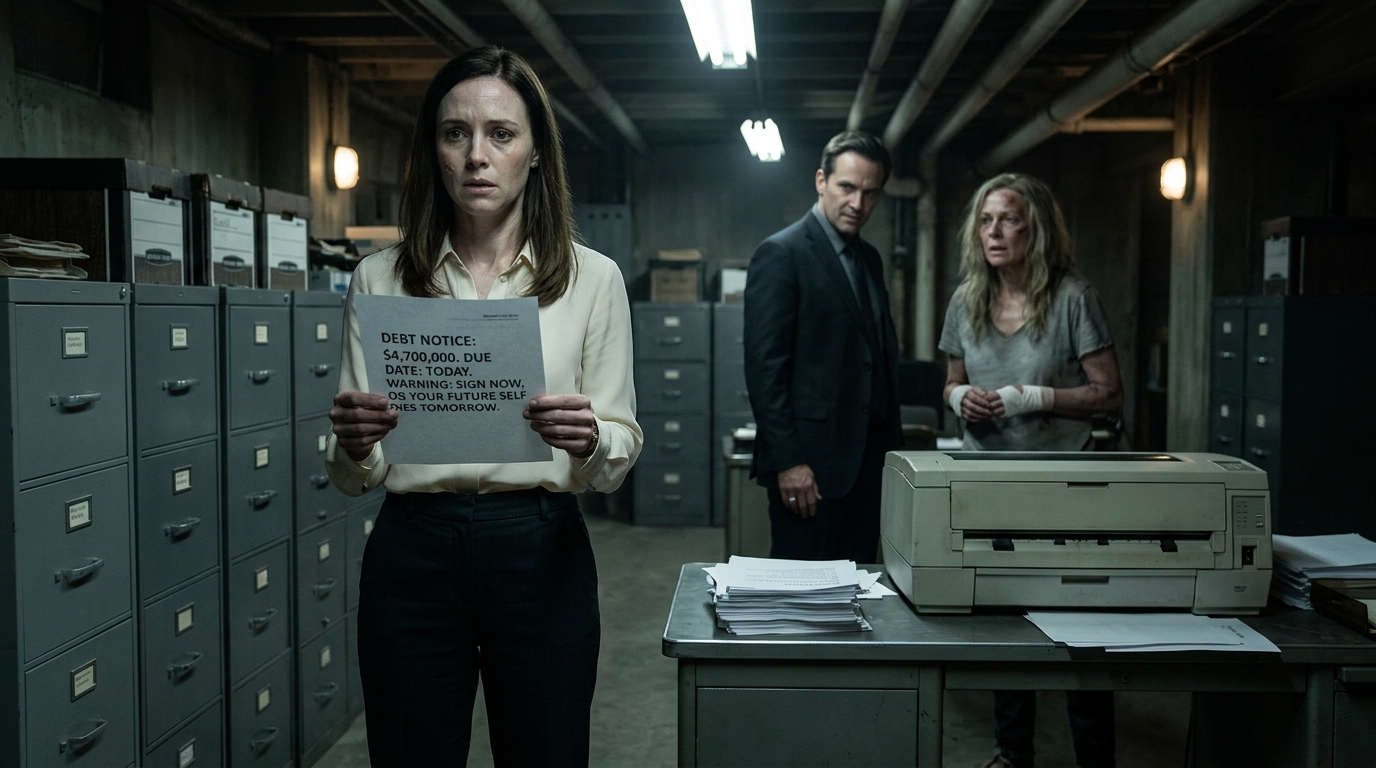
It was a new debt notice.
Amount:
$4,700,000.
Due date:
Today.
Borrower status:
PRESENT.
Beneath that, one line printed slowly.
IF YOU DO NOT SIGN NOW, YOUR FUTURE SELF DIES TOMORROW.
A door opened behind me.
I turned.
Thomas stood in the darkness.
But he was not alone.
Beside him was a woman with my face.
Older.
Bruised.
Bandaged wrists.
The woman from the video.
My future self.
She looked at me with exhausted eyes and whispered:
“Don’t believe me either.”