
The Bank Kept The Bill
The bank kept the bill.
They called it evidence.
I called it theft.
Daniel Cross, the bank manager, slid the strange future bill into a plastic sleeve and locked it inside a metal drawer behind his desk.
The teller named L looked like she wanted to stop him.
She didn’t.
People inside banks are trained to obey quiet orders.
Even when the order feels like a crime.
“Mr. Hale,” Daniel said, folding his hands on the desk, “you need to forget this happened.”
I almost laughed.
A tenant had paid rent with money that had not been printed yet.
A bank database said the serial number was real.
The print date was six months in the future.
Then Mira Vale had called from nowhere and said:
They know which version you are now.
Forget?
Men like Daniel Cross only tell you to forget when remembering becomes dangerous for them.
“I want the bill back,” I said.
His face did not move.
“That bill is under investigation.”
“By who?”
“Internal authorities.”
“That is not an answer.”
“It is the only one you’re entitled to.”
The teller near the door lowered her eyes.
Her hands were clenched so tightly her knuckles had gone white.
Daniel stood.
The meeting was over.
“Go home,” he said. “Check on your tenant if you feel concerned. But do not involve police.”
That was the wrong thing to say.
Because before that moment, I had been frightened.
After that, I became suspicious.
I walked out of the bank with the serial number receipt hidden in my coat pocket and one thought repeating in my head.
If they kept the bill, they had kept the proof.
If they kept the proof, they already knew what it proved.
And if they already knew what it proved—
Mira was in more danger than I understood.
Room 306 Was Empty
I went straight back to the building.
Rain followed me the whole way.
Not heavy rain.
Thin, cold rain that made the streets look unfinished.
The kind of rain that turns every window into a reflection you don’t want to trust.
My building stood above the hardware shop like it always did.
Old brick.
Flickering stairwell light.
Paint peeling near the mailboxes.
Nothing about it suggested that one of the tenants might be living six months out of place.
I climbed to the third floor.
Room 306.
Mira’s door was closed.
No light underneath.
No sound inside.
I knocked once.
“Mira?”
Nothing.
I knocked again.
“Ms. Vale?”
Still nothing.
I used my landlord key.
I told myself it was allowed.
Emergency access.
Tenant welfare.
Possible fraud.
Practical words.
Comforting words.
Words people use when they already know they are about to cross a line.
The door opened.
Room 306 was empty.
Not messy.
Not packed.
Empty.
The bed was stripped.
The closet open.
The drawers bare.
No suitcase.
No shoes.
No shampoo in the bathroom.
No hairbrush.
No toothbrush.
No trace of a woman who had lived there for six months.
Only dust.
And a calendar.
It hung on the wall above the small desk near the window.
I had never noticed it before.
Maybe because it had not been there.
Maybe because the room had changed when I wasn’t looking.
The calendar showed the current month.
Every day had been crossed out in thick black marker.
Every day.
Past days.
Current day.
Days that had not arrived yet.
All crossed out.
Except tomorrow.
Tomorrow’s square remained clean.
White.
Untouched.
Circled in red.
Beside it, written in Mira’s careful handwriting, were four words:
The day I disappear.
My throat tightened.
I stepped closer.
Under the calendar sat a single envelope.
No name.
No seal.
Inside was a folded train ticket.
Meridian Metro Line.
Departure: 8:19 a.m.
Date: tomorrow.
Passenger: Mira Vale.
Destination: Central Exchange.
But the bottom of the ticket was wrong.
Printed beneath the route information was a line no ticket should have.
Expected fatality window: six months from departure.
My hands went cold.
Behind me, the door to Room 306 slowly clicked shut.
The Calendar Of Missing Days
I turned.
Nobody there.
The room remained empty.
But it no longer felt vacant.
It felt paused.
Like I had walked into a place someone had left seconds before they stopped existing.
I checked the desk drawers.
Nothing.
Then the wastebasket.
Empty.
Then the mattress frame.
Nothing.
Finally, I checked behind the calendar.
There was a message written directly on the wall.
Small.
Almost hidden behind the paper.
Mr. Hale, if you find this, I failed to stay ahead.
My breathing slowed.
There was more.
The first bill brought me here.
The second bill will take me back.
Do not let the bank print the first one.
Do not let them list me as dead before I die.
I stared at the sentence.
List me as dead before I die.
The words did not feel like metaphor.
Not anymore.
In the bank office, I had seen Mira’s face inside the holographic strip.
Older.
Terrified.
Screaming silently.
And now the calendar said she would disappear tomorrow.
I took photos of everything.
The calendar.
The train ticket.
The message on the wall.
The empty room.
Then my phone buzzed.
Unknown number.
For one second, I thought it would be Mira.
It wasn’t.
A text appeared.
Do not search tomorrow’s news.
My skin went cold.
Another message followed.
You will only teach it where to put her.
I looked toward the window.
Across the street, beneath a broken awning, stood the bank teller.
L.
She was soaked from the rain.
No umbrella.
No coat.
Just her work uniform and a face full of fear.
She lifted one hand and pointed downward.
Toward my office.
Then she mouthed one word through the rain.
Basement.
The Woman From The Bank
I found her waiting beside the rear entrance five minutes later.
She was shaking.
Not from cold.
From decision.
People look different after they decide to betray a system that owns them.
You can see the fear.
But also the relief.
“My name is Lena,” she said before I could ask.
“Do you know where Mira is?”
“No.”
“Do you know what that bill is?”
She looked toward the alley behind us.
Then back at me.
“It’s an anchor.”
I stared at her.
“A what?”
“A time-printed anchor. A physical object printed before its official issue date. It locks a person to a version of events.”
I almost walked away.
Then I remembered the calendar.
The train ticket.
The future serial number.
The bank manager’s face.
“What does that mean in normal language?”
Lena swallowed.
“It means if the bill enters the banking system before it is supposed to exist, the person carrying it becomes traceable across dates.”
“Mira.”
She nodded.
“She’s been using unreleased currency to stay alive.”
“That makes no sense.”
“I know.”
“Why would future money keep her alive?”
“Because she isn’t hiding from people.” Lena’s voice dropped. “She’s hiding from records.”
The rain sounded louder in the alley.
“What records?”
“Death records.”
My stomach tightened.
Lena pulled a folded paper from her pocket and pushed it into my hand.
It was a printed internal bank notice.
Restricted.
Red stamped.
Future Currency Event Detected.
Subject: Mira Vale.
Status: Pending casualty confirmation.
Date of death: six months from tomorrow.
I looked up slowly.
“You already have her death date.”
Lena nodded.
“But she isn’t dead.”
“Not yet.”
The words came out flat.
Tired.
Like she had said them too many times.
I gripped the paper.
“What happens tomorrow?”
Lena’s eyes filled with tears.
“A train accident.”
The Crash That Hadn’t Happened Yet
I did not sleep that night.
I sat in my office with the train ticket on the desk and the calendar photo open on my phone.
The day I disappear.
The words seemed to move every time I looked away.
At 5:17 a.m., my office printer turned on by itself.
One page came out.
A news article.
Not from today.
Not from tomorrow.
From six months later.
The headline read:
MERIDIAN METRO IDENTIFIES FINAL VICTIM FROM CENTRAL EXCHANGE TRAIN DISASTER.
Below it was a photograph of Mira.
Dark hair.
Pale face.
Same tired eyes.
The article said her remains had been identified after months of forensic delay.
Date of death:
Six months from tomorrow.
Not the day of the crash.
Not the day she disappeared.
Six months later.
I read that line until my vision blurred.
How could someone die six months after an accident and still be listed as a victim of it?
Unless the crash did not kill her.
Unless it took her somewhere.
At 7:42 a.m., I went to the station.
I told myself I would stop her.
I told myself I would stand at the platform and physically prevent Mira Vale from boarding that train if I had to.
But when I arrived, the platform was already packed.
Commuters.
Students.
Tourists.
Office workers holding coffee.
Normal people moving toward a disaster none of them believed in yet.
The announcement chimed overhead.
Meridian Metro Line now arriving.
I searched the crowd.
No Mira.
Then I saw her.
Across the platform.
Room 306.
Dark coat.
One suitcase.
Standing perfectly still while everyone moved around her.
She looked directly at me.
Not surprised.
Not relieved.
Sad.
I pushed through the crowd.
“Mira!”
She shook her head.
The train arrived between us.
Wind tore across the platform.
Doors opened.
People surged forward.
I fought through bodies, shouting her name.
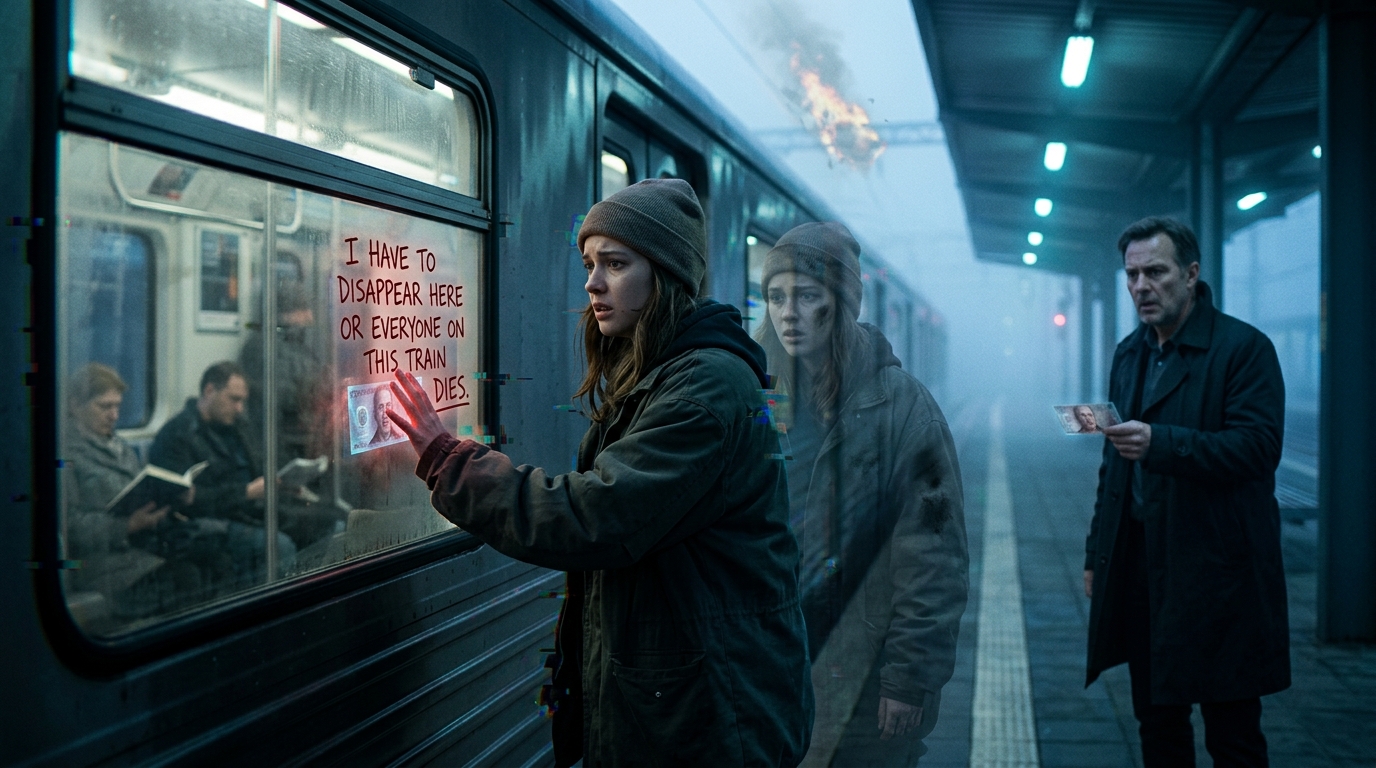
Mira stepped into the train.
Before the doors closed, she raised one hand to the glass.
In her palm was another bill.
Same unreleased design.
Same diagonal strip.
Same impossible future.
Written across it in red ink:
I have to disappear here, or everyone on this train dies.
The doors closed.
The train pulled away.
The Accident On The News
The crash happened at 8:31 a.m.
Not immediately.
That somehow made it worse.
For twelve minutes, I stood on the platform telling myself maybe I had changed something just by seeing her.
Maybe warnings worked.
Maybe calendars lied.
Maybe future money was only fraud with better printing.
Then the station screens went black.
Every screen.
Advertisements.
Arrivals.
Ticket machines.
All of them.
One line appeared in white text.
CASUALTY EVENT CONFIRMED.
Then the alarms began.
People screamed before they knew why.
Security shouted into radios.
The tunnel lights flashed red.
A deep sound came from underground.
Not an explosion exactly.
A metal scream.
Long.
Violent.
Final.
The news called it a derailment.
Then an electrical failure.
Then a collision with a maintenance vehicle that should not have been on the track.
By noon, the entire city knew.
Meridian Metro Line disaster.
Dozens injured.
Multiple confirmed dead.
Many missing.
I watched from my office because police had pushed everyone away from the station.
The small television above my filing cabinet showed emergency crews carrying stretchers from the tunnel.
Smoke.
Blood.
Broken glass.
Faces blurred for broadcast.
At 2:13 p.m., the victim list appeared.
I did not want to look.
I looked anyway.
Mira Vale.
Age: 26.
Resident of Room 306.
Status: deceased.
Date of death:
Six months from now.
The room went silent around me.
The news anchor did not react.
Why would she?
She did not see the date.
On the broadcast, the line corrected itself one second later.
Date of death: today.
But I had seen it.
My phone buzzed.
Unknown number.
One message.
You saw the first version.
Another message.
Now choose which one becomes official.
The office door downstairs opened.
I heard footsteps.
Slow.
Wet.
Climbing toward me.
The Girl Living In Tomorrow
I locked my office door.
The footsteps stopped outside.
Three soft knocks.
I did not answer.
A piece of paper slid under the door.
A bank deposit receipt.
Amount: $600.
Payer: Mira Vale.
Date: tomorrow.
Attached to it was a note.
Mr. Hale,
If the news says I died today, don’t believe it.
If the records say I die six months from now, don’t believe that either.
Both are traps.
The train did not kill me.
It moved me.
I read the last line twice.
The footsteps outside shifted.
A woman whispered through the door.
Not Mira.
Lena from the bank.
“Mr. Hale, open the door.”
I looked through the peephole.
Lena stood in the hallway.
Blood on her forehead.
One hand pressed to her side.
Behind her stood Mira.
Alive.
Soaked.
Bruised.
Six months older than she had been that morning.
My breath stopped.
I opened the door.
Mira stumbled inside and collapsed against the wall.
Her suitcase was gone.
Her hands were blackened with soot.
In one fist, she held the unreleased bill.
Now burned along one edge.
“I only had twelve minutes,” she whispered.
I knelt beside her.
“What happened?”
She looked up at me with eyes that had seen half a year pass in half a day.
“The crash isn’t an accident.”
Lena locked the door behind us.
Mira continued, voice shaking.
“It’s a sorting point.”
“A what?”
“A place where records decide who survives which version.”
I stared at her.
She laughed once.
Broken.
“I know how that sounds.”
“No,” I said quietly. “You don’t.”
Mira gripped my wrist.
“The bank isn’t investigating the bills. They’re printing them backward to mark people before disaster events.”
“Why?”
“Because some people are more valuable dead in one timeline than alive in another.”
The lights flickered.
Lena whispered, “Mira…”
Mira looked toward my office window.
Across the street, the bank manager Daniel Cross stood in the rain.
Looking up at us.
Smiling.
Mira’s grip tightened.
“He already printed your bill too.”
My blood went cold.
“I don’t have one.”
She looked at my desk.
I turned.
A white envelope sat where there had been nothing before.
My name written across it.
MR. HALE.
Inside was a single future bill.
Six months from now.
Same design.
Same diagonal strip.
But this one had my face inside the hologram.
Not screaming.
Not dead.
Smiling.
On the back, printed in fresh black ink, was one sentence:
LANDLORD ACCEPTED PAYMENT AND ASSUMED THE DEBT.
The office phone rang.
Mira began crying.
“Don’t answer.”
But the machine picked up by itself.
Daniel Cross’s voice filled the room.
“Mr. Hale, thank you for housing someone who was supposed to remain missing.”
The lights went out.
When they came back on, Mira was gone.
Only the burned bill remained on the floor.
And from Room 306 upstairs, someone began knocking from inside the empty room.