
The Company Behind The Laughter
I went back to The Laughter Exchange with no appointment.
No invitation.
No patience left.
The contract sat in my coat pocket, folded so many times the edges had started to tear.
The new clause still burned inside my head.
NEXT PAYMENT: $10,000 PER TEAR.
I had spent the entire night trying to cry.
Nothing came.
Not when I watched my father’s old video.
Not when I read my mother’s last birthday card.
Not when I stood in front of the mirror and realized I could remember joy without feeling it.
That was when I understood what they had done.
They had not paid me for laughter.
They had removed it.
Cleanly.
Professionally.
One laugh at a time.
The building lobby was empty when I arrived.
No guard.
No receptionist.
No directory.
Only the elevator waiting with its doors open.
Like it knew I was coming.
I stepped inside.
The button for the twenty-second floor lit up before I touched it.
The doors closed.
No music.
No reflection in the elevator walls.
That was new.
The polished steel should have shown my face.
Instead, it showed only the empty elevator.
As if the building had already begun forgetting me too.
When the doors opened, Mr. Vale was waiting.
Gray coat.
Black gloves.
Calm smile.
The same impossible patience.
“Mr. Reed,” he said. “You’re early.”
I held up the contract.
“What did you do to me?”
He tilted his head.
“We honored the agreement.”
“You stole my laughter.”
“No,” he said softly. “You sold it.”
I stepped toward him.
“To who?”
For the first time, his smile faded.
Not from fear.
From interest.
Like I had finally asked the right question.
He turned and walked toward the white room.
“Come with me.”
I should have refused.
Instead, I followed.
Because anger makes cowards brave for exactly long enough to enter traps.
The Recording
The white room looked different this time.
There was no desk.
No contract.
No glass jars.
Only one black speaker placed on a metal table.
Beside it sat an old tape recorder.
Not digital.
Not modern.
A tape recorder with two spinning reels and a red button worn smooth by fingers.
I stared at it.
“What is that?”
Mr. Vale removed his gloves carefully.
“Proof.”
“I don’t want proof. I want answers.”
“Most clients need to hear before they understand.”
He pressed play.
At first, there was silence.
Then laughter.
My laughter.
The bitter laugh from the alley.
The first one.
The one that earned me one thousand dollars.
I knew it instantly.
The breath before it.
The sharp crack in the throat.
The way it collapsed too quickly because I had not truly found anything funny.
My stomach tightened.
“That’s mine.”
“Yes.”
The recording continued.
The laugh repeated.
But something changed.
The second time, it came from a woman’s mouth.
Same laugh.
Same rhythm.
Same broken edge.
But female.
Older.
Then a child.
Then a man.
Then another man.
Then dozens.
Hundreds.
Thousands.
My laugh played from strangers’ throats, layered together until the room filled with a sound both familiar and horrifying.
It was me.
And not me.
It was my laugh wearing other bodies.
I backed away from the speaker.
“Turn it off.”
Mr. Vale did not move.
The laughter grew louder.
Clips overlapped.
A hospital room.
A classroom.
A dinner table.
A wedding toast.
A funeral reception.
Places I had never been.
People I had never met.
All laughing with the sound I had sold.
Then, underneath the laughter, I heard something else.
Silence.
Not absence.
The moment after.
Each laugh cut off.
Each voice ended.
And after each one, a person whispered the same sentence.
“I can’t laugh anymore.”
Again.
Again.
Again.
A little boy.
“I can’t laugh anymore.”
An old woman.
“I can’t laugh anymore.”
A young father.
“I can’t laugh anymore.”
A bride.
A nurse.
A teacher.
A mother.
Thousands of people.
The speaker clicked.
The recording stopped.
The room felt too quiet afterward.
I stared at Mr. Vale.
“What did you do?”
He folded his hands behind his back.
“We redistributed joy.”
The People Who Paid Without Knowing
I lunged at him.
I am not proud of that.
I wanted to hurt him.
I wanted my hands around his throat.
I wanted him to make a sound that was not controlled.
But before I reached him, the floor shifted.
Not physically.
Something in the room changed distance.
Mr. Vale was suddenly across the room.
I was on my knees.
My hands empty.
My chest heaving.
He looked down at me.
“Violence is not billable under your current contract.”
I laughed.
Or tried to.
Nothing came out.
The failure hurt more than a punch.
I stood slowly.
“Each time I laughed…”
“Yes.”
“Someone lost theirs.”
“Yes.”
“Forever?”
Mr. Vale’s face remained calm.
“Most emotional removals are permanent.”
“Most?”
“Occasionally, the donor dies before depletion completes.”
The word donor made something inside me split.
“Donor?”
He gestured toward the speaker.
“You prefer victim.”
“Yes.”
“That is imprecise.”
“They didn’t agree.”
“No. But you did.”
The room became colder.
I understood then.
The contract had not only sold my laughter.
It had authorized taking joy from others to replace whatever hollow space I created.
Every thousand dollars.
Every deposit.
Every joke I laughed at alone in my expensive apartment.
A child somewhere stopped giggling.
A mother stopped laughing at her baby.
A husband stopped smiling at old memories.
A stranger woke up and found the world still funny in theory, but dead in the body.
I thought of my neighbor’s little girl in the hallway.
The one who used to laugh every morning.
The one who had gone silent.
My throat tightened.
“Her too?”
Mr. Vale did not ask who I meant.
“Yes.”
Rage returned.
But beneath it was something worse.
Guilt.
Real guilt.
The kind money cannot disguise.
I whispered, “I didn’t know.”
“No one ever wants to know during payment.”
The Archive Of Silent People
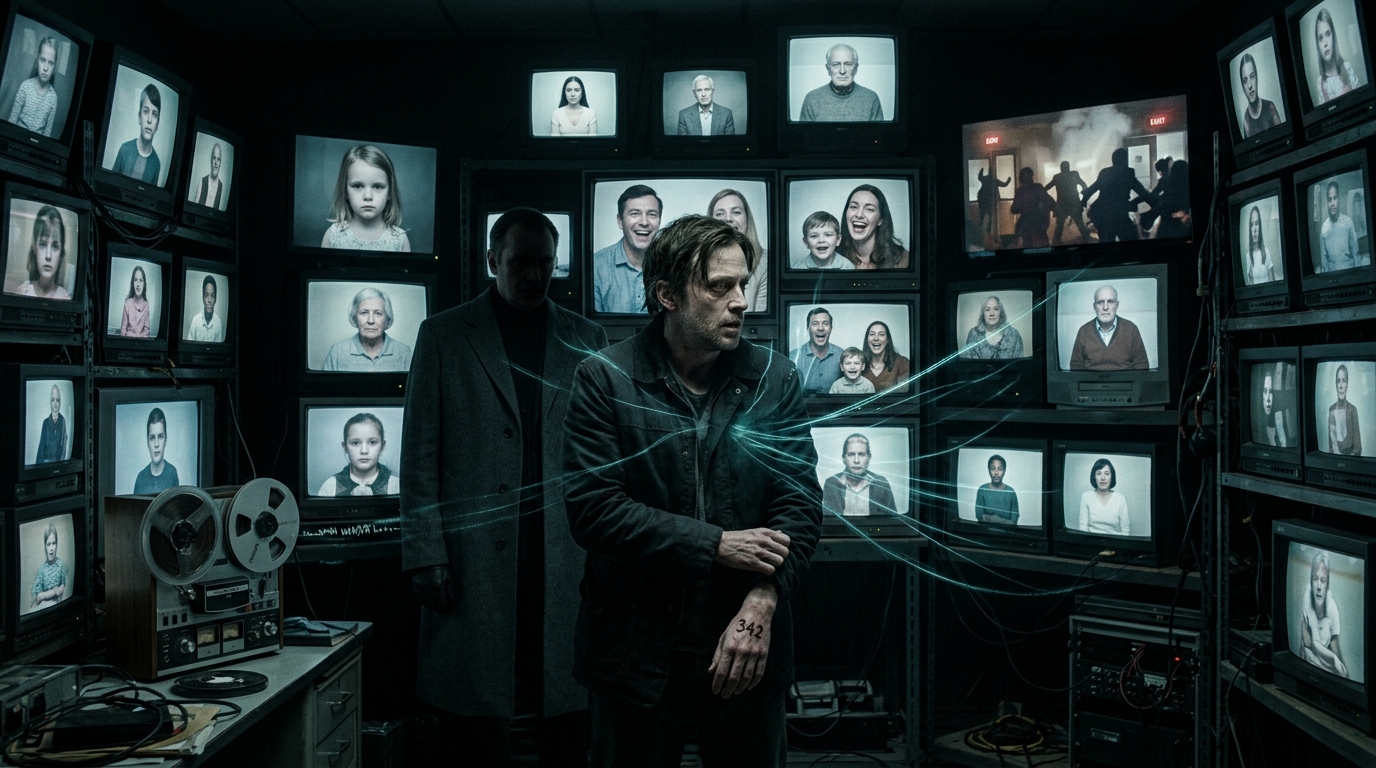
He opened the wall again.
This time, the room behind it was not full of jars.
It was full of screens.
Thousands of them.
Each screen showed a person.
A woman sitting in a kitchen while her family laughed around her.
She smiled politely.
No sound.
A boy watching cartoons with blank eyes.
A nurse holding a baby and rocking gently while other nurses smiled nearby.
A man at a comedy club staring at the stage like he was watching a language he used to speak.
A little girl in a hallway outside an apartment.
My neighbor.
Her name was Lily.
I knew because her mother called it every morning.
Lily stood beside the elevator holding a pink backpack.
Her mother crouched in front of her, making silly faces, desperate, exhausted, trying to pull even one giggle out of her child.
Lily only blinked.
My chest hurt.
“Stop showing me this.”
“You asked where your laughter went.”
“I didn’t ask to see children.”
Mr. Vale looked at me.
“That is where it went.”
Screen after screen.
Person after person.
All marked with labels.
Source event.
Transfer amount.
Emotional depletion status.
Replacement sound assigned.
I stepped closer to one screen.
An old man in a hospital bed.
Status: laughter removed.
Recipient: Julian Reed.
Payment: $1,000.
Date: February 19.
That was the day I made seven thousand dollars watching old sitcoms.
I opened another file.
A kindergarten teacher.
Recipient: Julian Reed.
Another.
A bride.
Recipient: Julian Reed.
Another.
A young woman at her father’s funeral.
Recipient: Julian Reed.
The room spun.
“How many?”
Mr. Vale answered without emotion.
“Three hundred and forty-two complete removals.”
I grabbed the edge of the console.
“And partials?”
He paused.
“Seven thousand, nine hundred and twelve.”
My knees nearly gave out.
Seven thousand people.
Touched by my contract.
Some completely emptied.
Some partially drained.
All because I thought laughter was mine to spend.
Then every screen changed.
One image appeared across all of them.
Me.
Standing in the archive.
Watching the silent people.
Below my image was a new file label.
JULIAN REED.
Status: depleted.
Next available extraction: tears.
Market demand: high.
I turned to Mr. Vale.
“You’re going to sell my grief.”
He corrected me gently.
“We’re going to see who needs it more.”
The Child Who Couldn’t Laugh
I ran from the building.
This time, the elevator let me leave.
That frightened me more than if it had trapped me.
Predators do not chase prey that already carries the hook inside.
I went straight to Lily’s apartment.
My neighbor.
The little girl in the archive.
Her mother opened the door looking like someone who had not slept in weeks.
She recognized me from the hallway.
“Mr. Reed?”
I could barely speak.
“Is Lily home?”
Her face tightened.
“Why?”
“I think I can help.”
That was a lie.
Or a hope.
Sometimes they look the same when you have nothing else.
She almost shut the door.
Then Lily appeared behind her.
Pink backpack.
Dark hair.
Round face.
Silent eyes.
The hallway light flickered above us.
I crouched down slowly.
“Hi, Lily.”
She looked at me.
No fear.
No curiosity.
Just emptiness where childhood sound should have lived.
Her mother whispered, “She hasn’t laughed in two months.”
Two months.
The timing matched.
My stomach twisted.
“She used to laugh at everything,” her mother said. “Cartoons. Dogs. Her own hiccups. Then one morning she just… stopped.”
Lily held something in her hand.
A small toy clown with a red nose.
She pressed the nose.
It squeaked.
Nothing.
Her mother covered her mouth to keep from crying.
I looked at Lily.
“I’m sorry.”
The girl tilted her head.
Like she understood apology but not feeling.
Then she stepped closer and touched my wrist.
The moment her fingers met my skin, a sound filled my head.
Laughter.
My laughter.
Her laughter.
Mixed together.
Stolen.
Stored.
Still alive somewhere.
Lily’s eyes widened.
She heard it too.
For one second, her mouth twitched.
Almost a smile.
Then my phone buzzed.
Unknown number.
One message.
RETURNING PRODUCT WITHOUT AUTHORIZATION VIOLATES CONTRACT.
The hallway lights went out.
Lily’s mother screamed.
When they came back on, Lily was gone.
The toy clown lay on the floor.
Its red nose had been cut off.
And on my wrist, where Lily had touched me, a black number had appeared beneath the skin.
342.
The number of people whose laughter I had taken completely.
The Refund Clause
I went back to The Laughter Exchange carrying Lily’s toy.
This time, I did not go through the elevator.
The building entrance opened before I touched the handle.
The lobby lights were red.
The elevator doors stood open.
Inside, instead of buttons, there was a contract taped to the wall.
Refund Request Form.
My name was already filled in.
Julian Reed.
Assets acquired:
Laughter.
Pending assets:
Tears.
Fear.
Hope.
Below that was a question.
Which acquired sound would you like to return first?
My hand shook as I picked up the pen.
All of them.
The ink vanished.
A new line appeared.
Insufficient balance.
I gripped the pen harder.
“What do you want?”
The elevator speaker crackled.
Mr. Vale’s voice answered:
“Equal value.”
The doors closed.
When they opened again, I was back on the twenty-second floor.
Mr. Vale stood in the white room with Lily beside him.
She wore the same pink backpack.
Her face blank.
Her small hand in his.
I stepped forward.
“Let her go.”
He looked almost disappointed.
“You still think this is about one child.”
“It is to me.”
“That is why comedians fail at scale. You confuse one crying room with the whole world.”
I held up the toy clown.
“She touched me. I heard the laughter. It still exists.”
“Of course.”
“Then give it back.”
He smiled faintly.
“Nothing is lost here, Mr. Reed. Only reassigned.”
“To who?”
He gestured toward the speaker.
The tape recorder began playing again.
This time, my laughter came from a stadium.
Thousands of people laughing in perfect rhythm.
Not naturally.
Not freely.
Like an audience commanded by invisible strings.
A screen lit up behind him.
A luxury theater.
Rich people seated in darkness.
Silent.
Waiting.
Onstage stood a woman under golden lights.
She opened her mouth.
My laugh came out.
The audience applauded.
Mr. Vale said:
“Private collectors pay very well for joy untouched by their own suffering.”
I stared at him.
“You sell it as entertainment.”
“We sell emotional authenticity.”
I looked at Lily.
Her eyes were fixed on the floor.
“What does it cost to buy hers back?”
Mr. Vale’s expression softened.
Almost kindly.
“That depends.”
“On what?”
“Whether you want to return only her laughter…”
He stepped closer.
“Or everyone’s.”
The room went silent.
I knew the trap before he opened it.
Still, I asked.
“What’s the price?”
He handed me a new contract.
One page.
One sentence.
To restore all acquired laughter, participant agrees to surrender the source of all future joy.
My throat tightened.
“What does that mean?”
Mr. Vale looked toward Lily.
“It means you may give them back the ability to laugh.”
His smile returned.
“But you will never again feel a reason to.”
I looked at the contract.
Then at Lily.
Then at the screens behind him, showing thousands of silent people whose joy had been taken through my hunger.
I picked up the pen.
The moment I touched it, every screen changed.
My mother appeared on one.
My father on another.
My old audience.
My neighbors.
My childhood home.
Every memory that had once made me laugh.
All waiting to be erased.
Mr. Vale whispered:
“Sign, and you become the joke no one remembers laughing at.”
Lily finally looked up at me.
For the first time, a tear slid down her face.
Then she whispered:
“Don’t. He already made you sign once.”
I froze.
“What?”
The contract in my hand changed.
The signature line was no longer blank.
My name was already there.
Signed in my handwriting.
Dated three months before I met Mr. Vale.
And beneath it, in small black print, was the real first clause.
Participant agrees to forget volunteering.
The room tilted.
Mr. Vale leaned close and whispered:
“You were never unemployed when we found you, Julian.”
The screens behind him flickered.
One by one, they showed the same memory.
Me.
Standing on a stage.
People laughing.
A little girl in the front row.
Lily.
Laughing so hard she could barely breathe.
Then a fire alarm.
A locked exit.
Smoke.
Screaming.
My voice on a microphone yelling for everyone to stay calm.
Then silence.
Mr. Vale’s hand on my shoulder.
His voice saying:
We can remove the guilt, if you give us the laughter.
I dropped the pen.
Lily whispered:
“You didn’t sell your laughter for money.”
The lights dimmed.
Mr. Vale smiled.
“You sold it to forget why they stopped laughing in the first place.”
Then the tape recorder played one final sound.
Not laughter.
Children screaming behind a locked theater door.