The Grave He Always Visited
I went back to the cemetery the next morning.
That was the first stupid thing I did.
The second was going alone.
Grayford City Cemetery looked different in daylight.
Less haunted.
More neglected.
Wet grass.
Crooked headstones.
Dead flowers wrapped in plastic.
A groundskeeper smoking near the maintenance shed.
Crows sitting along the iron fence like they had been waiting for me to return.
I told myself I was there for answers.
That sounded better than admitting I wanted proof I had not gone insane.
The night before, my passenger had sat in my taxi at 4 a.m.
He had told me he visited himself.
Then he had paid me with coins old enough to belong in a museum.
Then he had walked through the locked cemetery gate.
I had seen it.
I knew I had seen it.
But daylight makes fear feel embarrassing.
So I walked through the cemetery paths with my phone in one hand and the photo from the wooden box in the other.
The photo showed me in the back seat of my own taxi.
With Edmund Hollow driving.
I still could not explain that.
I found the grave near the east fence.
Not the old neglected one from before.
A new grave.
Fresh soil.
Clean stone.
White flowers still damp from the morning rain.
The headstone was polished black marble.
Too new.
Too expensive.
Too recently placed.
And on it was his photograph.
The man from my taxi.
Same black coat.
Same gray hat.
Same hollow eyes.
His name was carved beneath the picture.
EDMUND HOLLOW.
Born 1941.
Died 2011.
Fifteen years ago.
My knees weakened.
No.
That was not possible.
I had driven him last night.
I had heard his voice.
I had watched him count coins onto my console.
I had smelled the damp wool of his coat inside my car.
Dead men do not leave tips.
Dead men do not rate rides five stars.
Dead men do not ask drivers to bring shovels next month.
I reached out and touched the headstone.
Cold.
Real.
Freshly carved.
At the bottom of the stone, beneath the death date, someone had added one more line.
Still waiting for the last ride home.
The Cemetery Record
I found the cemetery office near the front gate.
A small brick building with fogged windows, a rusted filing cabinet, and an old woman behind the desk who looked like she had been born knowing where everyone ended up.
She did not ask why my hands were shaking.
That made me trust her less.
“I need to ask about a grave,” I said.
“Family?”
“No.”
She looked up.
“Then why?”
I placed the photograph of Edmund Hollow on the desk.
Her face changed.
Not surprise.
Recognition.
Then discomfort.
“That plot is private.”
“I drove him here last night.”
She stared at me for a long moment.
Then said quietly:
“No, you didn’t.”
My mouth went dry.
“You know him?”
“I know the grave.”
“That’s not what I asked.”
She folded her hands on the desk.
“Edmund Hollow died fifteen years ago.”
“I saw the headstone.”
“Then you already know.”
“I picked him up from 17 Blackwater Lane.”
Her fingers tightened.
Only slightly.
But I noticed.
“Who told you that address?”
“He did.”
The old woman leaned back.
The office clock ticked too loudly above us.
“Mr. Vale,” she said, “no one has lived at 17 Blackwater Lane since the fire.”
My blood turned cold.
“What fire?”
She looked toward the window.
Toward the cemetery.
Toward the new black headstone.
Then back at me.
“The one that killed Edmund Hollow.”
I sat down without being invited.
The chair creaked beneath me.
“How did he die?”
She opened the drawer slowly and pulled out an old file.
Not from the computer.
Paper.
That frightened me more.
Some things are kept off systems for a reason.
She placed the file between us but did not open it.
“Officially, smoke inhalation.”
“And unofficially?”
Her eyes lifted to mine.
“Buried before he was dead.”
The room seemed to tilt.
“Who buried him?”
She did not answer.
Instead, she pushed the file toward me.
Inside was a newspaper clipping.
Fifteen years old.
HOUSE FIRE CLAIMS LOCAL BUSINESSMAN.
Another clipping.
BODY IDENTIFIED THROUGH PERSONAL EFFECTS.
Another.
FAMILY DECLINES PUBLIC SERVICE.
The final page was not a newspaper article.
It was a cemetery note.
Plot opened three times.
Body absent.
My throat tightened.
“The groundskeeper said his old grave was empty.”
The woman nodded.
“Because they never found him where they buried him.”
I stared at her.
“What does that mean?”
She looked at the taxi photo in my hand.
“It means someone keeps driving him back.”
The Empty Back Seat
I ran to my car.
Not walked.
Ran.
The cemetery gravel scattered beneath my shoes as I crossed the parking lot.
My taxi sat under a bare tree, windows fogged from the inside.
I stopped when I saw that.
Fogged.
The engine was off.
The doors were locked.
No one inside.
Still, the rear passenger window was covered in condensation.
And on the glass, written by a finger from inside the car, were two words:
CHECK CAMERA.
My stomach dropped.
I unlocked the door with shaking hands.
The smell hit me immediately.
Damp wool.
Smoke.
Old coins.
The back seat was empty.
Of course it was.
But the air still carried him.
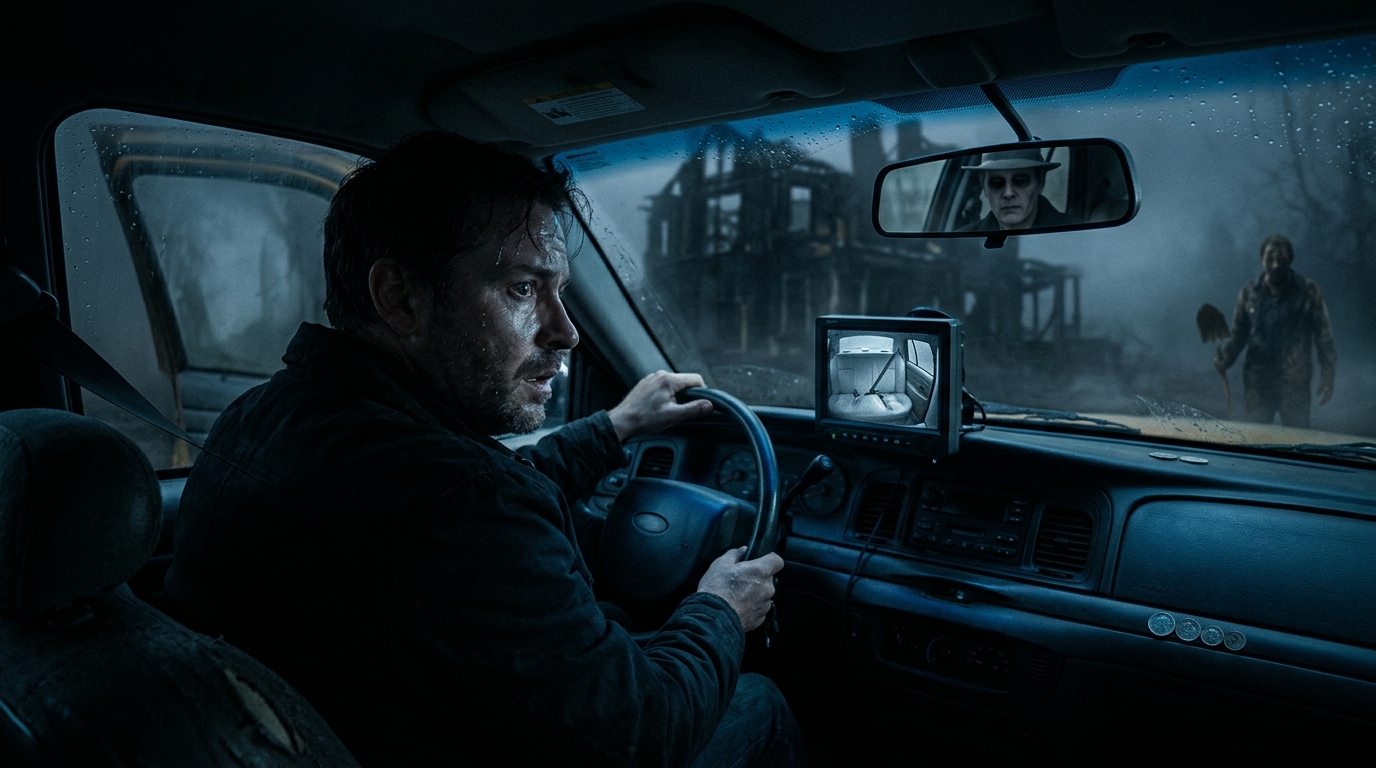
I opened the dash camera app.
My taxi had two cameras.
Front road.
Interior cabin.
I never watched the interior footage unless a passenger caused trouble.
Or accused me of something.
Or left something behind.
My thumb shook as I selected last night’s ride.
4:00 a.m.
Pickup.
17 Blackwater Lane.
The front camera showed the house.
Dark.
Condemned.
The meter starting.
The route to the cemetery.
Normal.
Then I opened the cabin camera.
The video loaded.
For one second, I held my breath.
The rear door opened.
Cold air moved the plastic hanging from the seat divider.
The door shut.
The seatbelt warning chimed.
But the back seat was empty.
No man.
No black coat.
No gray hat.
No wooden box.
Nothing.
Still, in the audio, my voice said:
“Grayford Cemetery?”
Silence.
Then I answered myself.
“Sure. Long night?”
My skin turned to ice.
The camera showed me driving with both hands on the wheel, glancing into the rearview mirror again and again.
Talking.
Pausing.
Listening to no one.
Then speaking again.
Every response.
Every question.
Every moment I thought Edmund Hollow sat behind me.
There was only me.
My voice sounded normal.
Casual.
Then nervous.
Then frightened.
At 4:17 a.m., on the footage, I asked:
“Who do you visit every month?”
The back seat remained empty.
The audio recorded a long silence.
Then I whispered, in a voice that was not quite mine:
“Myself.”
I dropped the phone.
It hit the floor mat beneath the steering wheel.
The video kept playing.
On-screen, my face in the rearview mirror looked pale.
My eyes looked wrong.
Not empty.
Occupied.
Then the taxi reached the cemetery gate.
I stopped the car.
The rear door opened by itself.
No one got out.
But the seat cushion rose slowly, as if a weight had lifted.
Then the old coins appeared on the console.
One by one.
Not placed by a hand.
Just appearing.
Clink.
Clink.
Clink.
The final coin rolled toward the camera.
It stopped against the gearshift.
On it was my name.
CALEB VALE.
The Fare That Paid Itself
I sat in the cemetery parking lot for twenty minutes with the doors locked and the camera footage frozen on the empty back seat.
There is a kind of fear that makes you want to scream.
This was not that.
This was quieter.
Worse.
It made me question every mirror I had ever trusted.
Had I driven him?
Had he entered the cab?
Had the taxi been empty?
Had the passenger been sitting behind me?
Or inside me?
I picked up the old coin from the console.
The one with my name scratched into it.
It was still there.
Solid.
Cold.
Proof.
Or bait.
On the other side of the coin was a date.
Next month.
First Monday.
4:00 a.m.
The same date carved beneath my name on Edmund Hollow’s old empty grave.
My phone buzzed.
Taxi app notification.
Ride receipt updated.
Passenger: Edmund Hollow.
Fare: Paid.
Tip: One memory.
My mouth went dry.
The screen changed before I touched it.
A new file opened.
Interior camera.
But not from last night.
From fifteen years ago.
That was impossible.
My taxi was only six years old.
Still, the footage played.
The cabin looked older.
Different upholstery.
Different dashboard.
Rain hammered against the windshield.
In the driver’s seat sat a younger Edmund Hollow.
Alive.
Terrified.
His face streaked with soot.
In the back seat sat a man I recognized from somewhere I could not place.
Tall.
Black gloves.
Face hidden by shadow.
Between them was a wooden box.
The same one from the grave.
The man in the back seat said:
“You know what happens if you tell them.”
Edmund gripped the wheel.
“My family is inside.”
“No,” the man said softly. “Your family is already a receipt.”
The footage glitched.
When it returned, Edmund was no longer driving.
The back seat was empty.
The car was parked outside 17 Blackwater Lane.
The house was burning.
Then the camera turned by itself toward the passenger window.
A child stood outside in the rain.
Maybe ten years old.
Barefoot.
Covered in ash.
Looking directly into the lens.
The child lifted one hand.
In it was an old coin.
Then the video ended.
17 Blackwater Lane
I drove to the house before I could talk myself out of it.
That was becoming a pattern.
Blackwater Lane was worse by day.
At night, darkness hides decay.
Daylight shows where the world gave up.
Number 17 stood behind a rusted fence.
Boarded windows.
Burn marks above the second floor.
Front door chained shut.
A condemned notice hung crooked near the mailbox.
No one had lived there in fifteen years.
Yet every month, my taxi app picked up Edmund Hollow from that address.
I parked across the street.
The meter turned on by itself.
Pickup confirmed.
My hands froze on the wheel.
It was not 4 a.m.
It was 11:36 in the morning.
Still, the app displayed the same destination.
Grayford City Cemetery.
Then changed.
Destination updated:
INSIDE.
I looked at the house.
A curtain moved behind one boarded window.
No.
Not a curtain.
A figure.
Small.
Child-sized.
My throat tightened.
The old coin in my hand warmed suddenly.
The car radio turned to static.
Then Edmund Hollow’s voice filled the cab.
Not from behind me.
From the speakers.
“Do not go in through the front.”
I looked at the empty back seat.
“Where are you?”
The radio crackled.
“Not where they buried me.”
My pulse hammered.
“Who buried you?”
Static.
Then:
“The man you become if you take the next fare.”
The words hit me slowly.
“What does that mean?”
The rearview mirror darkened.
Not fog.
Not shadow.
Darkened like something was standing close behind my reflection.
Then a face appeared over my shoulder.
Not Edmund.
Me.
Older.
Burned along one side.
Eyes hollow.
Mouth full of dirt.
The reflection whispered:
“Bring the shovel next month.”
I threw the car door open and stumbled into the street.
The radio kept playing behind me.
A child’s voice joined Edmund’s.
Soft.
Urgent.
“He’s under the kitchen.”
Then the front door of 17 Blackwater Lane unlocked by itself.
The Kitchen Floor
Inside, the house smelled like smoke trapped in wood for fifteen years.
Burned wallpaper peeled in black curls.
The staircase had collapsed halfway up.
Rain dripped through a hole in the ceiling into a metal bowl someone had placed there recently.
Recently.
That word mattered.
Someone had been inside.
Someone living.
Or hiding.
Or waiting.
I followed the child’s voice in my memory.
He’s under the kitchen.
The kitchen sat at the back of the house.
Charred cabinets.
Cracked tile.
Rusting sink.
A refrigerator with no door.
In the center of the floor was a square outline.
Trapdoor.
Painted over.
Burned around the edges.
I pulled at it.
Nothing.
Locked from below.
Then the old coin in my pocket began vibrating.
I took it out.
It spun in my palm.
Faster.
Faster.
Then dropped onto the floor.
It rolled to the corner near the oven and stopped beside a loose brick.
Behind the brick was a key.
Blackened.
Cold.
I unlocked the trapdoor.
The smell that came up was not smoke.
It was earth.
Wet.
Deep.
Grave earth.
I opened the door.
Stone steps led down beneath the kitchen.
A basement that should not have survived the fire.
At the bottom, I found a room lined with old taxi meters.
Dozens of them.
Each one still running.
Different fares.
Different dates.
Different names.
All ending at 4:00 a.m.
On the far wall hung photographs of drivers.
Some old.
Some recent.
Some I recognized from local missing-person reports.
Each photo had a coin pinned beneath it.
A fare paid.
A memory taken.
And in the center of the room sat the wooden box.
The one Edmund carried every ride.
The one from the grave.
This time, it was open.
Inside was a taxi license.
Mine.
Issued next month.
But the photo showed me fifteen years older.
And beneath it, one line:
AUTHORIZED TO TRANSPORT THE DEAD.
Behind me, the trapdoor slammed shut.
The taxi meters all stopped at once.
4:00.
A voice spoke from the darkness beneath the stairs.
Edmund Hollow.
“Now you know why I needed a driver.”
I turned slowly.
He stood there.
Not as a passenger.
Not as a reflection.
Covered in grave dirt.
Eyes empty.
Holding a shovel.
Then he whispered:
“The man who killed me still rides for free.”