
The Soup My Mother Used To Make
The soup was not Julian’s.
That was what broke me.
At first, my mind had reached for the safest explanation.
My brother’s final recipe.
The dish from the night our restaurant burned.
The one no one should have been able to recreate.
But as the flavor settled on my tongue, deeper memories rose beneath it.
Older.
Softer.
More painful.
Bay leaf crushed between fingers.
Chicken bones roasted until golden.
White pepper.
Cream.
Black mushrooms.
And the faint sweetness of dried winter root.
My mother’s soup.
The one she made when I was sick.
The one she made when Julian cried because our father forgot his birthday.
The one she made every winter until the cancer took her voice, then her hands, then everything else.
My mother had been dead for twenty years.
No one alive knew that recipe.
Not fully.
Not even Julian.
She never wrote it down.
She cooked by touch, by smell, by memory.
A pinch of this.
A handful of that.
Stir until it looks like rainwater at dusk.
That was how she taught me.
And now that exact taste sat inside a forbidden bowl in Ashbourne House.
I gripped the counter while the locked dining room breathed beyond the black door.
Mrs. Harrow stood near the corridor, white-faced.
The soup bowl on the trolley boiled without fire.
Six bowls.
Seven spoons.
One locked room.
No guests.
And from behind the service hatch, my brother’s voice had whispered:
Adrian… don’t feed them.
But underneath his voice, behind it, inside it, I heard something worse.
My mother humming.
The same melody she hummed when stirring soup at our old kitchen stove.
My eyes burned.
“What is this?” I whispered.
Mrs. Harrow shook her head.
“You should not have tasted it.”
“What is in the soup?”
“Memory.”
I looked at her.
She swallowed.
“Grief.”
The black door at the end of the corridor groaned softly.
The hatch opened again.
Darkness waited behind it.
Then a woman’s hand reached out.
Pale.
Thin.
Wearing my mother’s wedding ring.
I stopped breathing.
Mrs. Harrow whispered, “Do not go near it.”
But the hand slowly turned palm-up.
As if asking for another bowl.
Or asking me to take it.
I took one step forward.
The hand vanished.
The hatch slammed shut.
And every spoon on the trolley bent toward the black door.
The Room That Ate Dinner
I grabbed the fire axe from the kitchen wall.
Mrs. Harrow screamed my name.
For the first time, she sounded human.
Not polished.
Not obedient.
Terrified.
“Chef Vale, don’t!”
I ignored her.
The corridor seemed longer than before.
Impossible, but true.
The black door waited at the end, its surface glossy under the dim wall lamps, reflecting nothing.
Not me.
Not Mrs. Harrow.
Not the trolley behind us.
A door that refused witnesses.
I struck it once.
The axe bounced hard enough to numb my arms.
Behind the door, something sighed.
I struck again.
Wood splintered.
Mrs. Harrow sobbed behind me.
“You don’t understand. The room is all he has left.”
I turned.
“Who?”
She covered her mouth.
Before she could answer, a man’s voice came from the kitchen doorway.
“Me.”
Lord Ashbourne stood beneath the light.
I had not seen him since arriving.
Not properly.
Only his portrait in the entrance hall.
In person, he looked older.
Seventy, perhaps.
Tall but collapsed inward by a grief that money had failed to repair.
His suit was immaculate.
His eyes were ruined.
He stared at the axe in my hands.
Then at the black door.
“Please,” he said quietly. “Don’t open it.”
That word should have stopped me.
Please.
Rich men rarely use it unless something is truly beyond purchase.
But the taste of my mother’s soup still burned in my mouth.
And the voice behind that door had worn my brother’s pain.
I lifted the axe.
Ashbourne stepped forward.
“I said please.”
I struck the door a third time.
The lock broke.
The black door swung inward.
Cold air poured out.
The smell hit first.
Not rot.
Not death.
Paper.
Wax.
Old flowers.
A room sealed around decades of waiting.
I raised the axe.
Then stopped.
There was no dining table.
No family.
No child.
No monster.
No one at all.
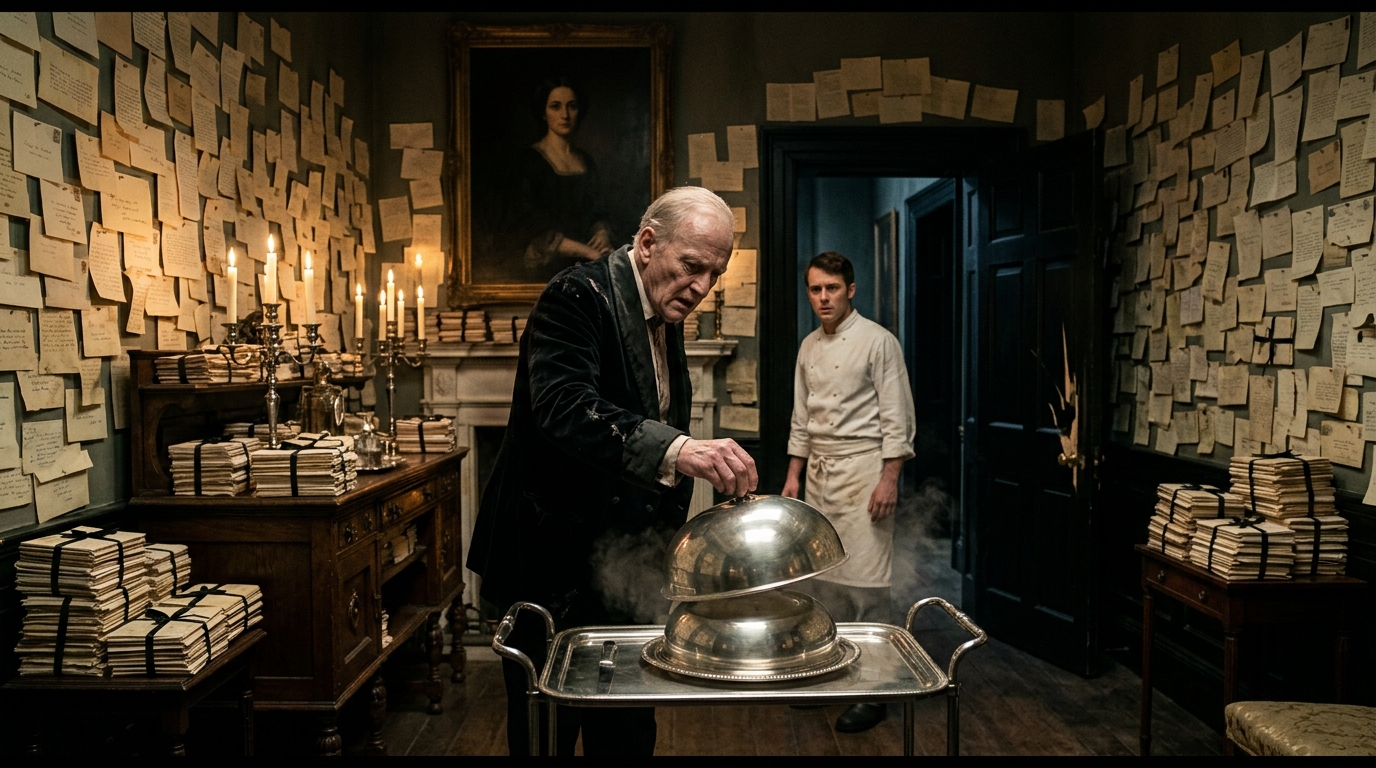
Only letters.
The Letters To A Dead Woman
The room was full of them.
Hundreds.
Maybe thousands.
Letters covered every wall from floor to ceiling.
Pinned.
Stacked.
Tied in bundles with black ribbon.
Some yellowed with age.
Some fresh.
Some written on expensive stationery.
Some on napkins.
Some on torn kitchen paper stained with sauce and wine.
All addressed to the same woman.
My beloved Elise.
My dearest Elise.
My wife.
My love.
The room had no windows.
No chairs except one at the center.
On that chair sat a porcelain plate.
Empty.
Beside it, seven spoons arranged in a perfect circle.
Above the chair hung a portrait of a woman.
Not my mother.
But for one terrible second, I almost thought it was.
Because she had the same softness around the eyes.
The same tired kindness.
The same look of someone who had spent her life feeding other people before anyone asked whether she was hungry.
Elise Ashbourne.
Lord Ashbourne’s wife.
The dates under the portrait made my stomach drop.
1968–2005.
Dead twenty years.
Mrs. Harrow stood in the doorway crying silently.
Lord Ashbourne entered behind me like a man stepping into a chapel.
He did not look at me.
He looked at the empty plate.
“She liked soup best,” he whispered.
His voice broke on the last word.
The room seemed to inhale around him.
The letters rustled though no wind entered.
I walked toward the nearest wall and read one.
Elise,
The chef tonight had your sister’s hands. He chopped parsley exactly the way she used to. I almost asked him if he knew her. I did not. You always said I frightened people when I wanted too much from them.
Another letter.
Elise,
The young woman who baked the tart smiled like Clara. I hired her for three evenings, then let her go before I started seeing your face in hers.
Another.
Elise,
Tonight’s chef had Adrian Vale’s eyes. You would have liked him. You loved his mother’s soup, remember? You said it tasted like being forgiven.
My blood froze.
Adrian Vale.
Me.
My mother’s soup.
I turned slowly toward Lord Ashbourne.
“You knew my mother.”
His face crumpled.
“No.”
“Then how do you know her recipe?”
He stared at the letters.
“Elise knew her.”
My throat closed.
“What?”
“They met before either of us had money.” He smiled faintly through tears. “Your mother cooked at a shelter near the old station. Elise volunteered there before her father dragged her back into society.”
My chest tightened painfully.
“My mother never told me.”
“Elise spoke of her often. Said she made soup for people as if hunger were a wound she could close with both hands.”
I looked at the empty plate.
The seven spoons.
The bowls outside.
The rule.
Do not taste anything.
“Why hire me?”
Lord Ashbourne’s shoulders trembled.
“Because you look like her when you cook.”
The words struck harder than I expected.
Not a threat.
Not an explanation.
A confession soaked in madness.
He turned toward me then.
Eyes red.
Face bare.
“Twenty years ago, my wife died at that table.”
I looked at the empty chair.
“She died here?”
He nodded.
“During dinner.”
The Last Meal
Lord Ashbourne sat slowly in the chair at the center of the room.
Not on the guest side.
On the servant side.
As if he had spent twenty years punishing himself with proximity.
“Elise was ill,” he said. “Worse than she admitted. She refused doctors. Refused hospitals. She said hospitals made death feel administrative.”
His hands shook against his knees.
“She asked for one last dinner.”
Mrs. Harrow sobbed softly in the doorway.
“I ordered the best chefs in the country. Paid absurd amounts. Made impossible demands. I wanted perfection.”
He laughed once.
It was a terrible sound.
“She didn’t want perfection. She wanted memory.”
I said nothing.
He looked at the portrait.
“She asked for seven spoons because she said every person she had ever loved had fed her somehow. Her mother. Her sister. Your mother. An old baker from Paris. A boy she saved from the street. A nurse. Me.”
His voice cracked.
“She said food was the only way the dead visited honestly.”
The room felt colder.
I remembered my mother saying something similar once.
People come back through taste.
I had been twelve.
I thought she meant nostalgia.
Now I was not sure.
Lord Ashbourne continued.
“She died before the soup arrived.”
Silence.
The letters rustled again.
My hand tightened around the axe.
“So you kept feeding her?”
He nodded.
“At first, I cooked myself.”
His voice dropped.
“I burned everything.”
He smiled bitterly.
“She would have laughed at that. I was hopeless in the kitchen. Could buy restaurants, but couldn’t boil water without making it taste like punishment.”
He looked at me.
“So I hired chefs.”
“Without letting them taste the food.”
His expression darkened with shame.
“If they tasted it, they remembered.”
“Remembered what?”
“Elise.”
“No.” I shook my head. “I tasted my mother.”
“Exactly.”
I froze.
Lord Ashbourne’s eyes filled again.
“The room gives back the person who taught you hunger, grief, love, whatever you buried deepest. Every chef who tasted the food heard someone. Saw someone. Lost someone again.”
Mrs. Harrow whispered, “Some never recovered.”
I turned toward her.
“How many?”
She looked away.
Lord Ashbourne covered his face.
“Too many.”
The walls suddenly seemed crowded.
Not with letters.
With absences.
Every chef.
Every person hired because they resembled someone Elise had loved.
Every meal cooked for a woman who could no longer eat.
Every taste forbidden because memory could open doors the living were not built to survive.
I looked back at him.
“Why keep doing it?”
He lowered his hands.
“Because sometimes…”
His voice became almost inaudible.
“Sometimes the plates came back warm.”
The Chefs She Loved
Mrs. Harrow stepped into the room at last.
The silver key at her throat trembled.
“I tried to stop him,” she said.
Lord Ashbourne closed his eyes.
“No, you didn’t.”
“I hid the menus.”
“You rewrote them.”
“I dismissed chefs early.”
“And found new ones.”
Their grief had its own language.
A marriage of guilt and employment.
I looked from one to the other.
“How many of us were chosen?”
Lord Ashbourne did not answer.
So Mrs. Harrow did.
“Seven at a time.”
My stomach turned.
“What?”
“Elise loved seven people most in her life. Lord Ashbourne believed if the right seven chefs cooked the right seven meals, the room would give her back.”
The room seemed to tighten.
I stared at the empty plate.
“Give her back?”
Lord Ashbourne whispered, “One night, I heard her voice.”
The letters rustled harder.
The candles along the walls flickered though none had been lit before.
I turned.
Tiny flames now burned on seven black candles beside the portrait.
Lord Ashbourne looked at them with awe and terror.
“Every year, on the anniversary, I tried again.”
I swallowed.
“And this year?”
He looked at me.
“You are the seventh.”
The air left my lungs.
Outside the room, the soup bowls began rattling on the trolley.
One by one.
Softly at first.
Then louder.
Mrs. Harrow backed toward the door.
“No…”
Lord Ashbourne stood.
His face changed.
Hope.
That was the most frightening expression I had seen all night.
Not madness.
Hope.
“Adrian,” he whispered. “What did you taste?”
I did not answer.
He stepped closer.
“What did you hear?”
I thought of my mother’s humming.
Julian’s voice.
Don’t feed them.
I looked at the seven spoons arranged around the empty plate.
One bent.
The same spoon from the first night.
The one returned twisted.
Like someone inside the room had rejected it.
Or tried to hold on.
“I heard my brother.”
Lord Ashbourne’s smile faded.
“He isn’t dead.”
“No.”
“Then why would the room use his voice?”
A cold realization moved through me.
Because Julian had been here before.
The private dinner.
The anonymous client.
The recipe.
The restaurant fire.
My brother had not invented that final dish.
He had been hired by Ashbourne too.
And he had tasted the food.
That was why his memory broke after the fire.
Not from smoke alone.
From this room.
I looked at Lord Ashbourne.
“You hired Julian Vale six months ago.”
He flinched.
“Briefly.”
“My restaurant burned that night.”
His eyes filled with horror.
“I didn’t know.”
I stepped toward him.
“You didn’t know?”
Mrs. Harrow whispered, “The room follows what it tastes.”
The words landed slowly.
The soup outside began boiling harder.
The black door slammed shut behind us.
The Room Remembered My Brother
The letters tore themselves from the walls.
One by one.
Then dozens.
Then hundreds.
They swirled through the room like dead birds, circling the portrait of Elise Ashbourne.
Lord Ashbourne shouted her name.
Mrs. Harrow screamed for the door.
I grabbed the handle.
Locked.
Of course.
The empty plate on the chair cracked down the middle.
The seven spoons lifted from the table.
Suspended in the air.
Pointing toward me.
No.
Not me.
Toward the taste still alive on my tongue.
My mother’s soup.
Julian’s warning.
Elise’s hunger.
Every grief the room had been fed for twenty years.
Lord Ashbourne fell to his knees.
“Elise,” he sobbed. “Please.”
The portrait changed.
Not moving exactly.
But the woman’s painted eyes opened.
Mrs. Harrow screamed.
The eyes did not look at Lord Ashbourne.
They looked at me.
A voice filled the room.
Soft.
Warm.
Dead.
“Adrian Vale.”
My body went cold.
“Who are you?”
The voice sounded almost sad.
“Elise.”
Lord Ashbourne began crying harder.
“Elise, my love—”
The candles blew out.
The voice sharpened.
“You were told not to feed me grief.”
The room went silent.
Lord Ashbourne froze.
I stared at him.
“What does that mean?”
Elise’s painted eyes remained fixed on me.
“He did not cook for me.”
The letters on the floor began turning over by themselves.
Every page.
Every letter.
Every confession.
The same line appeared on each in dark ink.
HE COOKED SO I COULD NOT LEAVE.
Lord Ashbourne shook his head violently.
“No. No, I loved you.”
The portrait voice replied:
“You loved being forgiven.”
The floor beneath the chair split open.
Not wide.
Just enough for cold air to rise from below.
Inside the crack, I heard whispering.
Not one voice.
Many.
Chefs.
Servants.
Women.
Men.
All the memories this room had eaten because one man could not let the dead remain dead.
Then, beneath them all, my brother’s voice surfaced again.
Weak.
Real.
“Adrian…”
My throat tightened.
“Julian?”
The crack widened.
A small object slid up from beneath the floor.
A spoon.
Burned black at the handle.
I knew it.
It came from our restaurant.
Julian used it every night.
The one missing after the fire.
The room had taken it.
No.
The room had taken part of him.
I picked it up with shaking fingers.
The moment I touched it, I saw him.
Julian standing in this room six months ago.
Younger than he looked now.
Laughing nervously.
Tasting soup.
Dropping the spoon.
Hearing our mother.
Then Lord Ashbourne saying:
One more course, Chef. She’s almost here.
Then flames.
Not in the room.
In our restaurant.
The room had followed the taste home.
I came back gasping.
Lord Ashbourne stared at me, terrified.
“You knew,” I whispered.
He shook his head.
“I didn’t mean—”
“You fed it my brother.”
“No.”
“You fed it everyone.”
The black door unlocked behind me.
Click.
Mrs. Harrow sobbed with relief.
But I did not leave yet.
Because the portrait of Elise was still looking at me.
Her voice lowered.
“Adrian, do not let him serve the final course.”
I looked toward the trolley outside the door.
The six bowls were gone.
In their place sat one covered silver dish.
I had not cooked it.
No one had.
Lord Ashbourne stood slowly.
His grief had changed again.
From shame.
To hunger.
He looked at the covered dish like a starving man seeing God.
“Elise,” he whispered. “Is that you?”
The silver lid trembled.
From beneath it came my mother’s humming.
Then Julian’s coughing.
Then a woman’s laugh I did not recognize.
Lord Ashbourne reached for the lid.
I grabbed the axe.
Mrs. Harrow whispered, “If he opens it, the room chooses who replaces her.”
Lord Ashbourne turned toward me.
His eyes were wet.
Feverish.
Almost childlike.
“She only needs one body,” he said.
Then every candle relit at once.
And the covered dish began to cry.