
The Chair Nobody Wanted
I only bought the chair because it was cheap.
That is the truth.
Not because it was beautiful.
Not because it looked antique.
Not because I believed old furniture carried stories worth saving.
I bought it because my apartment had one plastic stool, one mattress, and a kitchen table I ate at while standing.
The chair sat at the back of the clearance market beneath a torn blue tarp, half hidden behind broken lamps and boxes of mismatched dishes.
Dark wood.
High back.
One arm cracked.
Seat cushion faded into a color that might once have been green.
It looked tired.
That was the word that came to me.
Tired.
Like someone had sat in it for too many years waiting for someone who never came home.
The old man running the stall watched me touch the chair.
“Five dollars,” he said.
I looked at him.
“For the whole chair?”
He shrugged.
“Take it today.”
That should have warned me.
People selling furniture usually try to make it sound valuable.
Solid wood.
Vintage.
Imported.
Belonged to a doctor.
This man wanted it gone.
I lifted the chair by the backrest.
It was heavier than it looked.
Too heavy.
Something inside the frame shifted when I moved it.
A dull sound.
Not wood.
Metal.
“What’s wrong with it?” I asked.
The old man looked away.
“Nothing if you don’t sit too long.”
I laughed because I thought he was joking.
He did not laugh.
Still, I paid him.
Five dollars for a chair was five dollars less than I expected to spend.
My name is Caleb Ward, and at that point in my life, I had become very good at ignoring bad feelings when the price was low enough.
I carried the chair eight blocks home in light rain, stopping twice because the weight dug into my palms.
By the time I reached my apartment, my shirt was soaked, my back hurt, and the chair had left dark stains on both sleeves.
Not dirt.
Something oily.
Almost brown.
I told myself it was old varnish.
That was the first lie.
I would tell myself many more before the night ended.
The Mark Under The Seat
My apartment was on the third floor above a closed pharmacy.
The kind of building where every pipe groaned at night and every neighbor pretended not to hear arguments through the walls.
I placed the chair beside my kitchen table and stepped back.
It looked wrong immediately.
Not ugly.
Wrong.
As if it had not entered the room.
As if the room had adjusted around it.
The chair faced the window.
I had not placed it that way.
I was sure of that.
I turned it toward the table.
Then made coffee.
When I looked back, it seemed to face the window again.
Not fully.
Just slightly.
Enough that my mind noticed before I wanted to.
I blamed the uneven floor.
Then I started cleaning it.
The wood was covered in grime.
Old dust.
Sticky residue near the armrests.
Tiny scratches along the legs.
The cushion smelled faintly of damp cloth and smoke.
I removed the cushion first.
Nothing.
Just cracked springs and yellowed fabric underneath.
Then I flipped the chair onto its side.
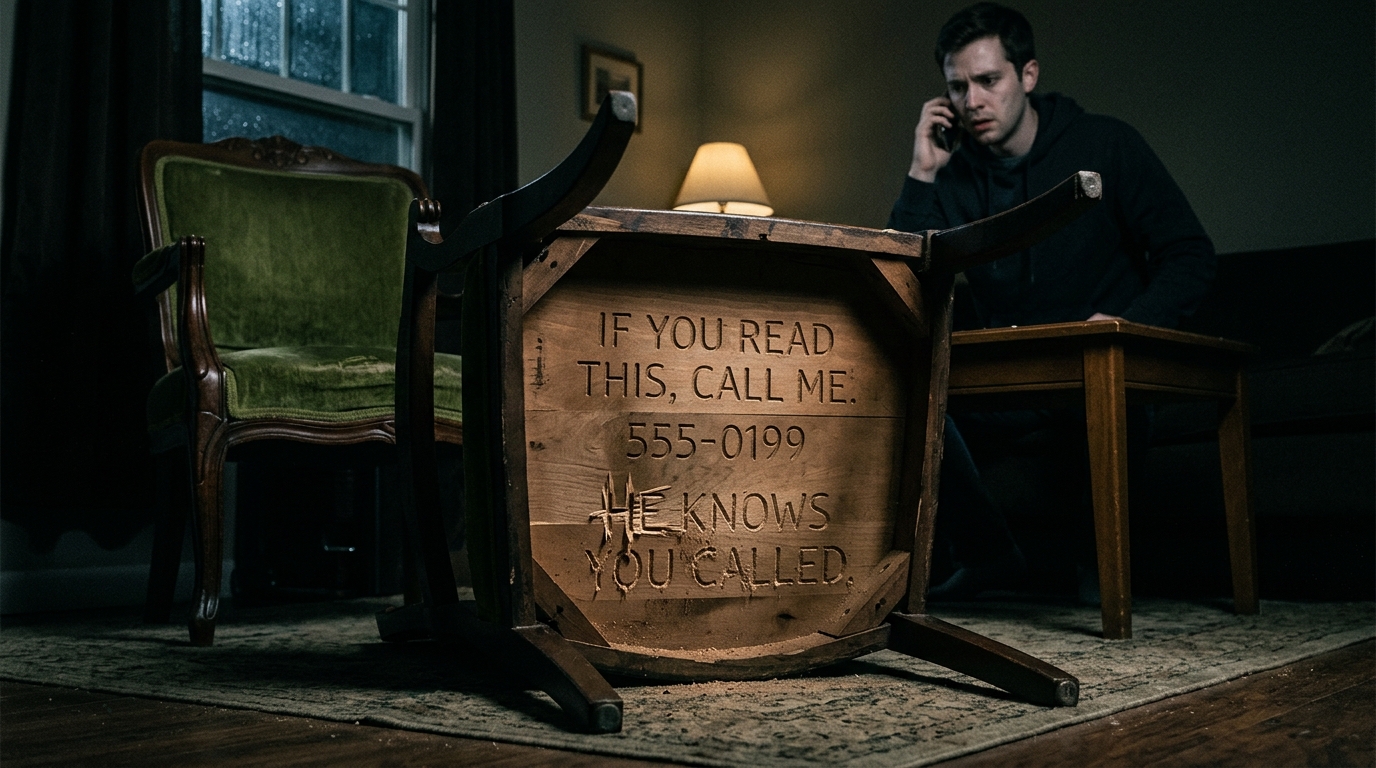
That was when I saw the marks under the seat.
At first, I thought they were scratches.
Random damage from moving or storage.
But when I wiped away the dust, letters appeared.
Carved into the wood with something sharp.
Not printed.
Not written.
Cut.
Deep enough that the person who made them must have pressed hard.
My pulse slowed.
The message read:
IF YOU READ THIS, CALL ME.
Beneath it was a phone number.
Ten digits.
The last two carved so violently the wood had split around them.
I stared at it for a long time.
The apartment suddenly felt too quiet.
Rain tapped against the kitchen window.
Somewhere downstairs, a car passed through standing water.
Normal sounds.
Normal world.
But the message under the chair did not belong to normal things.
I took a picture with my phone.
Then checked the number online.
No business listing.
No profile.
No result.
That should have been the end of it.
I should have sanded the message down, put the chair outside, and accepted that five dollars could still be too expensive.
Instead, I sat on the floor beside it and kept looking at the words.
IF YOU READ THIS, CALL ME.
Not help me.
Not call police.
Call me.
Like whoever carved it expected to still answer.
My thumb hovered over the number.
Curiosity is rarely dramatic.
It is usually quiet.
Small.
Embarrassingly easy to obey.
I called.
The Woman Who Started Crying
The phone rang once.
Then someone answered.
Immediately.
No voicemail.
No delay.
No confused hello.
Just breathing.
Fast.
Female.
Then crying.
Not polite crying.
Not the kind people do when they try to hide it.
This was the kind of crying that had already been waiting behind the mouth before the call began.
My throat tightened.
“Hello?”
The woman on the other end sobbed harder.
For several seconds, I heard only her breathing and rain.
Not rain outside my window.
Rain through the phone.
As if she were standing somewhere open.
Somewhere cold.
“Who is this?” I asked.
Her voice came through broken and small.
“You found the chair.”
My hand went cold around the phone.
I looked at the chair lying sideways on my kitchen floor.
“How did you know that?”
She did not answer.
Instead, she whispered, “Is it still green?”
I looked at the faded cushion.
It might have been green once.
“Yes.”
A sound escaped her.
Half sob.
Half laugh.
“Oh God.”
I stood slowly.
The chair creaked.
I had not touched it.
“Ma’am,” I said carefully, “I bought this at a clearance market. There was a number carved underneath.”
“I know.”
“You carved it?”
Silence.
Then:
“I tried.”
My skin tightened.
“What does that mean?”
The line crackled.
Her breathing grew shakier.
“Listen to me. You need to look inside the left arm.”
I glanced at the cracked armrest.
The wood had split near the front, but the crack looked old.
“What’s inside it?”
“My name.”
I did not move.
The rain outside my window became louder.
“What is your name?”
She took a breath that sounded painful.
“Lena.”
The name did not mean anything to me.
Not yet.
Then she said the last name.
“Lena Vale.”
My stomach dropped.
Because that name did mean something.
Everyone in the city knew it.
Lena Vale disappeared nine years earlier.
Twenty-eight years old.
Heiress to a real estate family.
Last seen leaving a charity auction.
Her husband cried on television for two weeks.
A body was never found.
The case became documentaries.
Podcasts.
True crime headlines.
Then nothing.
People moved on.
Money helped them.
I stared at the chair.
“Lena Vale is dead.”
The woman on the phone stopped crying.
For the first time, her voice became clear.
“No,” she whispered. “That’s what he paid them to say.”
The Left Arm
My apartment seemed to shrink around me.
I almost hung up.
That would have been easier.
A prank.
A sick voice actor.
Someone using an old missing-person case to scare strangers who bought junk furniture.
But the woman had described the chair before seeing it.
Green cushion.
Left arm.
And she knew the message.
My hands shook as I set the phone on speaker and grabbed a screwdriver from the kitchen drawer.
The left arm of the chair was cracked near the front.
When I pressed the screwdriver into the seam, the wood shifted.
Loose.
Not broken.
Hidden.
Someone had carved a small compartment into the armrest, then covered it so carefully that dirt and age disguised the edges.
The woman on the phone whispered, “Do you see it?”
I swallowed.
“Yes.”
“Open it.”
I pried harder.
The wood panel snapped free.
Inside was a narrow hollow space.
Dust.
A strip of blue fabric.
A small brass key.
And a folded photograph.
My heart began pounding.
I pulled the photograph out first.
It showed a woman sitting in the chair.
Dark hair.
Pale dress.
One hand resting on the cracked arm.
Smiling at someone outside the frame.
Lena Vale.
Younger.
Alive.
Behind her stood a man.
His face had been scratched out with something sharp.
Not from the printed photo.
Afterward.
Violently.
On the back, written in blue ink, were five words.
HE MADE ME SIT HERE.
The woman on the phone began crying again.
I stared at the brass key.
“What does this open?”
“The room where he kept me.”
My mouth went dry.
“Where are you calling from?”
A pause.
Then she whispered:
“I don’t know anymore.”
The answer chilled me more than any scream could have.
I picked up the blue fabric.
It looked like part of a dress.
Or a curtain.
There were dark stains along the edge.
I forced myself to ask.
“Lena, where are you now?”
For a moment, the line filled with static.
Then I heard something behind her.
Footsteps.
Slow.
Heavy.
Her breathing stopped.
My own body froze in response.
A man’s voice sounded faintly through the call.
“Who are you talking to?”
Lena whispered, “He’s back.”
“Who?”
She did not answer.
The chair beside me creaked again.
This time, the seat lowered slightly.
Like someone invisible had just sat down.
The Man Who Owned The Chair
“Lena,” I said, trying to keep my voice low, “listen to me. I’m calling the police.”
“No.”
The panic in her voice was immediate.
“No police.”
“Why?”
“Because he gives them chairs too.”
That sentence made no sense.
None of it made sense.
But fear does not require understanding to become real.
On the phone, something slammed.
Lena gasped.
The line muffled, as if she had pressed the phone against fabric.
Then her voice returned, almost too quiet to hear.
“If you found the chair, he’ll come for it.”
“Who?”
“My husband.”
The missing woman’s husband.
The grieving widower.
The man who had rebuilt his public image on loss.
His name came back to me from old headlines.
Victor Hale.
No.
Vale?
I tried to remember.
The woman whispered:
“Do not sell it. Do not burn it. Do not sit in it after midnight.”
I looked at the chair.
The hollow arm.
The hidden key.
The photograph.
“Why not?”
She sobbed once.
“Because that’s when it remembers who was tied to it.”
My hand went numb.
The chair creaked again.
A deeper sound this time.
Wood under pressure.
Rope tightening.
I stepped back.
My phone screen flickered.
The call timer showed 00:00.
That was impossible.
The call was still active.
Lena whispered one last thing.
“Caleb?”
I froze.
I had never told her my name.
“How do you know me?”
A long silence.
Then she said:
“Because you bought it before.”
The line went dead.
For several seconds, I could not move.
Then my phone buzzed.
A new message.
Unknown number.
A photo.
I opened it.
My blood turned cold.
It showed me standing in my kitchen.
Holding the phone.
The chair on the floor beside me.
Taken from behind.
Inside my apartment.
I spun around.
No one there.
Then another message arrived.
This one was not from Lena.
It read:
PUT THE CHAIR BACK WHERE YOU FOUND IT.
The chair slowly turned toward me.
Not falling.
Not sliding.
Turning.
Until the empty seat faced my body.
And beneath the carved message, new letters began appearing in the wood.
Fresh.
Wet.
Cut from the inside.
HE KNOWS YOU CALLED.