The Press Conference
Press conferences are not built for truth.
They are built for lighting.
For clean angles.
For polished podiums.
For city officials standing behind flags and speaking in sentences that sound important without saying anything dangerous.
My name is Clara Vale, and I was standing in the third row of reporters when Mayor Adrian Cross stepped onto the stage.
The room was packed.
Cameras from every major network.
Local journalists.
Business leaders.
Police officers.
City council members.
Parents holding signs.
Construction workers in bright yellow vests.
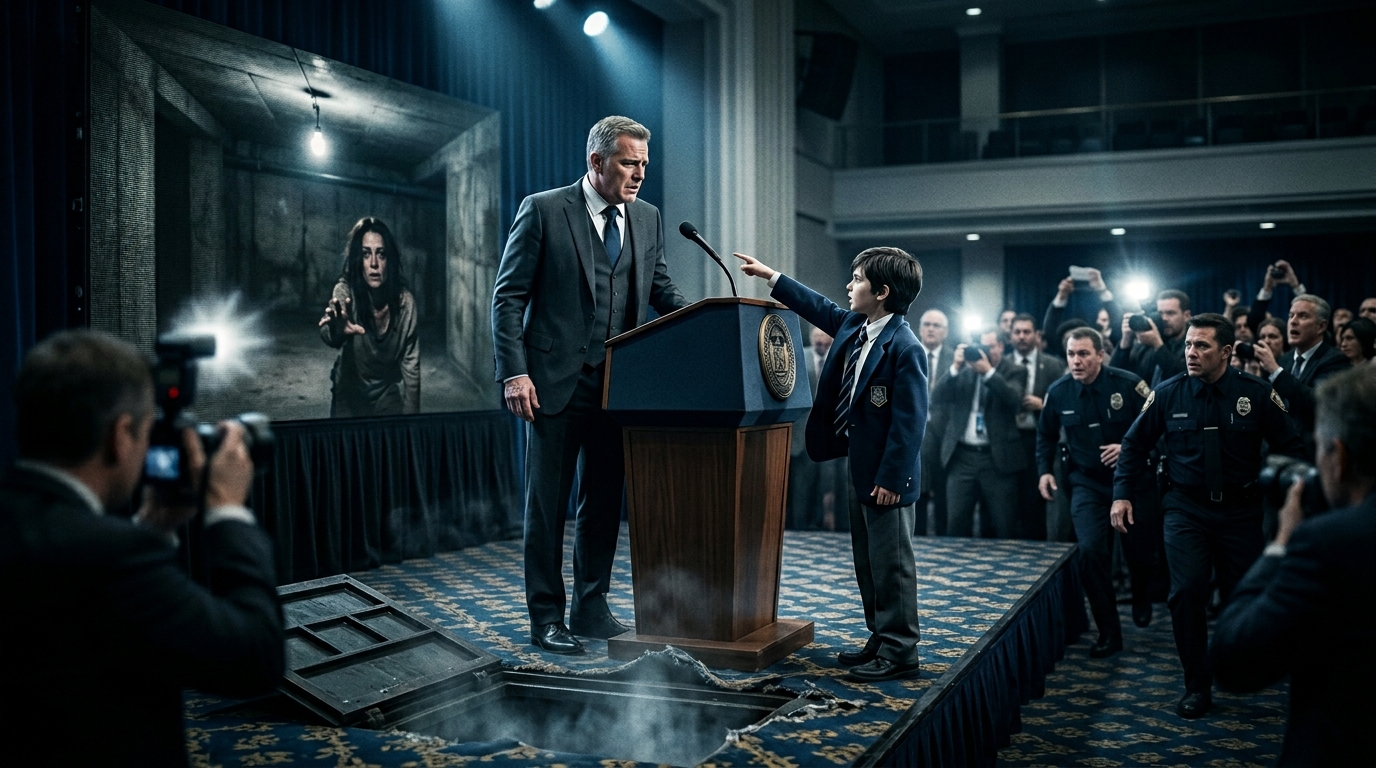
And behind the mayor, a giant screen displayed the project everyone had come to hear about.
THE HOLLOWBRIDGE RENEWAL PLAN.
A new hospital.
A new school.
A luxury residential tower.
A memorial park.
A train extension.
The mayor called it “the future of the city.”
The protesters outside called it “a grave with windows.”
For three months, rumors had spread about the old neighborhood they planned to demolish.
Missing tenants.
Eviction records altered.
A basement fire no one investigated properly.
A woman named Mara Ellis who disappeared after refusing to leave her apartment.
The mayor denied everything.
That was why the press conference mattered.
He was there to smile.
To reassure.
To bury the story under words like progress, safety, redevelopment, and opportunity.
He adjusted the microphone.
Looked into the cameras.
And smiled like a man who had already won.
“Today,” he said, “we begin a new chapter for Hollowbridge.”
Then a child screamed from the back of the room.
The Boy In The Crowd
At first, no one saw him.
The room was too full.
Too loud.
Too focused on the man at the podium.
Then a small figure slipped under the security barrier.
A boy.
Maybe nine years old.
Thin.
Dark hair.
School uniform too large for him.
One shoe untied.
Face pale with terror.
He ran straight toward the stage.
Security reacted too late.
One guard reached for him.
The boy ducked beneath his arm.
Another lunged from the side.
The boy slid past him and scrambled up the stage steps.
The mayor stopped mid-sentence.
The room gasped.
Cameras swung.
Phones lifted.
Someone shouted, “Get him!”
The boy reached the podium before anyone could grab him.
He seized the microphone with both hands and yanked it down toward his mouth.
For one second, the entire city listened to a child breathing.
Fast.
Broken.
Panicked.
The mayor tried to smile.
The kind of smile powerful men use when children interrupt ceremonies.
“Son, this isn’t—”
The boy screamed into the microphone:
“Don’t let him sign it!”
The speakers shrieked.
Everyone froze.
The mayor’s smile vanished.
Security Ran Toward Him
Two security officers rushed the stage.
The boy backed away, clutching the microphone like it was the only weapon he had.
“Please!” he cried. “Please listen!”
The mayor stepped toward him slowly.
Calm.
Gentle.
Public.
“It’s okay,” he said. “No one is going to hurt you.”
The boy shook his head so hard tears flew from his face.
“You said that to my mother.”
The room changed.
Not visibly.
But I felt it.
The shift.
The moment a political disruption became something else.
Every reporter leaned forward.
Every camera zoomed in.
The mayor’s jaw tightened.
Only for a second.
Enough.
I saw it.
The boy saw it too.
He pointed at the mayor.
“He told her if she stayed quiet, we could come home.”
A murmur moved through the room.
The mayor turned toward security.
“Remove him.”
The boy screamed:
“My mother is still under City Hall!”
Nobody moved.
Not security.
Not reporters.
Not even the mayor.
Because the child had not said missing.
He had not said dead.
He had said still.
The Name He Wasn’t Supposed To Say
I pushed through the reporters before I understood I was moving.
“What’s your name?” I called.
The boy looked toward me.
His eyes locked onto my press badge.
For one second, he looked relieved.
Like he had been searching for one person who might ask a question instead of filming a tragedy.
“Noah,” he said.
His voice shook.
“Noah Ellis.”
The room went silent.
Mara Ellis.
The missing tenant.
The woman whose disappearance the mayor’s office called “unverified social media misinformation.”
The woman activists had been asking about for weeks.
The boy was her son.
The mayor laughed once.
Too softly.
Too late.
“This is clearly a staged disruption.”
The boy turned on him.
“You know my name.”
The mayor’s face hardened.
The public mask cracked.
Just slightly.
But enough for every live camera to catch it.
Noah reached into his pocket and pulled out a folded photograph.
Security moved again.
The boy held the photo above his head.
The nearest camera zoomed in.
On the giant screen behind the mayor, the image appeared for everyone to see.
A woman sitting on the floor of a dark room.
Hands tied.
Face bruised.
Alive.
Holding a newspaper dated yesterday.
The room erupted.
The Photograph
The mayor stepped backward.
Not from fear of the boy.
From fear of the screen.
The photograph filled the giant display behind him.
Mara Ellis.
The missing woman.
Alive.
Under the photo, written in black marker, were five words:
DO NOT DEMOLISH THE BASEMENT.
The mayor grabbed the podium.
“That image is fake.”
Noah screamed:
“You sent it to me!”
Gasps filled the room.
The mayor turned sharply.
“I did not.”
Noah pulled out a phone.
Old.
Cracked.
Too large for his small hand.
He tapped the screen and held it toward the cameras.
A message thread appeared.
Unknown number.
One photo.
The photo of Mara.
Then a message beneath it:
Tell your mother goodbye before the mayor signs.
The timestamp was thirteen minutes before the press conference.
The mayor’s chief of staff stepped onto the stage, face white.
“We need to stop the broadcast.”
Too late.
Every channel was live.
Every phone was recording.
Every person in that room had already seen the woman under City Hall.
I looked at the mayor.
He was no longer smiling.
He was staring at the phone in Noah’s hand like it was a bomb that had already exploded.
Then the giant screen behind him flickered.
The project logo disappeared.
A live video feed appeared.
Dark.
Concrete walls.
A single light bulb swinging.
And beneath it—
Mara Ellis.
Still alive.
Still tied to a chair.
She lifted her head slowly.
Looked directly into the camera.
And whispered:
“Noah, run.”
The Door Beneath The Stage
The room exploded into chaos.
Reporters shouted questions.
Security rushed toward the control booth.
Police officers spoke into radios.
The mayor stepped offstage, but two protesters blocked his path.
Noah did not run.
He stood frozen, staring at his mother on the screen.
“Mama…”
Mara looked worse in the video than in the photograph.
Her lips were split.
One eye swollen.
Her hair matted with dirt.
Behind her, painted on the concrete wall, was a red number.
17.
The same number from the redevelopment permit.
The same number printed on the mayor’s signing folder.
The same number stamped on every demolition notice sent to the old neighborhood.
Mara looked past the camera, as if someone had entered the room.
Her breathing changed.
“Noah,” she whispered, “don’t let them open the door under the stage.”
I turned.
Under the stage?
The mayor stopped moving.
That was how I knew.
He knew exactly what she meant.
I looked down at the stage floor.
Black carpet.
Metal frame.
Temporary panels.
Nothing unusual.
Then Noah dropped to his knees beside the podium and tore at the carpet with both hands.
“Noah!” I shouted.
Security lunged toward him.
But the boy had already pulled the carpet back.
Beneath it was a trapdoor.
Small.
Metal.
Hidden directly under the mayor’s podium.
The entire room went silent again.
On the screen, Mara began crying.
“Noah, no…”
The trapdoor had no handle.
Only a keypad.
The screen on the keypad lit up by itself.
ENTER FINAL APPROVAL CODE.
The mayor whispered:
“Step away from that.”
Noah looked up at him.
His small face changed.
Not fear now.
Rage.
“You were going to bury her while everyone clapped.”
The Signing Folder
The mayor’s signing folder lay on the podium.
The one he had been moments away from opening.
The one that would authorize the final demolition phase of the Hollowbridge Renewal Plan.
I grabbed it before anyone could stop me.
Inside was the demolition approval form.
At the bottom, the mayor’s signature line was blank.
But beneath it was another page.
A basement clearance certificate.
Already signed.
Already dated.
Tomorrow.
Subject removal complete.
Tunnel sealing approved.
Witness disposal authorized.
My stomach turned.
Witness disposal.
Not relocation.
Not safety clearance.
Disposal.
At the bottom was a list of names.
Mara Ellis.
Noah Ellis.
Daniel Reed.
Clara Vale.
My own name.
I stopped breathing.
I had never been inside City Hall basement.
I had never spoken to Mara Ellis.
I had only reported on the story.
And yet my name was listed as a witness scheduled for disposal tomorrow.
The mayor looked at the folder in my hand.
His expression became very still.
“Ms. Vale,” he said softly, “you should not have opened that.”
The keypad on the trapdoor beeped.
One digit entered itself.
Then another.
Then another.
The approval code was being typed from somewhere else.
On the screen, Mara screamed.
“Noah, get away from it!”
The trapdoor unlocked.
A breath of cold air rose from below the stage.
It smelled like wet concrete.
Old paper.
And something buried too long.
Noah crawled backward.
The mayor shouted:
“Do not open that door!”
But the trapdoor opened by itself.
Darkness waited below.
Then a hand reached up.
A woman’s hand.
Bruised.
Bleeding.
Wearing a cheap silver ring.
Noah screamed:
“Mom!”
He grabbed the hand.
I grabbed Noah.
Security grabbed me.
The stage lights flickered.
The mayor ran.
And from beneath the stage, Mara Ellis whispered:
“He’s not the mayor.”
Every camera turned toward Adrian Cross.
He froze at the edge of the stage.
The giant screen behind him glitched.
His face on the live feed blurred.
Then changed.
For one second, the whole city saw the man beneath the face.
Older.
Scarred.
Smiling.
And from the dark beneath the stage, dozens of children began calling Noah’s name.